

Quick Answer
The best way to keep a bedroom rug from sliding is to place a floor-compatible non-slip rug pad underneath it. You can also use removable rug grippers, secure the rug beneath furniture, or apply suitable double-sided rug tape. Combining these solutions with proper rug and furniture placement helps reduce movement, bunching, and curled edges.
Quick steps to stop bedroom rug movement:
- Clean the floor: Remove dust, dirt, and moisture before installing the rug.
- Use a rug pad: Choose a non-slip material approved for your flooring.
- Secure the corners: Apply compatible removable rug grippers where needed.
- Anchor with furniture: Position the rug beneath stable bed or bench legs.
- Check the edges: Flatten curled corners and remove wrinkles that create tripping hazards.
Important safety tip:
- Avoid permanent adhesives and unapproved rubber materials that could discolor or damage your flooring.
A bedroom rug should make your room feel warmer, softer, and more comfortable. However, a rug that constantly moves can become frustrating and create a tripping hazard.
In this guide, I’ll explain how to keep a bedroom rug from sliding without unnecessarily damaging your floors. You’ll also learn which solutions work best for hardwood, tile, laminate, vinyl, and carpeted bedrooms.
What Does Keeping a Bedroom Rug From Sliding Mean?
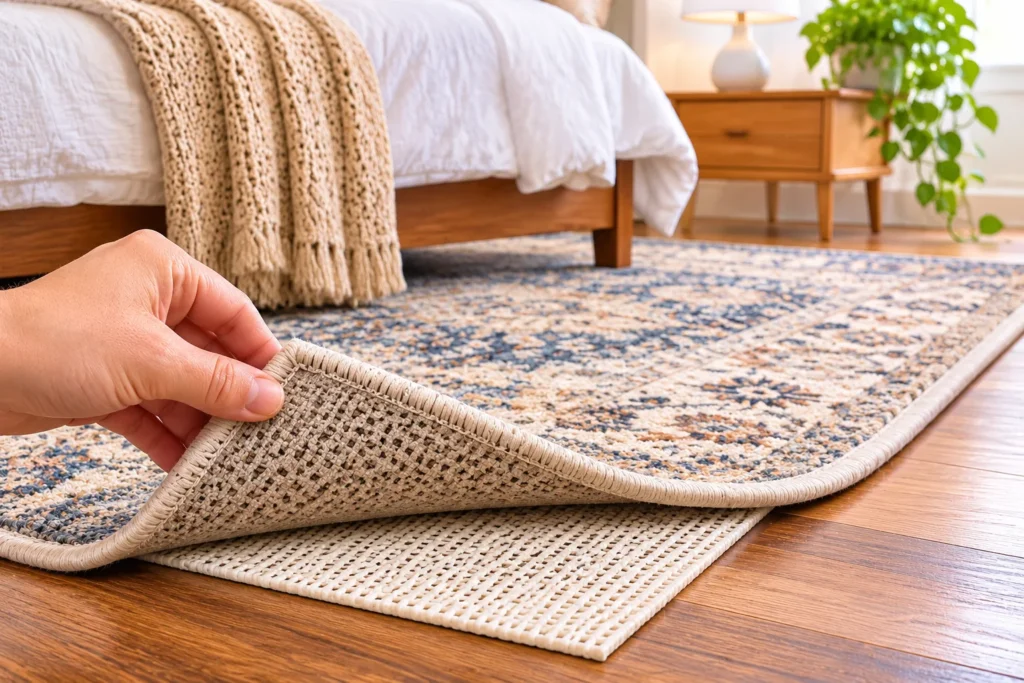
Keeping a bedroom rug from sliding means reducing unwanted movement between the rug backing and the floor underneath. It involves improving grip, stabilizing the rug, and keeping its edges flat.
Even an expensive area rug can move if its backing lacks traction. Smaller bedside rugs and lightweight runners are especially likely to shift during everyday use.
- Sliding: The entire rug moves across the floor.
- Bunching: Sections of the rug gather into folds or wrinkles.
- Corner curling: One or more rug corners lift away from the floor.
- Rug creeping: The rug gradually moves away from its original position.
These problems require slightly different solutions. Understanding which issue you’re dealing with makes it easier to choose the right fix.
Why Does My Bedroom Rug Keep Sliding?
Bedroom rugs usually slide because there isn’t enough friction between the rug backing and the flooring. Smooth surfaces, lightweight materials, and repeated foot traffic can make the problem worse.
Common Causes of Bedroom Rug Movement
- Smooth flooring: Hardwood, tile, and polished laminate may provide little natural grip.
- Lightweight construction: Thin cotton and flatwoven rugs move more easily.
- Incorrect rug size: Small rugs may lack furniture anchoring and sufficient surface contact.
- Dust underneath: Loose debris can interfere with the gripping surface.
- Worn backing: Older non-slip materials may lose their effectiveness.
- Frequent movement: Pets, walking, vacuuming, and moving furniture can shift rugs.
- Carpet pile direction: Rugs placed over carpet may gradually creep as the underlying fibers flex.
I recommend checking the entire underside before buying a new rug pad. A dirty floor or deteriorating backing may explain why your existing setup no longer works.
How to Keep a Bedroom Rug From Sliding: 9 Effective Methods
1. Install a Non-Slip Rug Pad
A non-slip rug pad is generally the most practical starting point for a sliding bedroom rug. It creates a gripping layer between the rug and the flooring.
Unlike corner grippers, a full-size pad supports most of the rug’s surface. This can reduce both shifting and bunching.
Look for the following features:
- Compatibility with your specific flooring material.
- A gripping surface suitable for the rug backing.
- A thickness that keeps rug edges low and stable.
- Materials that meet your flooring manufacturer’s requirements.
- A size that fits beneath the rug without visible edges.
The RUGPADUSA non-slip rug pad collection illustrates several available materials and gripping designs.
For most bedrooms, I would prioritize reliable grip over extra cushioning. A thick pad isn’t necessarily better if the main problem is movement.
2. Use Removable Rug Corner Grippers
Rug corner grippers help hold exposed corners in position. They’re particularly useful for small bedside rugs and runners with localized curling problems.
- Lift the rug corners carefully.
- Clean and dry the rug backing and floor.
- Attach compatible grippers according to their instructions.
- Lower the rug and press the corners into position.
- Inspect the corners regularly for movement or lifting.
Corner grippers aren’t a complete replacement for a full rug pad when the entire rug slides. They work best when the problem is concentrated near the edges.
Always confirm that the adhesive is suitable for your floor finish before installation.
3. Apply Double-Sided Rug Tape
Double-sided rug tape connects the underside of a rug to a compatible floor surface. It offers a low-profile solution without adding much thickness.
Choose removable tape specifically designed for rugs and your flooring material. Avoid ordinary duct tape or permanent mounting tape.
- Useful for lightweight rugs and runners.
- Suitable for selected low-profile applications.
- May require replacement as adhesion weakens.
- Can leave residue or damage incompatible finishes.
Test the product in an inconspicuous location first. Remove it according to the manufacturer’s directions rather than pulling aggressively.
4. Anchor the Rug Under Bedroom Furniture
Heavy, stable furniture can help reduce rug movement by holding part of the rug in position. A larger bedroom rug can often extend underneath the bed or an upholstered bench.
This method works best when the rug reaches far enough beneath the furniture to remain securely positioned.
- Place a substantial portion of the rug beneath the bed.
- Keep furniture legs evenly supported.
- Leave comfortable rug coverage beside the bed.
- Add a non-slip pad beneath exposed sections.
Furniture anchoring also improves the visual connection between the bed and surrounding decor. My guide to decorating a bedroom explains how furniture and floor coverings work together.
Don’t rely on furniture weight alone if the exposed rug edges continue to shift.
5. Choose a Larger or Heavier Rug
A larger rug often provides more surface contact and better opportunities for furniture anchoring. Heavier rugs may also resist movement better than thin, lightweight alternatives.
Consider these common bedroom rug dimensions:
- 2 x 3 feet: Small bedside accent rug.
- 2 x 6 feet: Narrow bedside runner.
- 5 x 7 feet: Compact bedroom area rug.
- 8 x 10 feet: Common option for queen-bed layouts.
- 9 x 12 feet: Potential option for spacious king-bed layouts.
These dimensions are starting points rather than universal requirements. Measure your room, bed, walkways, and door clearance before selecting a size.
A heavy rug can still slide on smooth flooring. Pair it with suitable non-slip backing when necessary.
6. Clean the Floor and Rug Backing
Dust, loose fibers, and cleaning residue can interfere with a rug pad’s grip. Cleaning both contact surfaces may improve the effectiveness of your existing setup.
- Remove the rug and its pad.
- Vacuum loose debris from the floor.
- Clean the floor using an approved cleaning method.
- Remove dust from the rug backing and pad.
- Allow all surfaces to dry completely.
- Reinstall the pad and rug.
Use only cleaners recommended for your flooring. Wax, oily products, and unnecessary polish may make certain surfaces more slippery.
7. Flatten Curled Rug Corners
Curled corners increase the chance of catching your feet on the rug. They can also make an otherwise stable rug feel unsafe.
For a newly unrolled rug, gentle reverse rolling may help if the manufacturer permits it. Place a flat, protective weight on stubborn corners and allow the material to relax.
- Avoid direct heat unless specifically approved.
- Don’t soak delicate rug materials.
- Use compatible corner grippers when necessary.
- Replace rugs with permanently damaged edges.
Flattening the corners solves an edge problem, not necessarily a traction problem. Check whether the rug still moves across the floor afterward.
8. Select a Rug With Built-In Non-Slip Backing
Some bedroom rugs include an integrated gripping layer. These designs can reduce the need for a separate rug pad when the backing performs adequately.
They’re worth considering for compact bedrooms, washable bedside rugs, and narrow walkways.
- Check whether the backing is approved for your floor.
- Follow the manufacturer’s washing instructions.
- Inspect the backing for cracks or deterioration.
- Replace the rug if it no longer provides sufficient grip.
A non-slip label doesn’t guarantee compatibility with every surface. Vinyl and certain hardwood finishes may have specific restrictions on backing materials.
9. Use a Carpet-to-Carpet Rug Pad
When a bedroom rug sits on wall-to-wall carpet, use a pad specifically designed for carpet-on-carpet installations. These pads help reduce movement caused by the underlying carpet fibers.
Ordinary hard-floor rug pads may not perform well over soft carpet. A purpose-built carpet pad provides a more appropriate gripping interface.
- Choose a rug with a relatively flat, stable construction.
- Avoid unnecessarily thick combinations of rugs and pads.
- Keep the rug edges flat.
- Check for bunching after normal foot traffic.
If the rug continues to wrinkle over deep-pile carpet, removing it may be safer than adding more layers.
What Is the Best Way to Stop Rugs Sliding on Different Floors?
The best rug-gripping method depends on the flooring underneath. A product that works on ceramic tile may not be appropriate for vinyl or a sensitive hardwood finish.
Bedroom Rug Anti-Slip Method Comparison
| Floor type | Recommended solution | What to avoid |
|---|---|---|
| Hardwood | Approved natural rubber or felt-and-rubber pad | Unapproved adhesives and backing materials |
| Ceramic tile | Non-slip pad or compatible rug grippers | Moisture trapped beneath the rug |
| Laminate | Manufacturer-approved non-slip pad | Permanent adhesive tape |
| Vinyl or LVP | Pad explicitly approved for vinyl flooring | Rubber, latex, or other restricted materials |
| Wall-to-wall carpet | Carpet-to-carpet rug pad | Unsuitable hard-floor pads |
| Natural stone | Non-staining, stone-compatible rug pad | Unapproved colored backing and adhesives |
Always follow the flooring manufacturer’s care instructions before choosing a rug pad. Compatibility matters more than a product’s general non-slip claims.
How to Choose the Right Rug Pad Size and Thickness
A rug pad should generally sit slightly inside the rug’s outer edges. This keeps the pad hidden while allowing the rug edges to rest closer to the floor.
A common starting point is approximately one inch of clearance along each edge. Follow the pad manufacturer’s sizing instructions if they recommend a different allowance.
| Actual rug size | Example pad size |
|---|---|
| 2 x 3 feet | 22 x 34 inches |
| 5 x 7 feet | 58 x 82 inches |
| 8 x 10 feet | 94 x 118 inches |
| 9 x 12 feet | 106 x 142 inches |
Which Rug Pad Thickness Works Best?
- Approximately 1/8 inch: A useful low-profile option for lightweight rugs and runners.
- Approximately 1/4 inch: A practical balance between grip and cushioning for many bedroom rugs.
- Approximately 3/8 inch or more: Extra cushioning where sufficient clearance exists and the edges remain stable.
For example, if your bedside runner sits near a door, I would choose a thin gripping pad rather than a thick cushioning model. This reduces the likelihood of the door catching the rug.
How Can You Stop a Bedroom Rug From Sliding Without Damaging the Floor?
Choose a non-adhesive rug pad specifically approved for your flooring. Avoid permanent adhesives, unsuitable backing materials, and improvised chemical treatments.
This is particularly important in rental properties and bedrooms with expensive flooring.
- Check flooring warranty and maintenance requirements.
- Allow newly finished floors to cure fully before covering them.
- Avoid permanent glue, nails, and staples.
- Inspect underneath the rug periodically.
- Remove trapped moisture promptly.
I would start with a removable, floor-compatible pad before experimenting with adhesive products. It’s generally easier to reposition and inspect.
Is a Sliding Bedroom Rug a Safety Hazard?
Yes. Loose rugs, raised edges, and wrinkles can contribute to slips and trips, especially when walking through a bedroom at night.
The American Academy of Orthopaedic Surgeons’ home safety checklist recommends securing loose area rugs with suitable anti-slip backing or tape.
- Keep walking routes free of loose rug edges.
- Provide accessible bedside lighting.
- Check rug stability after vacuuming.
- Never conceal electrical cords underneath rugs.
- Remove rugs that cannot remain securely positioned.
For older adults with an elevated fall risk, the National Institutes of Health fall prevention guidance recommends avoiding small throw rugs altogether.
Common Mistakes When Securing Bedroom Rugs
Many rug movement problems come from choosing the wrong material or overlooking basic placement. Even a quality rug pad can perform poorly when installed incorrectly.
- Buying felt-only pads: Cushioning alone doesn’t necessarily provide traction.
- Ignoring floor compatibility: Some backing materials may damage certain finishes.
- Using oversized pads: Exposed pad edges can create uneven transitions.
- Installing over dirty floors: Debris may interfere with grip.
- Ignoring curled edges: A stable rug can still present a tripping hazard.
- Choosing excessive thickness: Thick layers may interfere with doors or create raised edges.
Rug stability is part of a functional bedroom layout. Avoiding these common bedroom decorating mistakes can also help create a more comfortable space.
How Often Should You Check or Replace a Non-Slip Rug Pad?
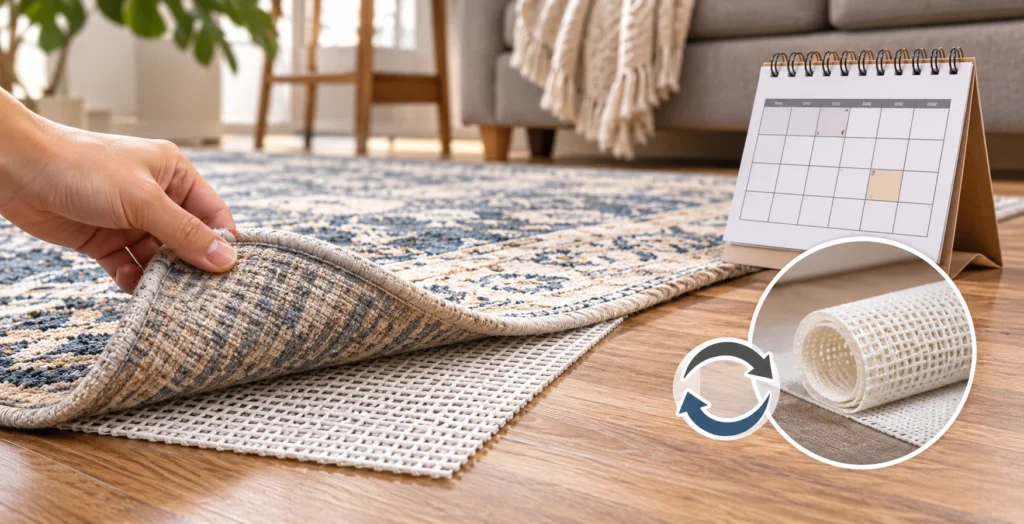
Inspect your rug pad regularly and whenever the rug begins shifting again. Replacement depends on the pad’s condition rather than a fixed lifespan.
Watch for these warning signs:
- Reduced grip during normal walking.
- Cracks, crumbling, or brittle backing.
- Persistent wrinkles or bunching.
- Sticky residue or floor discoloration.
- Moisture damage or persistent odors.
For a practical 2026 bedroom maintenance routine, check exposed rug corners weekly. Inspect underneath the rug whenever you perform a more thorough bedroom cleaning.
Best Products to Keep Bedroom Rugs From Sliding
If you’re ready to improve your bedroom rug setup, these three products address different floor and rug requirements. Choose according to compatibility, grip, cushioning, and available clearance.
Affiliate disclosure: As an Amazon Associate, I earn from qualifying purchases. Product suggestions are based on published specifications and intended uses, not personal hands-on testing.
🏆 Grip and cushioning
Mohawk Home Dual Surface 1/4-Inch Rug Pad
Best suited to larger bedroom area rugs
Combines felt cushioning with a latex-backed gripping surface. I’d consider this for a larger bedroom rug where comfort and floor compatibility are priorities.
💰 Low-profile option
Gorilla Grip Original Slip-Resistant Rug Pad
Best suited to lightweight rugs
Features a low-profile, open-grid gripping construction for suitable hard floors. I’d choose this type for a thin bedside rug that doesn’t need extra cushioning.
🛏️ Carpeted bedrooms
RUGPADUSA Carpet Lock Rug Pad
Best suited to rugs over carpet
Uses textured felt and a natural rubber gripping surface for carpet-on-carpet applications. I’d consider it when a bedroom area rug repeatedly creeps over fitted carpeting.
Frequently Asked Questions
How Do I Stop My Bedroom Rug From Moving on Hardwood Floors?
Use a non-slip rug pad approved for your hardwood finish, such as a suitable felt-and-rubber combination. Clean the floor before installation and position the rug beneath stable furniture when possible, avoiding permanent adhesives and backing materials that could damage the finish.
Can You Keep a Rug From Sliding Without a Rug Pad?
Yes, you can use compatible removable rug grippers, double-sided rug tape, or stable furniture to reduce rug movement. However, a full-size non-slip rug pad generally provides more consistent support when the entire rug moves rather than just its corners.
Why Does My Rug Still Slide With a Non-Slip Pad?
Your rug may still slide because the pad is dirty, worn, incorrectly positioned, or incompatible with the flooring. Check both sides of the pad for damage and confirm that the gripping surface faces the correct direction according to the manufacturer’s instructions.
How Do You Keep a Bedroom Rug From Bunching Up on Carpet?
Install a carpet-to-carpet rug pad designed to reduce movement between an area rug and fitted carpeting. Choose a stable, relatively flat rug construction and anchor it beneath suitable furniture where possible, removing the rug if persistent bunching creates a tripping hazard.
Is Double-Sided Rug Tape Safe for Bedroom Floors?
Double-sided rug tape can be suitable when both the tape and flooring manufacturers approve the application. Some adhesives may leave residue or damage sensitive finishes, so test a small hidden area first and follow the recommended installation and removal instructions.
Final Thoughts: Keep Your Bedroom Rug Secure and Comfortable
Learning how to keep a bedroom rug from sliding starts with understanding your flooring, rug construction, and everyday movement. A compatible non-slip rug pad is usually the most practical first choice.
Removable grippers, furniture anchoring, and regular cleaning can provide additional stability. Carpeted bedrooms may require a specialized carpet-to-carpet pad instead.
- Choose a rug pad approved for your flooring.
- Measure the rug accurately before purchasing.
- Keep all corners and edges flat.
- Inspect the rug and backing regularly.
- Remove any rug that remains a persistent safety hazard.
Start by checking your current rug backing and identifying where movement occurs. Choose the simplest compatible solution that keeps the rug securely positioned and your bedroom comfortable.