

⚡ Quick Answer
The biggest bedroom decorating mistakes come from ignoring scale, function, lighting, and visual balance. A bedroom can look stylish but still feel awkward when furniture blocks movement or lighting feels harsh. Undersized rugs and excess décor can add visual clutter. Measure first, build around the bed, layer light, and leave enough visual breathing room.
Bedroom mistakes that cause the most problems
- Wrong scale: Oversized or tiny furniture makes proportions feel uncomfortable.
- Poor lighting: One ceiling fixture rarely handles every bedroom activity.
- Too much décor: Excess accessories compete for attention and collect clutter.
- Weak planning: Decorating before measuring often creates expensive layout problems.
Fix your bedroom before buying more décor
- ✓Measure the bed wall and walking paths first.
- ✓Remove clutter before choosing new accessories.
- ✓Test lighting at night, not only during daytime.
You walk into your bedroom, squeeze around the corner of the bed, and immediately notice three things competing for attention. The rug feels strangely small, the ceiling light is glaring, and the dresser seems to swallow an entire wall.
Bedroom decorating mistakes often happen because attractive individual pieces are chosen before the room is considered as a whole. James Fox uses a practical approach here: get the proportions, movement, lighting, and everyday function right first, then add personality without making the room work harder than it needs to.
📌 Key Takeaways
- →Furniture scale should fit the room while preserving comfortable movement around the bed.
- →Layered lighting creates more flexibility than depending entirely on one overhead fixture.
- →Larger rugs usually anchor the bed more convincingly than small floating rugs.
- →Intentional editing often improves a bedroom more than buying additional decorative objects.
Which Bedroom Decorating Mistakes Should You Avoid First?
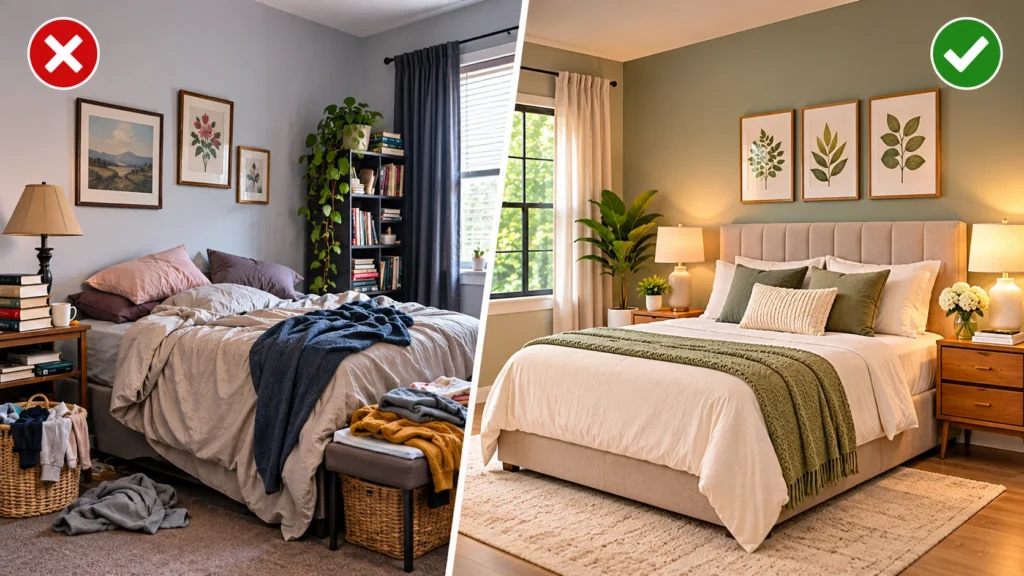
Start with mistakes that affect the room’s function and proportions before worrying about small decorative details. An inconvenient bed position, furniture that overwhelms the floor plan, poor lighting, undersized rugs, and uncontrolled clutter affect how the entire bedroom feels. Correcting those problems usually creates a bigger improvement than changing cushions, artwork, or decorative objects.
Think of the bedroom as a connected system rather than a collection of separate purchases. The bed establishes the main visual weight, surrounding furniture supports it, lighting controls mood and function, and rugs or window treatments visually connect larger surfaces. When one element is badly scaled, every surrounding item can look slightly wrong even when each piece is attractive on its own.
Use this quick comparison to identify the problems that deserve attention first.
Correct the large-scale problems first; smaller styling decisions become much easier afterward.
How Do You Avoid Furniture Scale and Bedroom Layout Mistakes?
Measure the room before choosing furniture, then plan around the bed because it usually carries the greatest visual and physical weight. Record wall lengths, door swings, windows, closets, outlets, and the space needed to move comfortably. A beautiful dresser is still the wrong dresser when its drawers collide with the bed or leave an awkward squeeze-through passage.
Scale also matters visually. A tall, bulky bed paired with tiny nightstands can feel unbalanced, while oversized bedside tables can crowd a modest bed. Aim for pieces that relate to one another in height and mass without forcing perfect symmetry. In a small bedroom, fewer properly sized pieces normally feel calmer than several miniature items placed around every available wall.
Should the Bed Always Be Centered on a Wall?
No. Centering often creates pleasing balance, but doors, windows, closets, radiators, or limited floor area can make another position more practical.
Place the bed where you can enter, make the bed, access storage, and use nearby furniture without unnecessary obstacles. Function should decide the layout before symmetry does.
Should All Bedroom Furniture Match?
A complete matching set is not required. Repeating one or two characteristics, such as wood tone, curved shapes, black hardware, or warm upholstery, can make different pieces feel connected without looking identical.
Why Are Lighting, Color, and Window Treatment Mistakes So Noticeable?
Lighting and window treatments affect the bedroom during both its brightest and darkest hours, so mistakes in these areas are difficult to ignore. Depending entirely on a bright ceiling fixture can make nighttime use uncomfortable, while insufficient task lighting makes reading, dressing, or finding items harder. Combine general room lighting with bedside or task lights that can be controlled independently.
Window treatments should also respond to the actual window instead of serving only as decoration. Curtains that are unnecessarily short or narrow can make a window feel visually restricted, while well-scaled panels can create a stronger vertical line. Color works similarly: repeating a limited family of tones usually feels more intentional than adding unrelated colors whenever an empty surface appears.
The sleep environment gives lighting choices a practical purpose as well. The CDC and NIH recommend keeping sleeping spaces dark, quiet, comfortable, and cool, while Sleep Foundation also emphasizes controlling light and reducing bedroom distractions. CDC sleep-environment guidance, NIH healthy sleep guidance, and the Sleep Foundation bedroom guide offer additional detail.
⚠️ COMMON LIGHTING MISTAKE
Do not judge bedroom lighting only at noon. Turn on every fixture after dark and check whether the room still feels comfortable, useful, and easy to navigate.
Once the room works in both daylight and darkness, the finishing layers become much easier to judge.
How Do Rugs, Artwork, and Accessories Go Wrong in a Bedroom?
Rugs, artwork, pillows, mirrors, and accessories are finishing elements, but their scale can change how the entire room reads. A rug that barely reaches beyond the bed can appear disconnected, while a larger rug visually groups the bed and nearby furniture. As a useful starting point, many bedroom rug layouts allow roughly 18 to 24 inches of visible rug beyond the bed’s sides.
Artwork has the opposite problem: people often treat the entire wall as the reference point and hang pieces too far above the furniture beneath them. Keeping artwork visually connected to the headboard, dresser, or console usually creates a stronger composition. Designers commonly use a gap of roughly 6 to 12 inches above furniture as a starting range, then adjust for the artwork’s size and surrounding architecture.
Can a Small Bedroom Use a Large Rug?
Yes. An appropriately large rug can reduce visual fragmentation and help a compact room feel more unified. Small rugs scattered around furniture often create more visual breaks than one adequately scaled piece.
How Many Decorative Accessories Are Too Many?
There is no universal number. The warning sign is losing usable space on nightstands, dressers, benches, or floors because every surface has become a display area.
Keep pieces that add function, texture, meaning, or a clear focal point. Leaving some empty space makes the objects you keep easier to notice.
What Do Most People Get Wrong About Bedroom Decorating?
The biggest misconception is that an attractive bedroom requires filling empty areas. Empty wall space, open floor area, and a clear nightstand can be intentional design decisions rather than unfinished decorating. Visual breathing room helps important elements stand out, especially when the bed, artwork, rug, or window treatment already provides a strong focal point.
Another common mistake is assuming every rule must be followed literally. A centered bed, matching nightstands, pale paint, symmetrical lamps, and perfectly coordinated bedding can create a polished result, but none is mandatory. Good bedroom decorating depends more on proportion, function, repetition, and deliberate contrast than strict formulas. Rules are useful starting points, not substitutes for observing how your own room actually works.
- Myth: Small bedrooms need only small furniture. A few correctly scaled pieces can look cleaner.
- Myth: Every empty wall needs decoration. Negative space can improve visual balance.
- Myth: Matching furniture guarantees cohesion. Repeated colors and materials can connect mixed pieces.
- Myth: More pillows make a bed look luxurious. Excess pillows can become daily clutter.
The next step is deciding what to change when several of these problems already exist at once.
How Can You Fix a Bedroom That Already Feels Off?
Do not start by shopping. Remove obvious clutter, photograph the room from the doorway, and identify the largest visual problem first. It might be an oversized dresser, a badly positioned bed, a tiny rug, bare windows, excessive décor, or lighting that makes everything feel flat. Fixing one dominant problem gives you a clearer reference for every decision that follows.
Then rebuild the room in layers. Start with furniture placement and walking space, followed by lighting and window treatments. Add the rug, bedding, artwork, and smaller accessories only after the larger elements feel balanced. This order prevents decorative details from hiding structural problems and reduces the chance that you buy another item merely because the bedroom still feels unfinished.
A Simple Bedroom Reset
- Clear surfaces. Remove temporary clutter and décor you no longer notice.
- Measure the room. Record walls, furniture, doors, windows, and clearances.
- Reposition the bed. Test the strongest practical focal point.
- Correct the lighting. Add bedside or task lighting where useful.
- Review large textiles. Check curtains, rugs, and bedding for proportion.
- Finish selectively. Return only accessories that improve the final composition.
When the bedroom works before the decorative extras return, you know the foundation is doing its job.
What Is the Bottom Line on Bedroom Decorating Mistakes?
Most bedroom decorating mistakes are not really about choosing a bad color or owning the wrong style of furniture. They happen when individual pieces are selected without considering proportion, movement, lighting, storage, and the relationship between objects. That is why a room full of attractive products can still feel crowded, awkward, or unfinished.
The most reliable solution is to work from large decisions to small ones. Measure first, position the bed, protect comfortable movement, solve storage, layer lighting, and choose correctly scaled rugs and window treatments. Then add artwork and accessories with restraint. When each layer supports the next, the bedroom feels more intentional without needing more furniture or more decoration.
Before buying your next bedroom item, ask one question: does this solve a real problem or simply fill an empty space? That single check prevents many of the decorating mistakes that are hardest to undo later.
What Else Should You Know About Bedroom Decorating Mistakes?
Small bedroom decisions often raise questions because the best solution depends on room dimensions, furniture size, personal routines, and architectural limitations. The safest approach is to use common decorating guidelines as starting points, then test them against your actual space. Painter’s tape, temporary furniture positioning, and nighttime lighting checks can reveal problems before you spend money.
The following answers cover common issues that do not always require a full redesign. Each one follows the same principle used throughout the room: choose scale and placement according to the bedroom you have, not the showroom or inspiration photo you are copying.
What Is the Most Common Bedroom Decorating Mistake?
Decorating before planning the layout is one of the most costly mistakes. Measure the room and establish furniture positions before selecting rugs, artwork, or accessories.
How Can I Make a Small Bedroom Look Bigger?
Reduce unnecessary furniture, minimize visual breaks, keep pathways clear, and use properly scaled pieces. Full-height curtains and an adequately sized rug can also create stronger visual continuity.
Should Curtains Touch the Bedroom Floor?
Floor-length curtains usually create a cleaner vertical line when the architecture allows it. Avoid panels that end at an accidental-looking height unless the room requires shorter treatments.
Should Nightstands Match Each Other?
No. Different nightstands can work well when their heights, visual weight, colors, or materials create an intentional relationship with the bed.
How High Should Artwork Hang Above a Bed?
A gap of roughly 6 to 12 inches above nearby furniture is a common starting point. Adjust the spacing according to the headboard height, artwork scale, and ceiling.
Is It Bad to Use Dark Colors in a Small Bedroom?
No. Dark colors can create depth and intimacy when they are used deliberately. The room’s lighting, contrast, furniture scale, and overall palette matter more than a blanket rule against dark paint.
How Do I Know When My Bedroom Has Too Much Décor?
If usable surfaces disappear, cleaning becomes difficult, or your eye has nowhere to rest, edit the room. Keep the pieces that provide function, meaning, texture, or a clear focal point.