

⚡ Quick Answer
Choose a sectional sofa by measuring your room and delivery path first, then matching the configuration to your traffic flow. Verify the chaise direction before ordering. After the layout works, compare upholstery, frame construction, cushion comfort, maintenance needs, and flexibility.
Your sectional sofa buying order
- 1Measure the room, walkways, doors, stairs, and delivery route.
- 2Choose an L-shape, U-shape, chaise, or modular configuration.
- 3Compare orientation, comfort, upholstery, construction, and care requirements.
Sectional mistakes worth avoiding
- ✓Never judge fit from a showroom photo alone.
- ✓Do not assume every retailer defines orientation identically.
- ✓Do not sacrifice clear traffic paths for extra seating.
You walk into the living room, picture a deep sectional stretching across the corner, and immediately wonder whether it will make the space feel comfortable or crowded. That uncertainty is normal because a sectional sofa combines several decisions—size, shape, orientation, comfort, fabric, and room layout—into one large purchase.
James Fox recommends solving those decisions in that order rather than starting with color or style. Once you know the available footprint, the people who need seats, and the paths that must stay open, choosing the right sectional becomes much simpler.
📌 Key Takeaways
- →Measure first. Room dimensions and delivery access should eliminate unsuitable sectionals before style enters the decision.
- →Protect circulation. A sectional should create seating without turning normal walking routes into obstacles.
- →Check orientation. Confirm the chaise position from the retailer’s diagram instead of relying only on LAF or RAF terminology.
- →Buy for life. Fabric, cushions, construction, pets, children, and cleaning habits matter more than a trend.
What Is a Sectional Sofa and How Is It Different From a Regular Sofa?
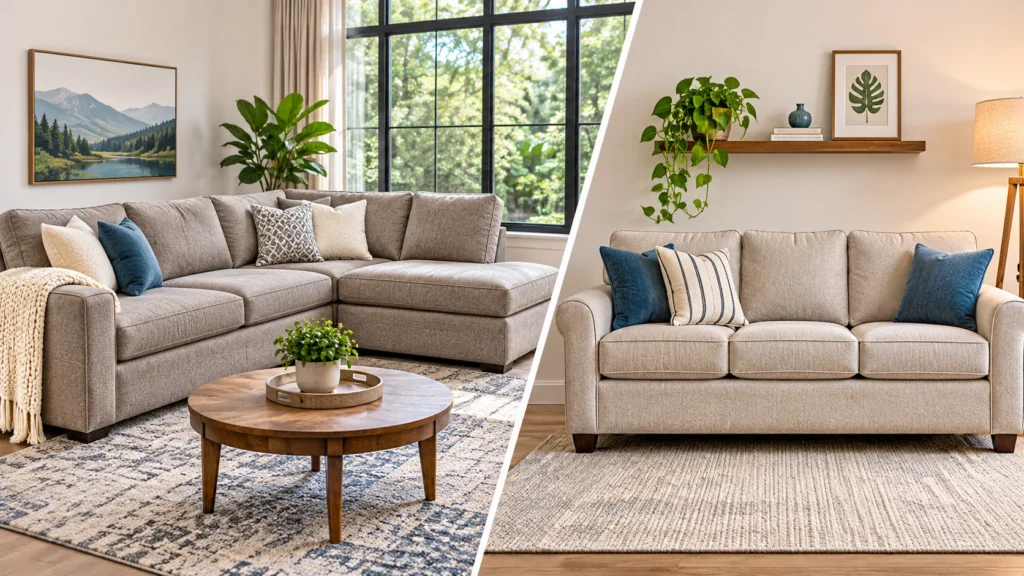
A sectional sofa is a seating system made from multiple connected sections rather than one continuous sofa frame. Depending on the model, those sections can include a chaise, corner unit, armless seat, loveseat, recliner, ottoman, or additional modules. Fixed sectionals stay in one planned configuration, while modular sectionals can often be separated and rearranged when your room or seating needs change.
The practical difference is flexibility versus commitment. A traditional sofa generally occupies one straight run of floor space and can be paired with movable chairs. A sectional can concentrate more seating into one connected footprint, but its return or chaise also reaches farther into the room. That makes room geometry and circulation more important than they are with a standard couch.
You might be thinking that more sections automatically mean more useful seating. Not always: wide arms, deep corner wedges, oversized chaises, and bulky consoles can increase the overall footprint without adding the same amount of comfortable sitting space.
That is why your next decision should be based on measurements rather than seat count alone.
How Do You Measure for a Sectional Sofa?
Measure the entire room before measuring the wall where you expect the sectional to sit. Record room length and width, then mark doors, door swings, windows, vents, fireplaces, radiators, built-ins, outlets, and the routes people use to enter or cross the room. Next, compare those constraints with the sectional’s overall width, normal depth, and maximum chaise or return depth.
Main walking routes commonly work best with roughly 30 to 36 inches of clearance where the room allows it, while the sofa-to-coffee-table gap is often smaller. Treat those figures as planning starting points rather than rigid laws because household mobility, room dimensions, and furniture proportions vary. Current furniture-layout guidance consistently emphasizes protecting circulation rather than fitting the largest possible sofa.
🔢 Step-by-Step: Measure Before You Order
- 1
Measure the room
Record every wall, opening, fixed feature, and important traffic route.
- 2
Tape the footprint
Outline the full sofa and chaise dimensions directly on the floor.
- 3
Walk around it
Open doors and follow your normal paths while the tape remains down.
- ✓
Check the delivery path
Measure doors, halls, elevators, stairs, landings, and tight turns before purchasing.
This process also fits the broader principles in Super Dwelling’s guide to choosing living room furniture. Stanford researchers studying furniture layout likewise treated circulation, conversation, prominent room features, and visual balance as connected planning constraints. Stanford’s furniture-layout research provides the underlying design context.
Once the footprint works, you can decide which sectional shape uses that space most effectively.
Which Sectional Shape Fits Your Room Best?
The best sectional shape follows the room rather than forcing the room to follow the furniture. An L-shaped sectional is usually the easiest configuration to place because one side can anchor the main seating zone while the shorter return defines a corner or open-plan boundary. A U-shaped sectional creates more wraparound seating but demands substantially more clear floor area.
A chaise sectional gives you one extended lounging position without the full depth of a large U-shape. Modular sectionals are the most adaptable choice when you move often, expect your household to change, or simply like rearranging furniture. The trade-off is that multiple modules require more connections and can sometimes shift if their fastening system is weak.
Use this comparison to match configuration to the way your room actually functions.
Choose the shape that preserves the room’s useful circulation and focal point—not simply the configuration with the most seats.
If you are testing several placements, Super Dwelling’s living room layout ideas can help you compare different seating arrangements before committing.
The shape narrows your options, but the next detail—the direction of the chaise—can still make or break the layout.
How Do Left-Facing and Right-Facing Sectionals Work?
Left-facing and right-facing labels describe the side on which an arm, chaise, or return appears, but the terminology deserves careful checking before you order. Many retailers describe orientation while you stand in front of the sectional and face it. Under that convention, a chaise extending to your left is left-facing and one extending to your right is right-facing.
The problem is that product naming is not perfectly consistent across every seller. Some listings use different viewpoints or combine terms such as left-arm-facing, right-arm-facing, reversible chaise, and left-hand corner. For that reason, the safest method is to compare the listing’s diagram and product photographs with your taped floor plan rather than trusting the label by itself. Current measuring guidance specifically warns shoppers that seller terminology can differ.
⚠️ Orientation Check
Before checkout, match the retailer’s actual diagram to your room. If the chaise is reversible, confirm what parts must be moved to switch sides.
A wrong-facing chaise can block a doorway, cut across a natural walking route, or separate seating from the room’s focal point. Get the direction settled before comparing upholstery colors.
What Size Sectional Sofa Should You Choose?
Choose sectional size from the usable footprint left after circulation and fixed room features are protected. Retail categories are only rough guides: current buying resources commonly place compact sectionals below roughly the mid-90-inch range, standard models around the mid-90s to roughly 110 inches, and larger configurations beyond that. U-shaped and multi-module designs can become significantly wider.
Those numbers are not universal furniture standards. Retailers classify small, standard, and large sectionals differently, so your room dimensions remain more reliable than a category name. Wayfair, for example, currently groups some small sectionals below 89 inches and large options above 109 inches, while another current size guide describes approximately 78–94 inches as small and 95–110 inches as standard.
Think of these ranges as shopping filters, not a substitute for measuring.
Always use the manufacturer’s exact dimensions for the specific configuration you plan to order.
A sectional that technically fits against a wall can still be too large if the chaise cuts across the room. Scale and usable space matter together.
Which Fabric and Construction Features Matter Most?
Choose upholstery according to daily use first and appearance second. A lightly used formal room gives you more freedom with delicate textures and pale colors, while a sectional used every evening by children, pets, or frequent guests benefits from fabric that is easier to clean and resistant to everyday abrasion. Removable or reversible cushions can also make maintenance and wear management easier.
Construction matters because sectionals place substantial loads across several connected frames. Check what the manufacturer discloses about frame material, joinery, seat support, connectors, cushion fill, replacement parts, warranty coverage, and care instructions. A beautiful upholstery sample cannot compensate for weak connections or cushions that do not suit the way you prefer to sit.
What Should You Look for in Sectional Upholstery?
Start with the manufacturer’s care code and cleaning instructions. Ask for a fabric sample when possible and test how the color looks in your home’s daylight and evening lighting. For pets or children, consider tighter weaves and fabrics marketed for high-use environments, but confirm the actual performance information supplied for that textile rather than trusting a generic label.
What Should You Check in the Frame and Cushions?
Sit in several positions—not only the center seat. Check corner comfort, back support, cushion recovery, seat height, seat depth, and whether module connections feel stable. If buying online, read the construction specifications and return policy before purchase.
For U.S. shoppers, upholstered furniture is also subject to federal smolder-resistance requirements under 16 C.F.R. Part 1640. The CPSC explains the applicable testing and labeling requirements in its upholstered furniture guidance.
Once comfort and durability meet your needs, the remaining question is whether a sectional truly suits the amount of space you have.
Can a Sectional Sofa Work in a Small Living Room?
Yes, a sectional can work in a small living room when its footprint replaces several separate seating pieces without blocking the room’s essential circulation. A compact L-shaped or reversible-chaise model can use an otherwise empty corner efficiently, especially when the alternative would be a sofa plus multiple chairs occupying separate areas of the floor.
The deciding factor is not simply square footage. Door placement, room shape, window position, the location of the TV or fireplace, and how people move through the space all matter. A long narrow room with several doorways can be less suitable for a sectional than a smaller square room with one open corner. That is why floor-taping is more useful than broad rules about whether small rooms should or should not contain sectionals.
🎯 Which Seating Approach Fits Your Space?
If you have…
An open corner and want maximum connected seating
→ Consider a compact L-shaped sectional
If you have…
Changing layouts or limited commitment to one chaise side
→ Consider modular or reversible seating
If you have…
A narrow room with several doors and walkways
→ Compare a standard sofa with movable chairs
For rooms that already feel tight, use the same visual and layout principles covered in Super Dwelling’s guide on making a living room look bigger.
Small spaces do not automatically rule out sectionals—but they leave less room for measurement mistakes.
What Most People Get Wrong About Sectional Sofas
The first misconception is that the biggest sectional that physically fits is automatically the best use of the room. Furniture also needs usable space around it, so a sectional that reaches from wall to wall can still be oversized when it narrows circulation, crowds tables, or forces people to squeeze past the chaise.
The second misconception is that a sectional always seats more people than a sofa-and-chair arrangement. What matters is usable seat width and how comfortable the corner positions are. Thick arms, consoles, large wedges, and extra-deep modules can create an impressive footprint without producing proportionally more practical seating.
- Wrong belief: Sectionals belong only in large rooms. Reality: compact configurations can work well when the room geometry supports them.
- Wrong belief: A modular sectional can always become any shape. Reality: available configurations depend on the specific modules and connector design.
- Wrong belief: Chaise direction is obvious from the product name. Reality: always confirm it using the seller’s diagram.
You may also assume that pushing a sectional tightly against the walls saves the most space. Sometimes it does, but a small amount of breathing room can improve visual balance and circulation; Super Dwelling’s living room furniture arrangement guide explains how placement changes the way the whole room functions.
Correcting those assumptions leaves you with one final task: checking the complete purchase, not just the sofa.
How Do You Make the Final Sectional Sofa Buying Decision?
Make the final decision only after the exact configuration passes three tests: it fits the room, it can enter the home, and it suits the people who will use it every day. Confirm dimensions for the precise module combination in your cart because adding or removing a seat can change overall width, chaise depth, orientation, and connector placement.
Then check the non-dimensional details that are easy to ignore while shopping: upholstery care, cushion feel, frame specifications, module connections, warranty terms, return costs, assembly requirements, replacement parts, and whether the retailer allows configuration changes after ordering. If you cannot test the sectional in person, fabric samples and a clearly documented return policy become more valuable.
✓ Final Sectional Checklist
- ✓The full footprint is taped on your floor.
- ✓Doors, hallways, stairs, elevators, and landings have been measured.
- ✓The chaise orientation matches the retailer’s diagram.
- ✓Normal walking paths remain comfortable and unobstructed.
- ✓Seat depth and cushion firmness match your comfort preferences.
- ✓Fabric care, warranty, returns, and assembly terms are acceptable.
If every item passes, you are choosing a sectional for your actual room rather than for the showroom photo. That is the difference between a sofa that merely fits and one that functions comfortably for years.
Conclusion: What Matters Most When Choosing a Sectional Sofa?
The best sectional sofa is the configuration that fits your room, protects normal movement, and supports the way your household actually relaxes. Size and orientation should be settled before color, fabric, or extra features. A carefully measured compact sectional can outperform an oversized luxury model simply because it works with the space. Right now, spend two minutes taping the sectional’s maximum width and chaise depth onto your floor.
Frequently Asked Questions
What is a sectional sofa?
A sectional sofa is made from multiple connected seating sections that form one larger arrangement. Common components include corner seats, armless chairs, chaises, loveseats, ottomans, and recliners. Some sectionals have a fixed layout, while modular designs let you separate and rearrange individual sections.
How do I choose the right size sectional sofa for my living room?
Measure the room, identify traffic paths, and tape the sectional’s complete footprint onto the floor. Include the maximum chaise or return depth rather than measuring only the long side. The right sectional leaves enough usable space for doors, tables, walking routes, and other essential furniture.
What are the different types of sectional sofas?
Common sectional types include L-shaped, U-shaped, chaise, reclining, sleeper, and modular configurations. L-shaped designs suit many everyday living rooms, U-shaped models create larger conversation zones, and modular sectionals provide the most flexibility because individual seating units can often be rearranged.
What is the difference between a left-facing and right-facing sectional?
The terms normally describe which side contains the arm, chaise, or return when viewing the sectional from a specified direction. Because retailer terminology can vary, confirm orientation from the actual product diagram and photographs. Do not order a fixed-orientation sectional based on LAF or RAF wording alone.
Can a sectional sofa work in a small living room?
Yes. A compact sectional can use a corner efficiently and sometimes replaces a sofa plus several separate chairs. Success depends on room shape, doorway locations, traffic flow, and chaise depth. Tape the exact footprint on the floor before deciding whether the sectional genuinely saves usable space.
Are modular sectional sofas worth it?
A modular sectional is especially useful when you move frequently, rearrange rooms, or expect seating needs to change. Individual modules can provide more layout flexibility than a fixed sectional. Check which modules are actually interchangeable, how they connect, and whether extra pieces will remain available later.
Is a sectional better than a regular sofa?
Neither is universally better. A sectional works well when you want connected seating and have a layout that supports its larger footprint. A regular sofa offers more flexibility when the room is narrow, has several doorways, or needs movable chairs. Compare complete room layouts before choosing between them.