

Quick Answer
The best rug placement for a bedroom is usually underneath the lower two-thirds of the bed, with 18 to 24 inches of rug extending beyond both sides and the foot. This arrangement creates a comfortable landing area without covering unnecessary floor space. According to bedroom rug placement guidelines, the right arrangement should balance bed dimensions, furniture positioning, and visible floor space.
Best bedroom rug placement options:
- Under two-thirds: Choose this versatile layout for most standard bedrooms.
- Fully underneath: Place a large rug beneath the bed and nightstands for a luxurious appearance.
- Bedside runners: Use narrow rugs beside the bed in smaller bedrooms.
- Foot placement: Position a rug beneath or beyond the foot of the bed to add visual interest.
- Correct rug size: Start with an 8 x 10-foot rug for a queen bed or a 9 x 12-foot rug for a king bed.
- Balanced spacing: Keep rug edges clear of door swings, furniture drawers, and main walking routes.
Before buying:
- Test your layout: Mark the proposed rug dimensions with painter’s tape before choosing a size.
- Prevent movement: Use a rug pad compatible with your flooring.
A beautiful rug can still look awkward when it sits in the wrong place. I prefer to plan bedroom rug placement around everyday comfort rather than appearance alone.
In this 2026 guide, I’ll explain seven practical rug layouts, recommended sizes, furniture spacing, and common mistakes. You’ll also learn how to make a rug work in small, large, and unusually shaped bedrooms.
What Does Bedroom Rug Placement Mean?
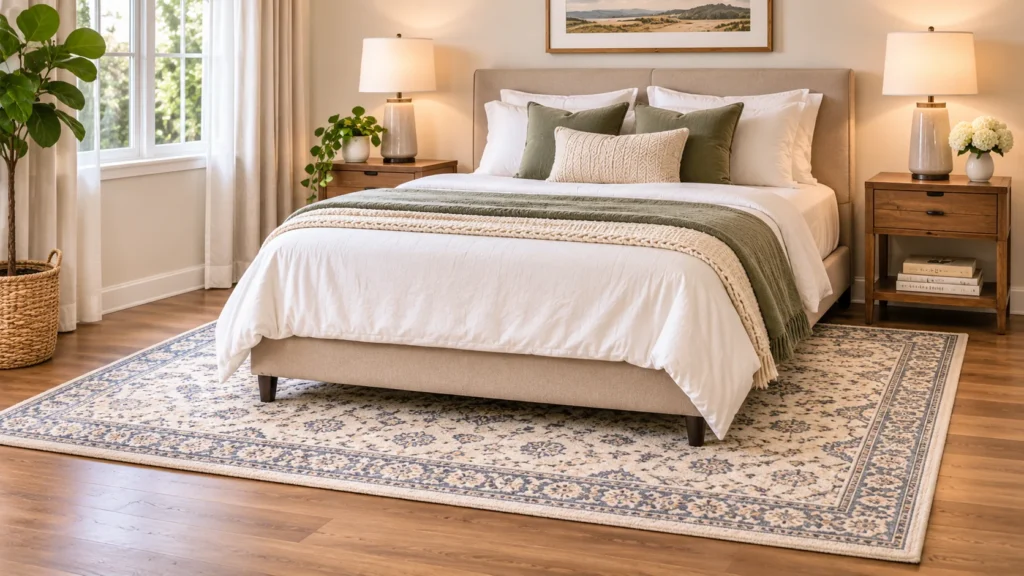
Bedroom rug placement is the positioning of an area rug relative to the bed, surrounding furniture, walls, and walking areas. Its purpose is to improve comfort while creating a visually connected bedroom layout.
A correctly positioned rug makes the bed feel anchored. It also provides a softer surface where you stand, dress, or walk.
Effective bedroom rug placement depends on several factors:
- Bed dimensions: The width and length of the actual bed frame.
- Room dimensions: The available floor space around furniture.
- Furniture arrangement: The location of nightstands, dressers, benches, and chairs.
- Walking routes: The areas you regularly use when moving around the bedroom.
- Flooring type: Hardwood, laminate, tile, or existing carpet.
- Visual balance: How evenly the rug connects the room’s main elements.
Consider your rug part of the overall furniture arrangement. My guide to arranging bedroom furniture explains how to establish comfortable walking routes before adding decorative elements.
What Is the Best Rug Placement for a Bedroom?
For most bedrooms, placing a rectangular rug under the lower two-thirds of the bed offers the best combination of comfort, appearance, and efficient floor coverage. The rug should extend beyond the bed where you normally place your feet.
Start the rug just beyond the front edges of the nightstands. Position its longer dimension across the width of the bed when the room and rug dimensions allow.
This arrangement offers several practical benefits:
- Creates comfortable landing areas on both sides of the bed.
- Connects the bed with the surrounding floor space.
- Leaves nightstands on a consistent flooring surface.
- Reduces unnecessary rug coverage behind the bed.
- Provides a balanced appearance without requiring an oversized rug.
I generally prioritize visible, usable rug space over the amount hidden beneath furniture. A slightly different position can make an existing rug more functional without requiring a replacement.
7 Best Bedroom Rug Placement Layouts
Different bedroom layouts require different rug arrangements. These seven options cover everything from compact guest rooms to spacious primary bedrooms.
1. Place the Rug Under the Lower Two-Thirds of the Bed
This is my preferred starting point for a standard bedroom. The rug supports the lower portion of the bed while leaving the headboard area and nightstands uncovered.
- Center the rug across the bed’s width.
- Keep its upper edge near the front of the nightstands.
- Aim for 18 to 24 inches of exposed rug beside the bed.
- Leave sufficient rug beyond the footboard.
Best for: Queen beds, king beds, modern bedrooms, and most medium-sized rooms.
Check where your feet land when getting out of bed. Move the rug slightly toward the headboard if the landing area remains uncovered.
2. Place a Large Rug Under the Entire Bed
A full-under-bed arrangement creates a unified, hotel-inspired appearance. The rug extends beneath the complete bed frame and may also support both nightstands.
- Select a rug large enough to support the furniture arrangement.
- Keep both nightstands either fully on or fully off the rug.
- Maintain a visible border of flooring around the perimeter.
- Check that nearby doors and drawers open freely.
Best for: Spacious primary bedrooms, large furniture arrangements, and luxurious interiors.
A 9 x 12-foot rug may work beneath a queen bed and compact nightstands. Larger king-bed arrangements may require a 10 x 14-foot rug.
3. Position the Rug Under the Lower Half of the Bed
A half-under-bed placement works when a standard two-thirds layout doesn’t fit. It emphasizes the lower part of the bedroom while leaving more flooring exposed near the headboard.
- Place the upper rug edge near the middle of the bed.
- Keep the rug centered from left to right.
- Maintain sufficient coverage around the footboard.
Best for: Smaller area rugs, compact bedrooms, and rooms with a decorative bench.
The main drawback is reduced coverage near your usual bedside landing point. Check this position carefully before moving heavy furniture onto the rug.
4. Use Matching Runners on Both Sides
Two bedside runners provide soft flooring without covering the area beneath the bed. This is a practical alternative when a large rug would overcrowd the room.
- Choose runners approximately 2 to 3 feet wide, depending on available space.
- Position them parallel to the bed.
- Align their starting and ending points for symmetry.
- Use suitable non-slip pads beneath both runners.
Best for: Narrow bedrooms, rental apartments, and budget-conscious decorating.
Runners are also easier to remove and clean than rugs trapped beneath heavy bed frames. Their smaller footprint makes seasonal changes more manageable.
5. Place a Rug at the Foot of the Bed
A rug positioned near the footboard adds texture and defines the lower bedroom area. It works particularly well beneath an upholstered bedroom bench.
- Center the rug relative to the bed.
- Choose a width that looks proportional to the bed frame.
- Keep the main walkway unobstructed.
Best for: Decorative bedroom layouts, dressing areas, and rooms with limited bedside space.
This option prioritizes appearance over bedside comfort. Choose another arrangement if warm flooring beside the bed is your main goal.
6. Use a Single Rug Beside the Bed
A single bedside rug works well when one side of the bed sits close to a wall. It adds comfort exactly where the room’s occupant needs it.
- Position the rug along the accessible side.
- Cover the area where you enter and exit the bed.
- Keep the rug edge away from door thresholds.
Best for: Twin beds, children’s bedrooms, studio apartments, and corner bed arrangements.
There’s no need to force symmetry into an asymmetrical room. Practical coverage matters more than matching both sides.
7. Create a Separate Seating or Dressing Zone
A bedroom rug doesn’t always need to sit beneath the bed. A separate rug can define a reading corner, vanity area, or small seating arrangement.
- Choose a rug proportional to the furniture in that zone.
- Keep chair legs stable on the floor or rug.
- Coordinate its colors with the bedroom’s existing textiles.
Best for: Large bedrooms, multipurpose rooms, and bedrooms with reading corners.
If you’re using two rugs, avoid placing their edges too close together. Leave enough exposed flooring to distinguish the separate areas.
Bedroom Rug Placement Comparison Table
The following comparison helps you select an arrangement based on available space and everyday needs.
| Placement | Suggested Rug Size | Best Use | Coverage |
|---|---|---|---|
| Lower two-thirds | 8 x 10 ft | Standard queen bedroom | High |
| Entire bed | 9 x 12 or 10 x 14 ft | Large bedrooms | Very high |
| Lower half | 6 x 9 ft | Limited rug coverage | Moderate |
| Matching runners | 2 x 6 or 2.5 x 7 ft each | Narrow bedrooms | Targeted |
| Foot of bed | 3 x 5 or 4 x 6 ft | Decorative arrangements | Limited |
| Single bedside rug | 2 x 5 or 3 x 5 ft | Corner beds | Targeted |
| Separate zone | 4 x 6 or 5 x 7 ft | Reading corners | Localized |
These dimensions are starting recommendations rather than universal requirements. Measure your actual furniture and available flooring before purchasing.
What Size Rug Should You Use for Each Bed Size?
Choose a bedroom rug according to the bed frame’s dimensions and desired exposed rug area. An 8 x 10-foot rug commonly suits queen beds, while a 9 x 12-foot rug offers generous coverage for many king beds.
| Bed Size | Standard US Mattress | Compact Rug | Generous Rug |
|---|---|---|---|
| Twin | 38 x 75 in | 5 x 7 ft | 6 x 9 ft |
| Full | 54 x 75 in | 5 x 8 ft | 6 x 9 ft |
| Queen | 60 x 80 in | 6 x 9 ft | 8 x 10 ft |
| King | 76 x 80 in | 8 x 10 ft | 9 x 12 ft |
| California king | 72 x 84 in | 8 x 10 ft | 9 x 12 ft |
Compact rug sizes generally assume partial under-bed placement rather than complete furniture coverage. Rotate rectangular rugs so their longer dimension runs across the bed when appropriate.
The Rugs Direct under-bed sizing guide offers additional guidance on matching area rugs with bedroom furniture.
How Much Rug Should Show Around a Bed?
Aim for approximately 18 to 24 inches of visible rug on either side of the bed and beyond its foot. Larger bedrooms can accommodate wider margins, while compact rooms may require smaller ones.
Calculate the exposed rug width using this simple formula:
Visible rug on each side = (Total rug width across the bed − Bed frame width) ÷ 2
For example, consider a queen bed frame measuring 64 inches wide. A rug extending 108 inches across the bed leaves 44 additional inches.
That provides 22 inches on each side when centered. This fits the commonly recommended bedside coverage range.
Remember to measure the complete frame rather than relying on mattress dimensions. Upholstered frames and decorative side rails often add several inches.
Where Should You Place a Rug in a Small Bedroom?
The best rug placement in a small bedroom usually involves a partially tucked area rug or narrow bedside runners. Both arrangements provide comfort without filling every available inch of flooring.
- Choose a low-profile rug that won’t interfere with doors.
- Leave exposed flooring around the rug where possible.
- Use runners when bedside clearances are narrow.
- Avoid oversized rugs that extend into closets or doorways.
- Consider light or understated patterns for a less visually crowded appearance.
A rug shouldn’t make furniture harder to use. Check the placement of storage drawers, wardrobes, and under-bed compartments before finalizing the layout.
Should Bedroom Nightstands Sit on the Rug?
Bedroom nightstands can sit on or off the rug, provided their placement remains stable and visually consistent. Keeping both nightstands on bare flooring is often easiest with a partial under-bed layout.
When using a larger rug, position all nightstand legs on the same surface. Avoid arrangements that cause the furniture to tilt.
For more ideas about coordinating furniture and floor coverings, see this guide to arranging furniture around a rug.
How Do You Position a Bedroom Rug Correctly?
Measure and test your rug layout before moving heavy furniture. This reduces unnecessary lifting and helps prevent expensive sizing mistakes.
- Measure the bedroom. Record its usable width, length, and major obstructions.
- Measure the bed frame. Include upholstered sides, footboards, and projecting legs.
- Choose a placement style. Decide between full coverage, partial coverage, or bedside runners.
- Mark the rug outline. Use floor-safe painter’s tape to visualize its footprint.
- Test furniture clearances. Open doors, drawers, and storage compartments.
- Install a suitable rug pad. Follow the rug and flooring manufacturers’ recommendations.
- Position and straighten the rug. Get help lifting heavy furniture and check the final alignment.
Practical tip: Walk around the taped rug outline before buying. Pay attention to where you stand when getting dressed, making the bed, and opening drawers.
Does Bedroom Rug Material Affect Placement?
Yes. Rug thickness, backing, and fiber construction influence furniture stability, door clearance, and maintenance requirements.
- Low-pile rugs: Suitable beneath beds and furniture where clearance is limited.
- Wool rugs: Offer natural softness and insulation, depending on construction.
- High-pile rugs: Provide plush comfort but may interfere with low doors or furniture.
- Washable rugs: Convenient in accessible areas where removal is straightforward.
- Natural fiber rugs: Add texture but may feel coarse against bare feet.
Review the cleaning and maintenance recommendations from the Carpet and Rug Institute when considering different fiber types.
What Bedroom Rug Placement Mistakes Should You Avoid?
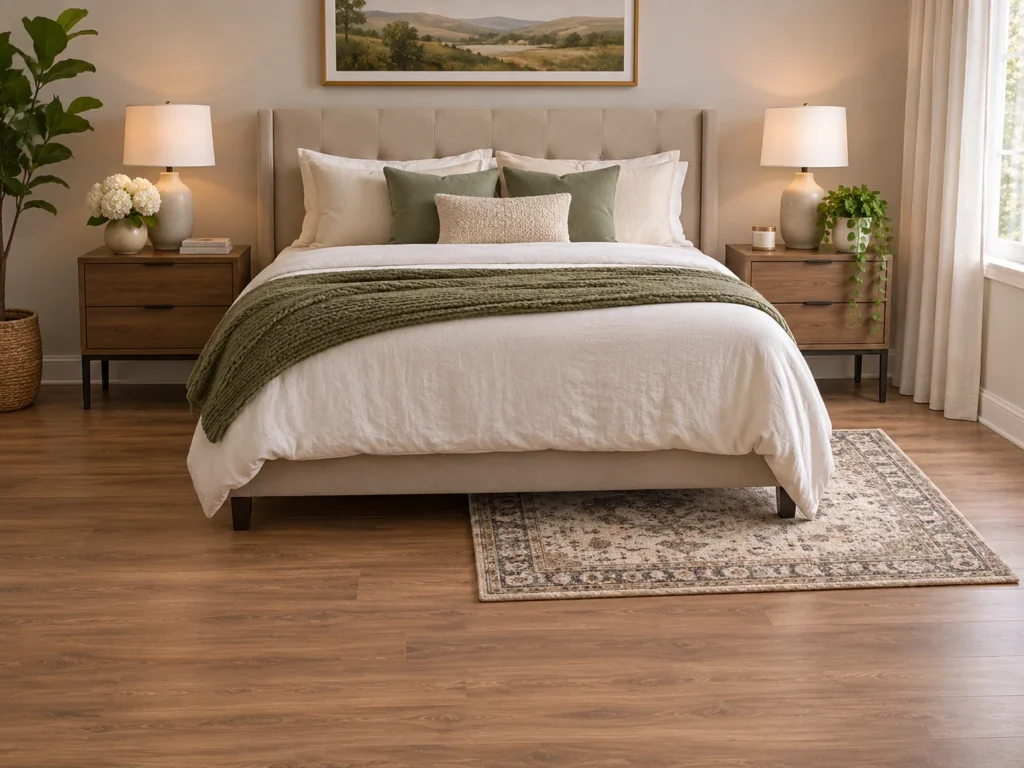
The most common mistakes involve poor sizing, inadequate bedside coverage, and unstable rug edges. Address these issues before focusing on decorative details.
- Buying an undersized rug: Too little visible coverage can make the arrangement look disconnected.
- Ignoring the bed frame: Mattress dimensions alone may underestimate the necessary rug width.
- Covering unnecessary space: A rug hidden mostly beneath furniture offers limited everyday benefit.
- Skipping the rug pad: Unsecured rugs may shift or develop uneven edges.
- Blocking door movements: Thick rugs can interfere with doors and storage drawers.
- Creating uneven furniture support: Nightstands may wobble when only some legs rest on a thick rug.
- Ignoring walking routes: Raised or curling edges can create tripping hazards.
These issues often overlap with other common bedroom decorating mistakes, especially when furniture size and available floor space don’t match.
Best Products for Comfortable Bedroom Rug Placement
A properly sized rug and compatible rug pad make bedroom layouts more comfortable and manageable. Here are three products worth considering for different placement needs.
As an Amazon Associate, I earn from qualifying purchases. The scores below reflect editorial suitability for the stated use, not verified customer ratings or hands-on testing.
🏆 Best for Under-Bed Placement
Safavieh Adirondack Collection Area Rug
★★★★½ 4.5/5 editorial score
This collection offers low-pile synthetic rugs in numerous rectangular sizes and distressed patterns. I’d consider an 8 x 10-foot option for a typical queen bedroom with partial under-bed coverage.
📏 Best for Narrow Bedrooms
Ottomanson Ottohome Collection Runner Rug
★★★★☆ 4/5 editorial score
This collection includes slim runner rugs suitable for narrow walking areas. I’d choose matching runners when a conventional area rug would interfere with bedroom furniture or storage.
🛡️ Best for Rug Stability
Mohawk Home Dual Surface Felt and Rubber Rug Pad
★★★★½ 4.5/5 editorial score
This felt-and-rubber pad combines cushioning with grip for compatible flooring surfaces. I’d prioritize the thinner version where door clearance matters and confirm flooring compatibility before installation.
Frequently Asked Questions
Should a bedroom rug go all the way under the bed?
A bedroom rug doesn’t need to extend beneath the entire bed. Positioning it under the lower two-thirds usually provides comfortable bedside coverage while using less material, although full coverage can create a more luxurious appearance in spacious bedrooms.
Is an 8 x 10 rug too big for a queen bed?
An 8 x 10-foot rug is often an appropriate size for a queen bed, especially when positioned beneath the lower portion. Measure the room, bed frame, and furniture clearances to determine whether it fits without obstructing nearby doors or storage.
Can you put a bedroom rug over carpet?
Yes, you can place an area rug over existing bedroom carpet when both surfaces remain stable. Use a rug pad specifically designed for carpet-on-carpet applications, and avoid thick combinations that create uneven furniture support, bunching, or difficult walking surfaces.
Should a bedroom rug be centered under the bed or in the room?
Center an under-bed rug relative to the bed rather than automatically centering it within the room. This creates a stronger connection between the rug and furniture, particularly when the bed sits off-center because of windows, doors, or built-in storage.
What rug placement makes a bedroom look bigger?
A well-proportioned rug beneath the lower section of the bed can make a bedroom feel more cohesive. Leaving visible flooring around the perimeter and choosing understated patterns may also reduce visual clutter, although the effect depends on the room’s overall design.
Final Thoughts: Choose the Best Rug Placement for Your Bedroom
The best rug placement for a bedroom combines comfortable floor coverage, balanced proportions, and unobstructed movement. For most bedrooms, placing the rug beneath the lower two-thirds of the bed is an excellent starting point.
Use matching runners in narrow rooms or choose complete under-bed coverage when space allows. Always measure your furniture and test the proposed arrangement before purchasing.
Ready to improve your entire bedroom? Explore this practical guide on how to decorate a bedroom to coordinate your rug with furniture, bedding, lighting, and accessories.