

Quick Answer
A bedroom should generally have 100–150 lux of ambient lighting for everyday activities and 60–100 lux for relaxation. A typical 12 × 12-foot bedroom can start with approximately 2,000–3,000 lumens of total light output, adjusted for room design and fixture efficiency. Combine warm, dimmable ceiling lights with suitable layered bedroom lighting for greater comfort and flexibility.
Recommended Bedroom Light Brightness:
- General lighting: Aim for approximately 100–150 lux throughout the bedroom.
- Bedside lamps: Choose adjustable bulbs with approximately 400–800 lumens.
- Reading lights: Target around 300–400 lux directly on your book.
- Color temperature: Use warm white lighting between 2700K and 3000K.
- Evening relaxation: Reduce brightness and use softer, warmer light sources.
- Nighttime lighting: Turn off unnecessary lights and use a dim nightlight when needed.
Practical Tip:
- Measure your bedroom, estimate the required lumens, and use separate lighting controls for different activities.
Finding the right bedroom light brightness can make your room feel more comfortable, functional, and inviting. However, choosing a brighter bulb doesn’t always solve lighting problems.
I recommend planning bedroom lighting around your daily activities rather than relying on a single ceiling fixture. In this 2026 guide, I’ll explain how to calculate brightness and create a balanced lighting setup.
What Does Bedroom Light Brightness Mean?
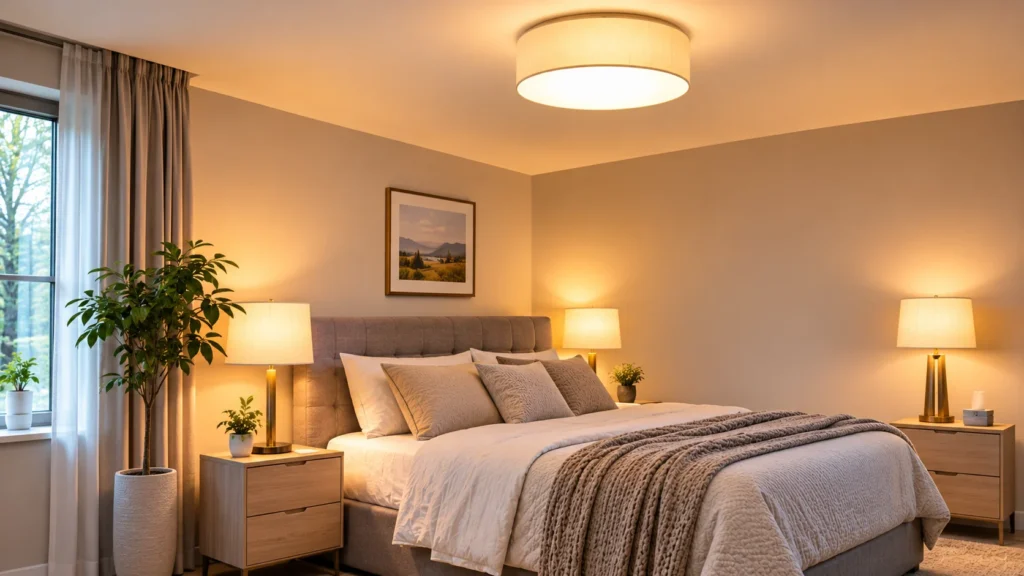
Bedroom light brightness describes how much visible light a lighting system produces and how much illumination reaches the room’s surfaces. It affects visibility, comfort, atmosphere, and everyday functionality.
Understanding the difference between light output and perceived brightness makes choosing suitable bulbs much easier.
- Lumens: Measure the amount of visible light a bulb or fixture produces.
- Lux: Measures the light reaching a particular surface.
- Watts: Measure the electrical power a light consumes.
- Kelvin: Describes the warm or cool appearance of white light.
- CRI: Color Rendering Index describes how accurately a light source reveals colors.
Two bulbs with identical lumen ratings can produce different lighting experiences. Lampshade materials, fixture placement, beam direction, and wall colors all influence the result.
According to the U.S. Department of Energy, lumens provide a more useful way to compare bulb brightness than wattage alone.
How Bright Should a Bedroom Light Be for Different Activities?
General bedroom lighting should usually provide around 100–150 lux. Reading, dressing, and detailed activities benefit from additional focused illumination.
The ideal brightness changes throughout the day. This is why adjustable lighting works particularly well in bedrooms.
| Bedroom Activity | Suggested Brightness | Lighting Type |
|---|---|---|
| General activities | 100–150 lux | Ceiling lights |
| Relaxing | 60–100 lux | Table or floor lamps |
| Reading in bed | 300–400 lux on page | Adjustable reading lamps |
| Dressing | 200–300 lux locally | Mirror or wardrobe lights |
| Working at a desk | 400–500 lux on desk | Task lighting |
| Nighttime navigation | Minimum safe illumination | Low-level nightlight |
These are practical planning targets rather than mandatory residential lighting standards. Individual eyesight, room conditions, and fixture design may require adjustments.
Lighting guidance from the Energy Saving Trust supports flexible bedroom illumination, with stronger localized lighting for reading and other visual tasks.
How Many Lumens Does a Bedroom Need?
Many bedrooms can start with approximately 15–25 lumens of installed light output per square foot. The actual requirement depends on how efficiently the fixtures distribute that light.
A small guest bedroom may need fewer lumens than a large master bedroom with dark walls and high ceilings.
Bedroom Lumens by Room Size
| Room Dimensions | Floor Area | Estimated Total Lumens |
|---|---|---|
| 8 × 10 ft | 80 sq. ft. | 1,200–2,000 lm |
| 10 × 10 ft | 100 sq. ft. | 1,500–2,500 lm |
| 10 × 12 ft | 120 sq. ft. | 1,800–3,000 lm |
| 12 × 12 ft | 144 sq. ft. | 2,160–3,600 lm |
| 12 × 14 ft | 168 sq. ft. | 2,520–4,200 lm |
| 14 × 16 ft | 224 sq. ft. | 3,360–5,600 lm |
| 16 × 20 ft | 320 sq. ft. | 4,800–8,000 lm |
These estimates represent combined installed light output, not the brightness that must remain active throughout the evening. Separate switches and dimmers let you reduce illumination when necessary.
How to Calculate the Right Bedroom Light Brightness
You can estimate bedroom lighting requirements by measuring floor area and selecting an appropriate light output target. For greater accuracy, consider how much emitted light reaches useful surfaces.
Step 1: Measure the Bedroom
Multiply the bedroom’s length by its width to calculate the floor area. A rectangular room is usually straightforward to measure.
- Room length: 12 feet.
- Room width: 12 feet.
- Floor area: 144 square feet, or approximately 13.4 square meters.
Step 2: Estimate the Required Lumens
Simple planning formula:
Estimated lumens = Floor area in square feet × 15–25.
Using 20 lumens per square foot, a 144-square-foot bedroom would require an estimated 2,880 lumens of installed light output.
This is a starting estimate, not a precise prediction of measured room brightness.
Step 3: Account for Lighting Efficiency
A more detailed calculation uses the target illuminance, room area in square meters, and estimated light utilization.
Estimated fixture lumens = Target lux × Floor area in square meters ÷ Light utilization factor.
For example, targeting 120 lux across 13.4 square meters with an assumed utilization factor of 0.60 produces an estimate of 2,680 lumens.
The utilization factor is illustrative. Professional lighting calculations account for fixture distribution, room geometry, surface reflectance, and maintenance losses.
Step 4: Distribute the Light
Instead of installing one powerful bulb, divide the estimated brightness among multiple fixtures. This creates more control and can improve visual comfort.
- Ceiling fixture: 1,600 lumens.
- First bedside lamp: 450 lumens.
- Second bedside lamp: 450 lumens.
- Accent light: 200 lumens.
- Combined light output: 2,700 lumens.
I prefer this approach because each fixture can serve a different purpose. You don’t need full room brightness every time you enter the bedroom.
What Is the Best Light Bulb Wattage for a Bedroom?
LED bulbs producing approximately 450–800 lumens work well in many bedroom lamps. Ceiling fixtures may require higher-output bulbs or several smaller light sources.
Always compare lumens rather than assuming that higher wattage means better lighting.
| Traditional Bulb | Typical LED Power | Light Output |
|---|---|---|
| 25W | 3–5W | 250 lumens |
| 40W | 4–7W | 450 lumens |
| 60W | 7–10W | 800 lumens |
| 75W | 10–13W | 1,100 lumens |
| 100W | 14–18W | 1,600 lumens |
LED wattage varies by manufacturer, bulb efficiency, and product design.
Check the fixture’s maximum wattage, socket type, voltage, and enclosed-fixture requirements before buying replacement bulbs.
What Color Temperature Is Best for Bedroom Lighting?
Warm white light between 2700K and 3000K is an excellent starting point for general bedroom lighting. Lower color temperatures can create a softer appearance during evening relaxation.
Color temperature affects the appearance of light independently of its lumen output.
| Temperature | Appearance | Best Use |
|---|---|---|
| 1800–2200K | Amber warm | Evening accent lights |
| 2700K | Soft warm white | Bedside and ambient lights |
| 3000K | Warm white | General bedroom activities |
| 3500–4000K | Neutral white | Dressing and daytime tasks |
| 5000–6500K | Cool daylight | Specialized daytime tasks |
I would start with 2700K bulbs for bedside lamps and either 2700K or 3000K for the main fixture. Matching their color temperatures helps maintain a consistent atmosphere.
How Bright Should a Bedside Lamp Be?
A bedside lamp producing around 400–800 lumens provides a useful range for relaxation and reading. Dimmable models offer more flexibility than fixed-output bulbs.
The amount of light reaching your book also depends on the lampshade and distance from the reading surface.
- 200–400 lumens: Soft decorative and relaxation lighting.
- 400–600 lumens: Everyday bedside illumination.
- 600–800 lumens: Brighter lighting for reading when properly directed.
- Adjustable output: Convenient for switching between reading and relaxation.
Position the lamp so its shade shields your eyes from direct glare. An adjustable wall-mounted reading light can work especially well for shared bedrooms.
For more guidance, explore this guide on how to choose bedside lamps that suit your bed height, nightstand, and lighting needs.
How Bright Should a Bedroom Ceiling Light Be?
A ceiling fixture producing approximately 1,200–2,000 lumens can serve as the main light in many small or medium bedrooms. Larger rooms may benefit from higher output or multiple fixtures.
A ceiling light doesn’t need to provide all the illumination by itself.
Recommended Ceiling Lighting Options
- Flush-mount lights: Suitable for rooms with low ceilings.
- Semi-flush fixtures: Combine decorative style with broad light distribution.
- Recessed lighting: Helps distribute illumination across larger rooms.
- Dimmable LED fixtures: Allow adjustments for different activities.
- Pendant lights: Add visual interest when ceiling height permits.
Choose a fixture with a diffuser if exposed bulbs create uncomfortable glare. A broad light distribution can make the room feel more evenly illuminated.
How to Create Balanced Bedroom Lighting
The most functional bedroom lighting combines ambient, task, and accent lighting. Each layer serves a distinct purpose without forcing the entire room to remain equally bright.
1. Ambient Lighting
Ambient lighting provides general illumination for moving around the bedroom. It normally comes from ceiling fixtures, recessed lights, or indirect wall lighting.
2. Task Lighting
Task lighting provides concentrated illumination for activities such as reading and dressing. Adjustable lamps make it easier to direct light where needed.
3. Accent Lighting
Accent lighting highlights architectural features, artwork, or decorative furniture. It adds visual depth without requiring powerful overhead lighting.
- Install a dimmable main ceiling fixture.
- Place an independently controlled lamp beside each side of the bed.
- Add focused lighting near the wardrobe or dressing mirror.
- Use concealed accent lighting for decorative effects.
- Keep nighttime navigation lights separate from the main fixtures.
As a practical design choice, I would prioritize independent controls before adding more fixtures. Control often matters more than maximum brightness.
What Factors Affect Bedroom Light Brightness?
Room size alone cannot determine the ideal brightness. Several physical and personal factors influence how much light a bedroom needs.
- Wall colors: Dark finishes absorb more light than pale surfaces.
- Ceiling height: Higher ceilings can reduce illumination at floor level.
- Natural daylight: Large windows may reduce daytime artificial lighting needs.
- Lampshade materials: Thick shades can reduce or redirect usable light.
- Furniture placement: Tall wardrobes and furniture may create shadows.
- Personal eyesight: Some people benefit from brighter localized task lighting.
- Fixture direction: Narrow beams produce concentrated illumination rather than uniform coverage.
A bedroom with navy walls may require more installed lumens than an identically sized white bedroom. Adjust your lighting plan according to the actual space.
How Can You Tell If Your Bedroom Light Is Too Bright?
Bedroom lighting may be excessive when it causes glare, discomfort, or harsh reflections. Brightness can also be unsuitable when it prevents you from creating a relaxing evening atmosphere.
Common Signs of Excessive Brightness
- You frequently squint when looking toward a fixture.
- Exposed bulbs feel uncomfortable from the bed.
- Mirrors produce distracting reflections.
- Overhead lights feel unnecessarily intense at night.
- Strong shadows create uneven visual contrast.
Common Signs of Insufficient Brightness
- Reading small print feels difficult.
- Wardrobe contents are hard to distinguish.
- Dark corners make walking around uncomfortable.
- You struggle to see details while getting dressed.
Use a dedicated lux meter if you want to measure illumination more reliably. Smartphone light-meter applications can provide rough estimates, but accuracy varies between devices.
How Bright Should Bedroom Lighting Be Before Sleep?
Bedroom lighting should become softer and less intense as bedtime approaches. Use low-output lamps instead of keeping every ceiling fixture switched on.
Both light intensity and timing influence how light affects the body’s sleep-wake cycle.
- Reduce overhead lighting during the evening.
- Choose warm, dimmable bedside lamps.
- Avoid unnecessary bright light directed toward your eyes.
- Turn off decorative lights before sleeping.
- Keep nightlights low and directed toward walking surfaces.
A warm bulb can still be too bright at full output. Combine an appropriate color temperature with reduced brightness rather than relying on warm color alone.
Common Bedroom Lighting Mistakes to Avoid
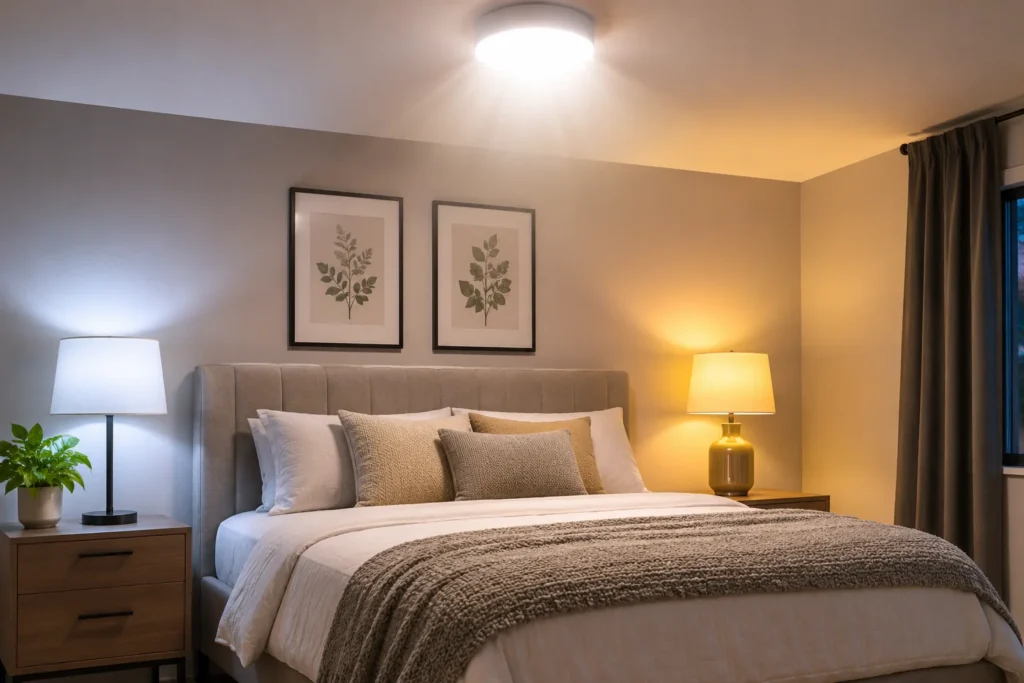
- Choosing bulbs by watts: Check lumen output before comparing brightness.
- Using one light source: Add separate fixtures for different activities.
- Ignoring glare: Select shades and diffusers that shield exposed bulbs.
- Mixing incompatible dimmers: Confirm LED dimming compatibility before installation.
- Ignoring room finishes: Account for dark walls and light-absorbing materials.
- Overlighting the room: Provide flexibility instead of keeping every fixture at maximum output.
- Neglecting task lighting: Illuminate books and dressing areas directly.
Remember to use the correct bulb base and voltage for your region. Consult a qualified electrician when installing new circuits, hardwired fixtures, or wall dimmers.
Recommended Light Bulbs for Bedroom Lighting
If you’re upgrading your bedroom lighting, these three products offer different ways to control brightness and improve everyday comfort.
Affiliate disclosure: As an Amazon Associate, we earn from qualifying purchases. Product selections are based on published specifications and intended use, not hands-on testing. Star scores represent editorial suitability assessments, not Amazon customer ratings.
🏆 Best for warm dimming
Philips Warm Glow A19 LED Bulb
★★★★☆ 4.5/5
Provides approximately 800 lumens with warm dimming between 2700K and 2200K. I’d choose this bulb for compatible dimmable bedside or ceiling fixtures.
💰 Best for everyday lighting
GE Relax HD A19 Soft White LED
★★★★☆ 4.2/5
The 60-watt replacement version offers approximately 800 lumens and a 2700K warm appearance. I’d consider it for straightforward general bedroom lighting without smart controls.
📱 Best for smart lighting
Philips Hue Essential A19 Smart Bulb
★★★★☆ 4.4/5
Offers up to 800 lumens with adjustable white tones and color lighting. I’d recommend it for bedrooms that benefit from scheduled brightness changes and personalized lighting scenes.
Check the manufacturer’s specifications before purchasing, particularly bulb bases, maximum brightness, control requirements, and dimmer compatibility. The Philips Hue website provides additional information about its smart lighting range.
Frequently Asked Questions
Is 800 lumens bright enough for a bedroom?
An 800-lumen bulb is suitable for many bedside lamps and may provide soft ambient lighting in a small bedroom. Most medium or large bedrooms benefit from additional light sources for even illumination, dressing, and other daily activities.
Is 2,000 lumens too bright for a bedroom?
Two thousand lumens is not necessarily too bright for a bedroom. It can provide useful general illumination in a small or medium room, especially when distributed across several fixtures. Dimming helps reduce brightness during evening relaxation.
Should bedroom lights be 2700K or 3000K?
Choose 2700K for a softer, warmer bedroom atmosphere or 3000K for a slightly more neutral warm appearance. Both options work well for residential bedrooms, and dimmable fixtures provide additional flexibility for nighttime use.
How many lumens are needed for a 12 × 12 bedroom?
A 12 × 12-foot bedroom can start with approximately 2,200–3,600 lumens of combined installed lighting. The exact amount depends on ceiling height, wall colors, fixture efficiency, and personal preferences. Separate task lights help illuminate reading and dressing areas.
Is warm or cool light better for a bedroom?
Warm light generally works better for relaxation and evening bedroom activities. Neutral or cooler light may suit daytime work and detailed tasks, but its brightness and timing should be considered before bedtime. Adjustable lighting offers the most flexibility.
Final Verdict: How Bright Should a Bedroom Light Be?
The ideal bedroom light brightness balances everyday visibility with a comfortable atmosphere. Start with approximately 100–150 lux for general activities and reduce illumination when relaxing.
Choose warm white bulbs, distribute lighting across multiple fixtures, and provide focused light for reading. Adjustable brightness makes a bedroom more functional without sacrificing comfort.
My recommendation: Measure your bedroom, estimate the necessary lumen output, and invest in independently controlled lighting. Start with the main ceiling fixture and bedside lamps before adding decorative accent lights.
With the right combination of brightness, placement, and color temperature, your bedroom can feel welcoming during the day and peaceful at night.