

Quick Answer
The best pendant light ideas for bedrooms include matching bedside pendants, frosted glass globes, woven bamboo shades, minimalist hanging lights, and dimmable central fixtures. Choose warm white bulbs between 2700K and 3000K, adjust hanging heights to suit your furniture, and combine pendants with other bedroom lighting solutions for a comfortable atmosphere.
Best bedroom pendant lighting ideas:
- Matching bedside pendants: Free up nightstand space while creating a balanced bedroom layout.
- Frosted glass globes: Diffuse light and complement contemporary interiors.
- Natural woven shades: Introduce texture and warmth into neutral bedrooms.
- Minimalist hanging lights: Reduce visual clutter in compact spaces.
- Dimmable central pendants: Provide adjustable illumination throughout the day.
- Plug-in pendant lights: Offer flexible placement without installing a new hardwired connection.
Quick placement tip:
- Start with bedside pendant shades around 18–24 inches above the nightstand, then adjust for reading comfort and glare. Maintain approximately 7 feet of clearance beneath fixtures in walking areas.
Looking for pendant light ideas for bedrooms that feel stylish without sacrificing comfort? I like to approach bedroom lighting as a combination of practical illumination, visual balance, and atmosphere.
This 2026 guide covers 15 pendant lighting designs, placement techniques, hanging heights, bulb choices, and common decorating mistakes.
What Is a Pendant Light for a Bedroom?
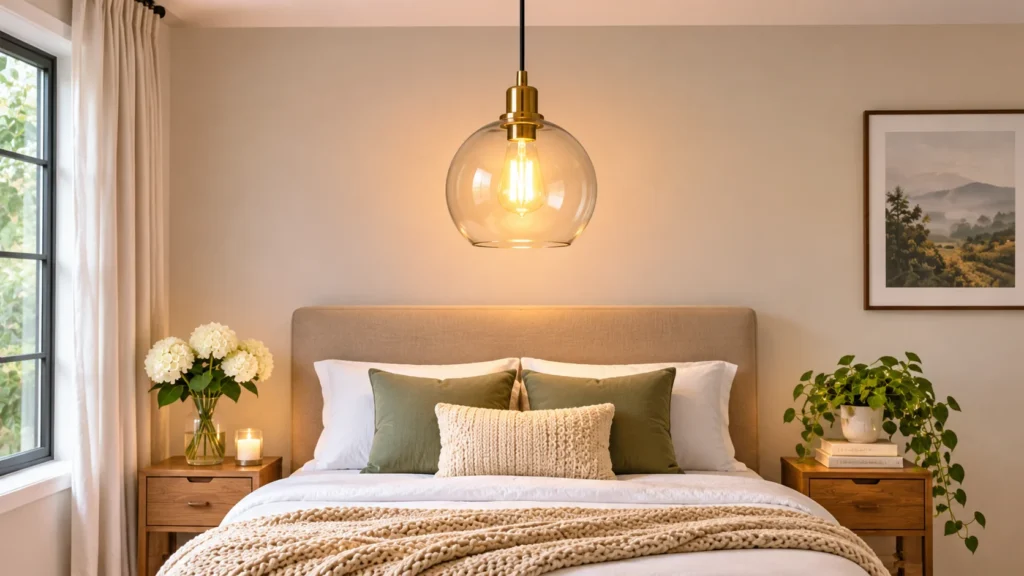
A bedroom pendant light is a lighting fixture suspended from the ceiling using a cord, chain, or metal rod. It can provide general room illumination, focused bedside lighting, or decorative accent lighting.
Unlike a traditional table lamp, a pendant doesn’t need to occupy furniture space. That makes hanging lights especially useful in bedrooms with narrow nightstands.
Why Use Pendant Lights in a Bedroom?
- Space saving: Keep bedside tables available for books, phones, and other essentials.
- Decorative appeal: Create an interesting focal point above furniture.
- Flexible positioning: Direct light toward reading areas or dressing spaces.
- Layered illumination: Combine hanging lights with other fixtures.
- Visual balance: Frame the bed with matching fixtures.
- Personal style: Introduce different materials, shapes, and finishes.
15 Best Pendant Light Ideas for Bedrooms
1. Matching Bedside Pendant Lights
Hang identical pendant lights on either side of the bed to create a symmetrical arrangement. This works particularly well with upholstered headboards and matching nightstands.
Choose shades that direct light toward the bedside surface without exposing the bulb directly to your eyes.
- Best for: Couples and master bedrooms.
- Recommended finish: Brass, matte black, or white.
- Suggested bulb color: 2700K warm white.
2. Woven Rattan and Bamboo Pendant Lights
Natural woven pendant shades introduce texture without requiring bold colors. Their organic appearance complements wooden furniture, linen bedding, and neutral walls.
Open-weave designs can cast decorative shadows, so consider a frosted bulb when visual comfort matters.
- Best for: Bohemian and coastal bedrooms.
- Pair with: Natural rugs and light wood furniture.
- Lighting effect: Warm, patterned ambient light.
3. Frosted Glass Globe Pendants
Frosted glass globe pendants create a simple, rounded focal point while softening the appearance of the bulb. They suit bedrooms with contemporary or mid-century furniture.
I would choose an opal glass shade over clear glass when reducing visible glare is the main priority.
- Best for: Modern and mid-century bedrooms.
- Recommended finish: Brass or brushed nickel.
- Lighting effect: Diffused illumination.
4. Minimalist Black Pendant Lights
Matte black pendants provide contrast against cream, white, and pale gray walls. Slim cords and uncomplicated shades keep the arrangement visually clean.
Metal shades often concentrate light downward, making them useful for bedside reading when properly positioned.
- Best for: Minimalist and industrial bedrooms.
- Pair with: Black furniture handles and simple bedding.
- Lighting effect: Focused downward illumination.
5. Oversized Central Pendant Lights
A large pendant can become the main decorative feature in a spacious bedroom. Fabric drums, sculptural shades, and broad woven fixtures work well in rooms with generous ceiling height.
Check the fixture diameter and overall hanging length before buying. An oversized shade can overwhelm a compact room.
- Best for: Large master bedrooms.
- Suggested shade diameter: Around 18–24 inches as a starting point.
- Important consideration: Walking clearance and ceiling strength.
6. Scandinavian Paper Lantern Pendants
Paper lantern pendants introduce soft shapes and a lightweight appearance. Their understated design works with Scandinavian furniture and neutral bedroom palettes.
Choose an appropriate LED bulb and follow the fixture’s maximum wattage and clearance instructions.
- Best for: Scandinavian and Japandi bedrooms.
- Recommended colors: White, ivory, or cream.
- Lighting effect: Soft ambient illumination.
7. Brass and Gold Hanging Lights
Brass pendant fixtures add warmth and sophistication to a bedroom without requiring extensive decorative accessories. They pair naturally with dark green, navy, cream, and dusty pink interiors.
Brushed brass offers a more understated appearance than highly polished gold finishes.
- Best for: Elegant and contemporary bedrooms.
- Pair with: Brass mirrors and furniture hardware.
- Lighting effect: Decorative or focused, depending on shade design.
8. Cluster Pendant Lighting
Cluster pendants combine several hanging lights into one decorative arrangement. Different cord lengths introduce depth and movement into the space.
Use this arrangement above a protected furniture area rather than a busy walking route.
- Best for: High-ceiling bedrooms.
- Recommended arrangement: Three coordinated shades.
- Important consideration: Combined brightness and fixture weight.
9. Adjustable Cord Bedside Pendants
Adjustable cord pendants let you customize the hanging height during installation. Some designs also allow later adjustment through a suitable pulley or repositioning system.
This flexibility is helpful when your mattress, headboard, or bedside table changes.
- Best for: Flexible furniture arrangements.
- Recommended shade: Adjustable or downward-facing design.
- Lighting effect: Practical bedside task lighting.
10. Fabric Drum Pendant Lights
Fabric drum shades create a softer appearance than exposed metal fixtures. Linen and cotton textures can complement bedding, curtains, and upholstered furniture.
A bottom diffuser helps conceal the bulb when you look upward from the bed.
- Best for: Traditional and transitional bedrooms.
- Recommended colors: Beige, ivory, or light gray.
- Lighting effect: Broad, softened illumination.
11. Vintage Industrial Pendant Lights
Industrial pendants combine simple metal shades with vintage-inspired detailing. They suit exposed brick, wooden furniture, and darker bedroom color schemes.
A warm LED filament bulb can preserve the vintage appearance while using less energy than traditional incandescent lighting.
- Best for: Rustic and industrial bedrooms.
- Recommended finish: Black, bronze, or aged copper.
- Important consideration: Glare from exposed bulbs.
12. Plug-In Pendant Lights for Renters
Plug-in pendant lights connect to a standard electrical outlet instead of requiring a new hardwired ceiling connection. They can offer a practical option for rental apartments.
Use approved mounting hardware, secure the cord appropriately, and obtain permission before modifying walls or ceilings.
- Best for: Renters and temporary decorating projects.
- Useful feature: Accessible inline switch.
- Installation consideration: Safe cord routing.
13. Dimmable Pendant Lights
Dimmable pendants allow you to change the room’s brightness according to your activities. Brighter settings help with everyday tasks, while lower settings create a calmer evening atmosphere.
Make sure the LED bulb, fixture, driver, and dimmer are compatible before installation.
- Best for: Multipurpose bedrooms.
- Recommended color temperature: 2700K–3000K.
- Useful feature: Independent bedside lighting controls.
14. Asymmetrical Bedside Pendant Arrangements
Asymmetrical pendant arrangements create visual interest by placing different fixtures or lighting types on opposite sides of the bed. One side might use a pendant while the other uses a table lamp.
Maintain similar visual weight through coordinated materials, colors, or shade sizes.
- Best for: Eclectic and contemporary bedrooms.
- Pair with: Mismatched bedside tables.
- Design priority: Functional and visual balance.
15. Sculptural Designer Pendant Lights
Sculptural pendants feature unusual shapes, curved forms, or artistic materials. They can serve as decorative centerpieces even when switched off.
Keep surrounding furniture and accessories relatively simple so the fixture becomes the primary focal point.
- Best for: Contemporary luxury bedrooms.
- Recommended materials: Glass, ceramic, or sculpted metal.
- Important consideration: Cleaning and maintenance requirements.
Which Pendant Light Style Is Best for Your Bedroom?
The right pendant style depends on your room size, decorating preferences, and intended lighting function. Use the following comparison as a practical starting point.
| Pendant style | Best bedroom style | Light distribution | Suggested shade width* |
|---|---|---|---|
| Glass globe | Modern | Diffused | 6–12 inches |
| Woven bamboo | Bohemian | Patterned ambient | 12–24 inches |
| Metal cone | Industrial | Directional | 6–10 inches |
| Fabric drum | Traditional | Soft ambient | 14–24 inches |
| Paper lantern | Scandinavian | Soft diffused | 12–20 inches |
| Cluster pendant | Luxury modern | Multiple directions | Varies by arrangement |
*Shade widths are illustrative design suggestions, not mandatory installation standards. Adjust them according to furniture dimensions and available clearance.
Where Should Pendant Lights Be Placed in a Bedroom?
Bedroom pendant lights work well above nightstands, near reading chairs, over dressing areas, or centrally beneath sufficiently high ceilings. Their placement should support the activity happening underneath.
Above Bedside Tables
Position each pendant near the center of its nightstand. Check that the shade doesn’t extend into the main route beside the bed.
Our guide on choosing bedside lamps explains additional considerations for comfortable nighttime lighting.
In the Center of the Bedroom
A central pendant provides a decorative focal point and general illumination. Choose a compact fixture if the bedroom has a standard eight-foot ceiling.
Above a Reading Corner
A directional pendant can illuminate a reading chair without taking up floor space. Position it so your head and shoulders don’t block the light reaching your book.
Near a Dressing Area
A pendant can supplement dressing-area lighting, but overhead illumination alone may create facial shadows. Combine it with suitable mirror lighting for better visibility.
How High Should Bedroom Pendant Lights Hang?
Bedside pendant shades can often start around 18–24 inches above the nightstand. In walking areas, aim for at least seven feet of clearance where possible and follow applicable building requirements.
| Location | Starting height |
|---|---|
| Bedside table | 18–24 inches above tabletop |
| Central walking area | At least 84 inches above floor where feasible |
| Dressing area | Maintain adequate standing and walking clearance |
| Reading chair | Adjust for seated eye level, glare, and head clearance |
Practical example: With a 24-inch nightstand and a 22-inch hanging gap, the shade’s bottom sits 46 inches above the floor.
I would mark that height with removable tape before installation. Check the position while sitting upright in bed and reaching for items on the nightstand.
What Is the Best Pendant Light Size for a Bedroom?
Bedroom pendant size should complement your furniture and ceiling height. Small bedside shades generally work better beside narrow nightstands, while larger central fixtures suit spacious rooms.
- Small bedside pendant: Start with a shade approximately 6–10 inches wide.
- Medium bedside pendant: Consider a 10–14-inch shade for wider tables.
- Central bedroom pendant: Explore 14–24-inch designs according to room proportions.
- Large statement pendant: Consider wider fixtures only when ceiling height and available space allow.
Measure both the shade and its complete hanging assembly. A compact shade can still hang too low if the canopy, rod, or cord is unusually long.
What Color Temperature Is Best for Bedroom Pendant Lights?
Warm white lighting between 2700K and 3000K is a useful choice for most bedrooms. Kelvin, abbreviated K, describes how warm or cool the light appears.
- 2200K–2700K: Extra-warm illumination for relaxed evening settings.
- 2700K–3000K: Comfortable warm white light for everyday bedroom use.
- 3000K–3500K: A more neutral appearance for selected tasks.
- 4000K and above: Cooler light that may feel less relaxing during the evening.
The U.S. Department of Energy’s Energy Saver resource provides information about efficient household lighting and LED technology.
Keep brightness low before bedtime when practical. Warm color temperature alone doesn’t guarantee that a light will be comfortable or suitable for nighttime use.
How Bright Should Bedroom Pendant Lights Be?
Bedside pendant lights can use approximately 250–500 lumens as an initial bulb selection range. Central pendants may need higher output, depending on room dimensions and supplemental lighting.
- Decorative accent pendant: Approximately 150–300 lumens.
- Bedside pendant: Approximately 250–500 lumens.
- Reading pendant: Approximately 450–800 lumens with suitable directional control.
- Central ambient pendant: Approximately 800–1600 lumens as part of a layered lighting scheme.
These ranges are starting estimates rather than fixed room-lighting requirements. Shade opacity, fixture efficiency, wall colors, and distance affect usable brightness.
Visit Energy Star for additional information about energy-efficient lighting products.
Are Pendant Lights Good for Small Bedrooms?
Yes, pendant lights can work particularly well in small bedrooms because they preserve bedside furniture space. Compact shades and short hanging assemblies prevent the room from feeling overcrowded.
Choose fixtures that remain proportional to the bed and nightstands rather than selecting the largest available design.
Small Bedroom Pendant Lighting Tips
- Choose compact globe or cone-shaped shades.
- Use light-colored materials to reduce visual heaviness.
- Keep hanging fixtures away from narrow walking routes.
- Consider shallow or semi-flush fixtures for low ceilings.
- Use independently controlled bedside lights.
- Combine pendants with other light sources when necessary.
For more ways to create a welcoming compact space, explore these tips on making a bedroom feel cozy.
How to Combine Pendant Lights With Other Bedroom Lighting
A well-designed bedroom uses several light sources rather than relying entirely on one ceiling fixture. This approach is called layered lighting.
- Ambient lighting: Provides general room illumination through ceiling fixtures or indirect lamps.
- Task lighting: Illuminates specific activities such as reading or dressing.
- Accent lighting: Highlights artwork, textures, or architectural features.
For example, a central fabric pendant can provide ambient light while two bedside pendants support reading. A small accent lamp can soften a darker corner.
Use separate lighting controls wherever practical so you can change the room’s atmosphere throughout the day.
Common Bedroom Pendant Lighting Mistakes to Avoid
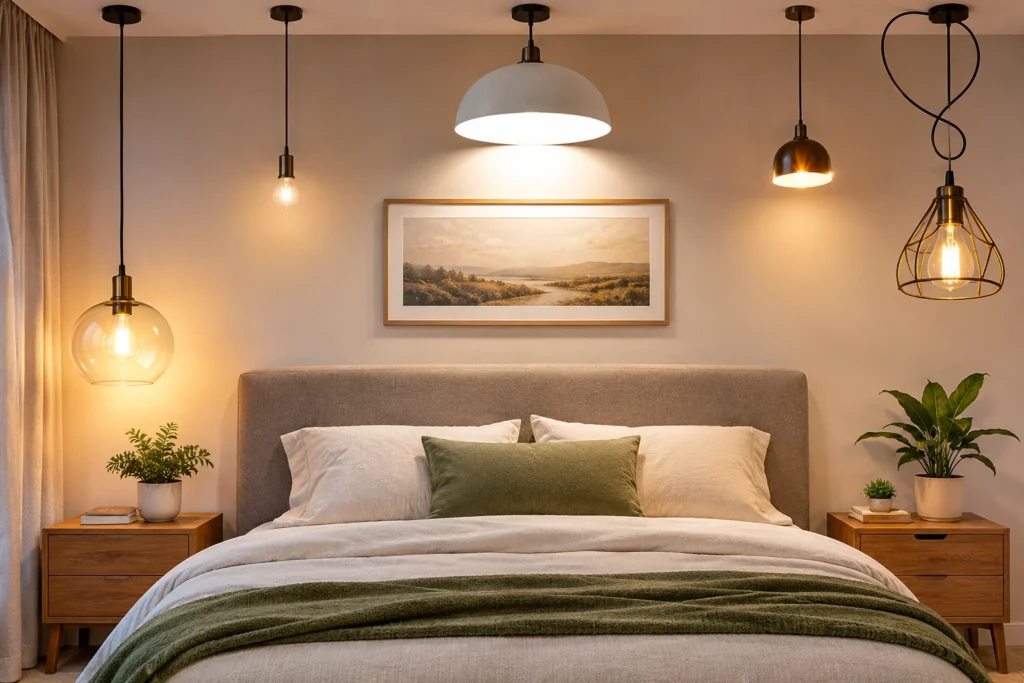
- Hanging fixtures too low: Poor clearance increases the risk of bumping into shades.
- Choosing oversized pendants: Large fixtures can dominate smaller bedrooms.
- Exposing bright bulbs: Unshielded bulbs can cause uncomfortable glare.
- Ignoring furniture dimensions: Measure nightstands and mattress heights before choosing cord lengths.
- Using incompatible dimmers: Incorrect combinations may cause flickering or unreliable operation.
- Relying on one fixture: A single pendant may leave reading areas and corners underlit.
- Overlooking switch placement: Make sure bedside controls remain convenient.
- Ignoring electrical safety: Check fixture ratings and use appropriate ceiling support.
Consult a qualified electrician for new hardwired installations. The Electrical Safety Foundation International offers useful household electrical safety information.
Best Pendant Light Products for Bedrooms
If you’re ready to select a fixture, these three pendant designs offer different approaches to bedroom lighting. Compare their dimensions, bulb requirements, and installation instructions before ordering.
Affiliate disclosure: As an Amazon Associate, we earn from qualifying purchases. The following selections are based on design suitability, not hands-on product testing.
🌿 Best natural style
IKEA SINNERLIG Bamboo Pendant Lamp
Features a handmade woven bamboo shade with an organic appearance and decorative light patterns. I would consider this design for a warm bedroom with natural wood and linen furnishings.
💡 Best minimalist style
IKEA SKURUP Pendant Lamp
A metal pendant design with a clean industrial appearance and downward-directed lighting. I would consider a compact version for focused bedside lighting with a modern finish.
🏮 Best decorative statement
IKEA PS 2014 Pendant Lamp
A distinctive adjustable shade design that changes its appearance and light distribution. I would reserve it for a bedroom with enough ceiling space to accommodate a sculptural centerpiece.
Confirm current model specifications and availability through the official IKEA website before purchasing.
Frequently Asked Questions
Are pendant lights suitable for bedrooms?
Yes, pendant lights are suitable for bedrooms when their size, brightness, and hanging height match the room. They provide decorative appeal and can replace bedside table lamps. Choose shielded or diffused designs to reduce glare and maintain safe clearance around furniture and walking areas.
Can pendant lights replace bedside table lamps?
Pendant lights can replace bedside table lamps if they provide enough focused illumination and have convenient switches. They are especially useful when nightstand space is limited. Position the shade to illuminate reading materials without shining directly into your eyes.
How many pendant lights should a bedroom have?
Many bedrooms work well with two bedside pendants or one central pendant supported by separate task lighting. Larger rooms may benefit from additional fixtures. The appropriate number depends on room dimensions, bulb output, furniture arrangement, and how you use the space.
Can you install pendant lights in a bedroom with a low ceiling?
Yes, compact pendant lights can work above nightstands or other protected furniture areas in low-ceiling bedrooms. Avoid long hanging fixtures in walking routes. A semi-flush ceiling fixture may provide better central illumination when there isn’t enough overhead clearance for a pendant.
Are warm or cool pendant lights better for bedrooms?
Warm white pendant lights around 2700K–3000K are generally more suitable for a comfortable bedroom atmosphere. Cooler lighting may support certain daytime tasks, but it can feel harsh during evening relaxation. Dimmable warm lighting offers greater flexibility for reading and preparing for sleep.
Final Thoughts: Choose Pendant Lights That Suit Your Bedroom
The best pendant light ideas for bedrooms combine comfortable illumination, appropriate proportions, and personal decorating style. Matching bedside pendants offer practical space savings, while woven shades and glass globes create different visual effects.
Start by measuring your furniture, ceiling height, and available walking clearance. Then select a fixture with suitable brightness, shade size, and accessible controls.
Explore our guide on creating a relaxing bedroom for more ways to combine lighting, furniture, and decor into a comfortable personal retreat.
Choose lighting that looks beautiful during the day and feels comfortable when you’re ready to unwind at night.