

Quick Answer
To hang bedroom curtains correctly, position the curtain rod 4–6 inches above the window frame and extend it 6–12 inches beyond each side where space allows. Choose curtains with a combined width approximately 1.5–2 times the usable rod width. Follow proper curtain installation techniques to create a balanced, secure, and attractive window treatment.
How to hang bedroom curtains in six quick steps:
- Measure the window: Record the window width, available wall space, and desired curtain length.
- Choose rod placement: Position the rod above and beyond the window frame for better proportions.
- Select curtain panels: Choose enough fabric to create attractive folds when closed.
- Install the brackets: Use a level, suitable screws, and wall-specific fixings.
- Hang the curtains: Attach the panels using grommets, rings, hooks, or rod pockets.
- Adjust the finish: Check the hem height, fabric folds, and ease of opening.
Best bedroom curtain hanging tip:
- For a clean, elegant bedroom, aim for curtains that finish approximately half an inch above the floor.
Knowing how to hang bedroom curtains can completely change the appearance of your sleeping space. Even affordable curtains can look expensive when you get the measurements and placement right.
In this 2026 guide, I’ll walk you through the installation process, common mistakes, and practical solutions for different bedroom layouts.
What Does Hanging Bedroom Curtains Involve?

Hanging bedroom curtains involves installing window covering hardware and positioning fabric panels to improve privacy, light control, and room appearance. The process includes measuring, mounting, attaching, and adjusting the curtains.
I recommend treating curtain installation as part of your bedroom design rather than simply covering a window. Small adjustments in rod height can noticeably change the room’s proportions.
A properly installed curtain arrangement should achieve four main goals:
- Privacy: Prevent unwanted views into the bedroom.
- Light control: Reduce sunlight when you need to rest.
- Visual balance: Complement the window and surrounding furniture.
- Functionality: Allow smooth opening and closing.
What Tools Do You Need to Hang Bedroom Curtains?
You need basic measuring and installation tools to hang most bedroom curtains. The exact hardware depends on your wall material and curtain weight.
- Tape measure
- Pencil
- Spirit level
- Electric drill and suitable drill bits
- Screwdriver
- Stud finder for framed walls
- Curtain rod and mounting brackets
- Suitable screws and wall anchors
- Stable step ladder
- Curtain panels, rings, or hooks
Check the curtain rod manufacturer’s instructions before selecting your fasteners. Plasterboard, timber, brick, and concrete require different installation methods.
How to Hang Bedroom Curtains Step by Step
The best way to hang bedroom curtains is to plan the measurements before drilling any holes. These 12 steps cover everything from choosing hardware to arranging the finished fabric.
1. Measure Your Bedroom Window
Start by measuring the outside width of the window frame. Next, check the available wall space above and beside it.
Record these important measurements:
- Outside window frame width.
- Window frame height.
- Distance between the window and ceiling.
- Distance from the planned curtain hanging point to the floor.
- Available wall space on both sides.
- Clearance around furniture and radiators.
Measure both sides of the window vertically because floors and ceilings aren’t always perfectly level. Use the shorter floor clearance when you want to prevent fabric from dragging.
2. Choose the Correct Curtain Rod Height
Position your curtain rod approximately 4–6 inches above the window frame as a starting point. Higher mounting can create the impression of taller walls.
For bedrooms with low ceilings, consider positioning the rod closer to the ceiling. Leave enough clearance for the brackets and decorative rod ends.
I prefer a consistent rod height across multiple windows in the same bedroom. It creates a more intentional appearance.
3. Extend the Rod Beyond the Window
A curtain rod should normally extend beyond both sides of the window frame. An extension of 6–12 inches per side works well in many bedrooms.
This extra space gives open curtain panels somewhere to gather without covering too much glass. It also makes the window appear wider.
Adjust the extension if nearby walls, wardrobes, or other furniture restrict your available space.
4. Calculate the Correct Curtain Width
Curtains need additional fabric to create soft folds instead of looking stretched across the window. Aim for a combined flat panel width around twice the usable rod width.
Use this simple calculation:
Total curtain width = usable rod width × desired fullness ratio.
For example, a 60-inch usable rod with a fullness ratio of 2 requires approximately 120 inches of total flat curtain width. Two 60-inch panels would provide that amount.
| Usable Rod Width | Fullness Ratio | Total Curtain Width |
|---|---|---|
| 48 inches | 2× | 96 inches |
| 60 inches | 2× | 120 inches |
| 72 inches | 2× | 144 inches |
| 84 inches | 2× | 168 inches |
| 96 inches | 2× | 192 inches |
These calculations apply to ordinary flat curtain panels. Pre-pleated curtains may use different sizing instructions.
5. Select the Right Curtain Length
Bedroom curtains generally look polished when they extend close to the floor. However, shorter curtains can work better around desks, radiators, and other obstacles.
Consider these curtain length styles:
- Sill length: Ends around the windowsill.
- Apron length: Extends several inches below the sill.
- Floating length: Finishes approximately half an inch above the floor.
- Floor length: Reaches or gently touches the floor.
- Puddle length: Uses extra fabric that gathers on the floor.
Common ready-made curtain lengths in the United States include 63, 84, 96, and 108 inches. Choose the closest suitable size after measuring your actual hanging point.
6. Choose a Suitable Curtain Rod
Your curtain rod must support the combined weight of the fabric and hanging accessories. Heavy blackout curtains require suitable hardware and secure mounting.
- Single rod: Suitable for one curtain layer.
- Double rod: Allows separate sheer and opaque curtain layers.
- Tension rod: Useful for compatible window recesses and lightweight curtains.
- Ceiling track: Creates a streamlined ceiling-to-floor arrangement.
- Wraparound rod: Helps reduce light entering around curtain edges.
Review the manufacturer’s curtain rod installation guidance before choosing your hardware.
7. Mark the Bracket Positions
Hold each bracket against the wall and mark its screw holes with a pencil. Check that both brackets sit on the same horizontal line.
Use a spirit level rather than relying on the ceiling or window trim. These surfaces may not be perfectly straight.
- Confirm that both brackets have adequate support.
- Check the placement of the center bracket, if required.
- Allow space for decorative rod ends.
- Locate potential concealed wiring and pipes before drilling.
Double-check every mark before making permanent holes. Moving a misplaced bracket later creates unnecessary wall repairs.
8. Install the Curtain Rod Brackets
Drill pilot holes according to the fastener and wall material. Secure the brackets using compatible screws or anchors.
Where possible, attach brackets directly to suitable structural timber or another appropriate solid mounting surface. Use correctly rated anchors when direct structural attachment isn’t available.
Safety tip: Never assume the supplied anchors suit every wall. Follow the hardware manufacturer’s load limits, and consult a qualified installer if you cannot identify a safe mounting location.
9. Attach the Curtain Panels
Prepare the fabric before placing the rod on its brackets. Remove one finial if your curtains slide directly onto the rod.
Different curtain headings require different attachment methods:
- Grommet curtains: Feed the rod through the metal eyelets.
- Rod pocket curtains: Slide the rod through the sewn fabric pocket.
- Tab-top curtains: Thread the rod through the fabric loops.
- Ring-top curtains: Attach compatible rings or clips.
- Pinch-pleat curtains: Connect curtain hooks to rings or track carriers.
Keep the hanging points evenly spaced. Uneven spacing can create irregular folds and prevent smooth movement.
10. Place the Rod on the Brackets
Lift the loaded curtain rod carefully onto its mounting brackets. Install the center support and tighten any retaining screws as directed.
Replace the decorative finials after positioning the curtains. Ask someone to help when installing long rods or heavy curtain panels.
11. Adjust the Curtain Folds
Spread the fabric evenly across the rod and arrange the folds by hand. Open and close the curtains several times to check their movement.
Remove wrinkles with a suitable garment steamer if the fabric care instructions allow it. Keep hot steam away from heat-sensitive coatings and delicate materials.
Consistent folds can make simple ready-made curtains look more tailored.
12. Check Privacy and Light Control
Close the curtains during daylight and inspect the edges, center, and top for unwanted light. Make adjustments wherever practical.
Check bedroom privacy after dark as well. Indoor lighting can make some sheer fabrics less private than they appear during daytime.
- Increase center overlap if panels leave a gap.
- Use suitable wraparound hardware for side coverage.
- Add a separate blackout layer when necessary.
- Check that the fabric clears heaters and other obstacles.
Which Bedroom Curtain Hanging Method Is Best?
The best hanging method depends on your preferred appearance, curtain weight, and how often you open the panels. Grommets and rings generally suit everyday use, while pleated curtains offer a more tailored finish.
| Method | Movement | Best For |
|---|---|---|
| Grommet | Generally easy | Modern bedrooms |
| Rod pocket | More resistance | Decorative panels |
| Curtain rings | Generally smooth | Frequent daily use |
| Pinch pleat | Smooth with suitable hardware | Elegant bedrooms |
| Ceiling track | Smooth with suitable carriers | Minimalist interiors |
| Tension rod | Depends on heading | Lightweight rental curtains |
For a bedroom where curtains open every morning and close every evening, I’d prioritize smooth movement over decorative complexity.
How High Should You Hang Bedroom Curtains?
Hang bedroom curtains at least several inches above the window frame where the room allows. A position 4–6 inches above the frame is a useful starting point rather than a fixed requirement.
Higher mounting works especially well with long curtain panels. A ceiling-mounted track can create an uninterrupted vertical line.
Explore the IKEA curtain measuring guide for additional window treatment planning advice.
How to Hang Bedroom Curtains Without Drilling
You can hang bedroom curtains without drilling by using a suitable tension rod, adhesive mounting system, or compatible no-drill window-frame brackets.
These methods work best when the curtain weight and mounting surface meet the manufacturer’s requirements.
- Tension rods: Fit between two suitable opposing surfaces.
- Adhesive brackets: Attach to approved smooth surfaces.
- No-drill frame brackets: Connect to compatible window trim.
- Magnetic rods: Attach to suitable magnetic metal surfaces.
For heavy floor-length curtains, I would generally choose securely fastened brackets instead of relying on lightweight adhesive hooks.
How to Hang Blackout Curtains in a Bedroom
Hang blackout curtains with sufficient coverage around the entire window to minimize incoming light. A wraparound rod can help reduce gaps along the sides.
Blackout fabric alone doesn’t guarantee a completely dark bedroom. Light may still enter around the curtain edges or through the center opening.
- Choose panels wider than the opening.
- Extend the curtain rod beyond the frame.
- Allow sufficient overlap between closed panels.
- Use suitable blackout-lined fabric.
- Install brackets rated for the curtain weight.
- Consider combining blackout curtains with blinds.
Window coverings can also influence heat transfer. The U.S. Department of Energy’s window covering guidance explains how different treatments can improve household energy efficiency.
How to Hang Curtains in a Small Bedroom
In a small bedroom, mount curtains higher and wider when the available wall space permits. Long, simple panels can create an impression of greater height.
Avoid excessive fabric pooling when floor space is limited. It makes cleaning more difficult and can interfere with furniture.
- Choose simple curtain headings.
- Use light or coordinated fabric colors.
- Keep curtain rods visually unobtrusive.
- Choose floating floor-length hems.
- Avoid blocking wardrobe doors and walkways.
- Use a ceiling track when appropriate.
A well-planned curtain arrangement should make a small bedroom feel more open without sacrificing privacy.
Common Bedroom Curtain Hanging Mistakes to Avoid
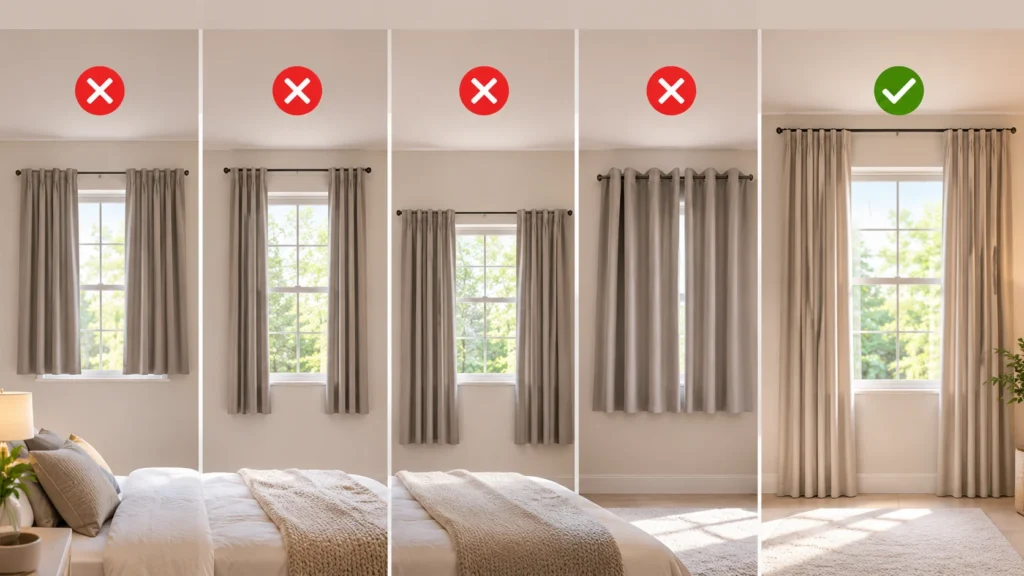
Most curtain installation problems come from incorrect measurements, insufficient fabric, or unsuitable hardware. You can prevent many of them before purchasing the curtains.
- Mounting too low: Can make the window and bedroom appear shorter.
- Using narrow rods: Prevents open panels from clearing the glass.
- Buying insufficient fabric: Produces flat, stretched-looking curtains.
- Ignoring curtain weight: Can overload brackets or mounting anchors.
- Skipping center supports: May cause long rods to bend or sag.
- Choosing incorrect lengths: Leaves awkward gaps or excessive fabric on the floor.
- Ignoring fabric care: Can damage curtain materials during steaming or washing.
- Blocking heaters: Can interfere with heating and create safety concerns.
My preferred measurement approach is to finalize the hardware position before purchasing the curtain panels. That removes much of the uncertainty around finished hem height.
Best Products for Hanging Bedroom Curtains
The right curtain hardware makes installation easier and improves daily usability. Here are three options worth considering for different bedroom arrangements.
Affiliate disclosure: As an Amazon Associate, we earn from qualifying purchases. The scores below are editorial suitability assessments, not verified customer ratings or hands-on test results.
🏆 Best for everyday curtains
Umbra Cappa Adjustable Curtain Rod
★★★★☆ 4.5/5 editorial score
This adjustable rod offers a simple decorative finish and several size options. I’d consider it for conventional bedroom curtain installations with suitable wall support.
🌙 Best for blackout curtains
Umbra Twilight Blackout Curtain Rod
★★★★☆ 4.4/5 editorial score
The curved ends allow compatible curtains to return toward the wall. I’d choose this design when reducing side light gaps is a priority.
🪟 Best for layered curtains
Umbra Cappa Double Curtain Rod
★★★★☆ 4.3/5 editorial score
The two adjustable rods accommodate separate curtain layers. I recommend this arrangement for combining daytime sheers with heavier privacy curtains.
Frequently Asked Questions
Should bedroom curtains touch the floor?
Bedroom curtains can touch the floor, but finishing approximately half an inch above it offers a practical balance between appearance and maintenance. Floor-touching curtains create a softer appearance, while puddled curtains require more cleaning and may interfere with nearby furniture.
How far above a window should bedroom curtains hang?
A curtain rod positioned 4–6 inches above the window frame works well in many bedrooms. You can mount it higher to create the impression of taller ceilings, provided there is enough room for the brackets, curtain headings, and correctly sized panels.
How wide should bedroom curtains be?
The combined flat width of standard bedroom curtain panels should generally measure around 1.5–2 times the usable curtain rod width. A fullness ratio of two creates attractive folds for many curtain styles. Follow different sizing instructions when purchasing pre-pleated curtains.
Can I hang bedroom curtains without a curtain rod?
Yes, you can use a compatible ceiling track, tension cable system, or appropriately rated curtain hanging hardware instead of a conventional rod. Ceiling tracks are particularly useful for modern bedrooms because they provide a discreet hanging system and support long curtain arrangements.
Why are my bedroom curtains not hanging evenly?
Uneven curtains may result from incorrectly positioned brackets, uneven floors, inconsistent hook spacing, or different panel lengths. Check the rod with a spirit level first. Then adjust the hanging accessories and inspect the curtain hems to identify the source of the problem.
Final Thoughts: How to Hang Bedroom Curtains Correctly
Learning how to hang bedroom curtains starts with accurate measurements and suitable hardware. Correct rod placement, sufficient fabric width, and a balanced hem length can improve the appearance of almost any bedroom.
For most bedrooms, I recommend hanging curtains above and beyond the window frame with enough fullness to create natural folds. Choose a hanging method that supports the fabric and makes everyday opening easy.
Ready to improve your bedroom? Measure your windows today, choose suitable curtain hardware, and create a comfortable, private, and beautifully finished sleeping space.