

Quick Answer
The best curtain length for most bedrooms is floor length, with the hem sitting approximately ½ inch above the floor. To choose the correct size, measure from your intended curtain hanging point to your preferred finishing point. Follow a reliable curtain measuring guide before purchasing standard 63-, 84-, 96-, 108-, or 120-inch panels.
Quick Steps to Choose Bedroom Curtain Length
- Measure your height: Determine the distance between the curtain hanging point and floor.
- Choose your style: Select sill, apron, floor, break, or puddle-length curtains.
- Check furniture placement: Consider beds, desks, radiators, and other obstacles.
- Allow floor clearance: Leave approximately ½ inch for practical everyday use.
- Check hanging hardware: Account for curtain rings, grommets, hooks, and tracks.
- Select panel length: Choose the closest suitable standard size or order custom curtains.
My Preferred Approach
- Choose floor-length panels: They offer an elegant appearance while remaining practical when correctly measured.
Choosing the wrong curtain length can make an otherwise beautiful bedroom feel unfinished. I prefer to approach curtain sizing as a balance between visual proportions, privacy, and everyday convenience.
In this guide, I’ll explain how to choose curtain length for a bedroom using practical measurements, styling examples, and simple design principles.
What Is Bedroom Curtain Length?
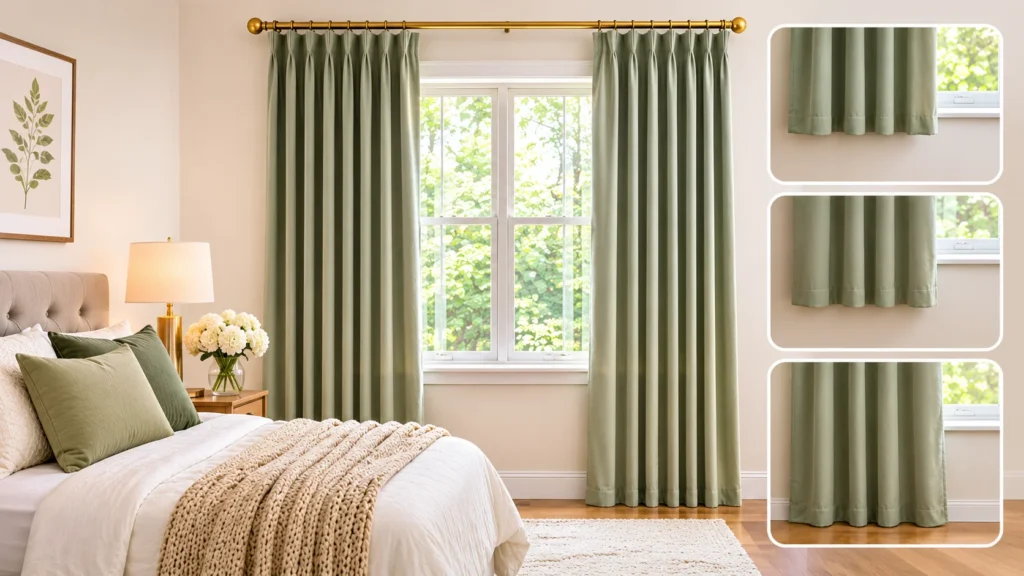
Bedroom curtain length is the vertical measurement of a curtain panel from its upper edge to its bottom hem. Its installed position determines where the fabric finishes relative to the window or floor.
Understanding this distinction matters because curtain rings, hooks, and grommets can change how a panel hangs. Two curtains with identical advertised lengths may finish at different heights.
Common Types of Bedroom Curtain Length
- Sill length: Finishes at or slightly above the windowsill.
- Apron length: Extends approximately 4 to 6 inches below the sill.
- Floating floor length: Stops approximately ½ inch above the floor.
- Floor-kissing length: Barely touches the floor without gathering.
- Break length: Adds approximately 1 to 2 inches of fabric at floor level.
- Puddle length: Creates decorative fabric folds on the floor.
Each length creates a different visual effect. Your ideal choice depends on bedroom dimensions, furniture placement, fabric type, and cleaning preferences.
What Are the Standard Curtain Lengths for Bedrooms?
Common ready-made curtain lengths in the United States include 63, 84, 96, 108, and 120 inches. Some manufacturers also offer 95-, 98-, or other intermediate lengths.
These measurements remain useful starting points in 2026. However, you should always measure your actual window treatment installation rather than rely solely on ceiling height.
| Length | Metric Size | Common Use |
|---|---|---|
| 63 inches | 160 cm | Short windows and furniture clearance |
| 84 inches | 213 cm | Lower curtain rod installations |
| 96 inches | 244 cm | Higher rods and floor-length styling |
| 108 inches | 274 cm | Tall ceilings and elevated rods |
| 120 inches | 305 cm | Extra-tall rooms and custom styling |
Metric measurements are rounded. Actual suitability depends on the installed hanging point and curtain heading.
How to Choose Curtain Length for a Bedroom: 12 Practical Tips
1. Measure From the Curtain Hanging Point
Start your measurement where the curtain fabric will hang, rather than automatically measuring from the top of the window frame. This gives you a more accurate finished length.
Use a rigid measuring tape instead of a flexible sewing tape for long vertical measurements. Keep it straight and measure down to your intended finishing point.
- Measure the left side of the window.
- Measure the center of the curtain installation.
- Measure the right side of the window.
- Record any differences in floor height.
- Account for your selected hanging hardware.
For floating curtains, use the shortest effective measurement when the floor is uneven. This helps prevent one side from dragging.
2. Choose Floor-Length Curtains for a Timeless Look
Floor-length curtains are my preferred starting point for most adult bedrooms. They create an uninterrupted vertical line that makes windows appear more elegant.
A hem positioned approximately ½ inch above the floor offers a practical balance. It provides the appearance of full-length curtains without excessive fabric touching the floor.
- Suitable for modern and traditional bedrooms.
- Visually extends the height of windows.
- Works with blackout and decorative fabrics.
- Allows easier sweeping and vacuuming than puddled curtains.
3. Match Curtain Length to Ceiling Height
Ceiling height influences how high you can install a curtain rod. Higher installations generally require longer panels.
A tall curtain can improve the proportions of a bedroom, especially when the window frame sits noticeably below the ceiling.
| Ceiling Height | Lengths to Consider |
|---|---|
| 8 feet | 84 or 96 inches |
| 9 feet | 96 or 108 inches |
| 10 feet | 108 or 120 inches |
| Above 10 feet | 120 inches or custom sizing |
These are shopping starting points rather than guaranteed fits. Confirm the actual rod-to-floor measurement before ordering.
4. Hang Curtains Higher to Make the Bedroom Look Taller
Installing the curtain rod above the window frame can make a bedroom appear taller. The additional fabric creates a stronger vertical line across the wall.
Consider mounting the rod approximately 4 to 6 inches above the window frame when space permits. A near-ceiling installation can create an even more dramatic effect.
- Use longer panels for higher mounting positions.
- Leave enough room for brackets and decorative finials.
- Keep curtain rods at consistent heights across nearby windows.
- Confirm that the wall can support the curtain hardware.
The Pottery Barn curtain buying guide provides useful guidance on window proportions and curtain installation.
5. Consider Furniture Beneath the Window
Not every bedroom has enough clearance for long curtains. Furniture beneath a window can make floor-length panels inconvenient.
Short curtains or alternative window treatments may work better when furniture prevents the fabric from hanging naturally.
- Bed beneath the window: Consider sill-length curtains or roller shades.
- Bedroom desk: Choose curtains that finish above the work surface.
- Window seat: Select short curtains or Roman shades.
- Dresser: Maintain sufficient clearance to prevent trapped fabric.
I would prioritize unrestricted access to furniture over a decorative floor-length effect.
6. Choose Short Curtains for Practical Window Areas
Sill-length and apron-length curtains are useful when floor-length treatments would interfere with daily activities. They also require less fabric and can simplify cleaning.
These styles work particularly well in compact bedrooms, rooms with built-in furniture, and windows positioned above desks.
- Finish at the sill for a neat, compact appearance.
- Extend several inches below the sill for added coverage.
- Keep hems clear of furniture and heating equipment.
Always follow the heating appliance manufacturer’s clearance requirements when installing curtains near radiators, heaters, or vents.
7. Use Puddle-Length Curtains for a Luxury Bedroom
Puddle-length curtains extend beyond floor level and form decorative folds. They create a relaxed, luxurious appearance that suits formal bedroom designs.
Heavy velvet and softly draping linen can work particularly well with this approach.
- Small break: Approximately 1 to 2 extra inches.
- Light puddle: Approximately 3 to 4 extra inches.
- Decorative puddle: Approximately 5 to 8 extra inches.
I would reserve substantial puddling for low-traffic bedrooms. Extra fabric collects dust and can interfere with cleaning or frequent curtain movement.
8. Account for Curtain Rings and Hanging Styles
Curtain heading styles influence the finished curtain position. Measure using the actual hardware rather than assuming every panel hangs from the same point.
- Grommet curtains: Fabric extends above and below the rod opening.
- Rod-pocket curtains: The pocket position determines the fabric’s upper edge.
- Tab-top curtains: Hanging loops influence the effective curtain drop.
- Pinch-pleat curtains: Hook placement affects the finished height.
- Clip-ring curtains: Rings and clips can lower the fabric beneath the rod.
- Ceiling-track curtains: Measure from the installed attachment position.
Check the manufacturer’s sizing instructions before choosing a panel. This small adjustment can prevent expensive measuring mistakes.
9. Select Curtain Length Based on Fabric Type
Curtain fabrics behave differently when hanging. Weight, texture, lining, and stiffness all influence the finished appearance.
Choose a length that complements the fabric’s natural drape rather than forcing it into an unsuitable style.
| Fabric | Suitable Length | Appearance |
|---|---|---|
| Linen | Floor or light break | Relaxed |
| Velvet | Floor or puddle | Luxurious |
| Cotton | Sill or floor | Casual |
| Polyester | Floating floor length | Practical |
| Sheer fabric | Floor or light break | Airy |
Natural fabrics may shrink during washing or change slightly with humidity. Follow the care label before making permanent alterations.
10. Choose Blackout Curtain Length for Better Sleep
Blackout curtains need adequate coverage around the entire window to reduce unwanted light. Longer panels can help reduce light entering beneath the window treatment.
However, fabric length alone does not guarantee a completely dark bedroom. Light can still enter through gaps around the rod, sides, and center.
- Mount the curtain rod above the window frame.
- Extend the rod beyond both sides of the window.
- Choose sufficiently wide panels.
- Consider a wraparound curtain rod.
- Combine blackout curtains with fitted shades when necessary.
Properly fitted curtains may also contribute to improved thermal comfort. The U.S. Department of Energy’s Energy Saver resources explain how window coverings can help manage heat transfer.
11. Allow Clearance for Cleaning and Maintenance
Bedroom curtains sit close to dust, carpet fibers, and pet hair. Excessive fabric touching the floor can increase maintenance requirements.
A small gap beneath the curtain helps keep the hem cleaner and allows easier movement across the room.
- Leave approximately ½ inch above smooth flooring.
- Measure to the top of permanent carpeting.
- Increase clearance slightly if cleaning equipment requires it.
- Avoid long puddles in bedrooms used by pets.
Floating floor-length curtains are especially convenient in bedrooms that require frequent cleaning.
12. Consider Custom Curtains for Unusual Windows
Standard curtain lengths may not fit bedrooms with unusual ceiling heights, bay windows, or uneven flooring. Custom-sized panels can solve these problems without compromising your preferred appearance.
Alternatively, purchase slightly longer ready-made curtains and have them professionally hemmed.
- Choose custom sizing for unusual window dimensions.
- Adjust rod height when suitable mounting space exists.
- Use hemming tape for compatible fabrics.
- Consider professional alterations for lined or expensive curtains.
A well-fitted affordable curtain often looks more refined than an expensive panel with unsuitable proportions.
How Do You Calculate the Correct Bedroom Curtain Length?
Calculate curtain length by measuring from the effective upper fabric position to the floor or preferred finishing point. Subtract any desired clearance or add fabric for decorative pooling.
For the following formula, assume the measurement already accounts for your curtain hardware.
Curtain length = Effective hanging height − floor clearance + extra fabric for pooling.
Example Curtain Length Calculations
| Desired Finish | Calculation | Result |
|---|---|---|
| Floating | 96 − 0.5 | 95.5 inches |
| Floor-kissing | 96 − 0 | 96 inches |
| Small break | 96 + 2 | 98 inches |
| Puddle | 96 + 6 | 102 inches |
My preferred sizing approach is to establish the desired hem position before choosing the panel. For example, a 95.5-inch requirement could work with a 96-inch panel after a minor adjustment to the mounting height.
Short vs Long Bedroom Curtains: Which Is Better?
Long curtains are generally better for creating a polished bedroom appearance, while short curtains offer practical advantages around furniture and window obstacles.
The right choice depends on how your bedroom functions rather than appearance alone.
| Feature | Short Curtains | Long Curtains |
|---|---|---|
| Appearance | Compact and casual | Elegant and refined |
| Furniture clearance | Better | Requires more space |
| Light coverage | More limited | Potentially better |
| Cleaning | Easier | Depends on floor clearance |
| Visual height | Less dramatic | Creates taller-looking walls |
What Curtain Length Is Best for a Small Bedroom?
Floor-length curtains mounted higher than the window frame are often an excellent choice for small bedrooms. Their vertical lines help create the impression of taller walls.
Light-colored fabrics can also reduce visual heaviness, especially when the room has limited natural light.
- Choose curtains close to the wall color.
- Avoid excessive fabric pooling.
- Use a slim curtain rod where appropriate.
- Keep the hem slightly above the floor.
- Use sheer and blackout layers for flexible lighting.
If furniture blocks the window, practical short curtains may be more suitable than long panels that occupy valuable space.
Common Bedroom Curtain Length Mistakes to Avoid
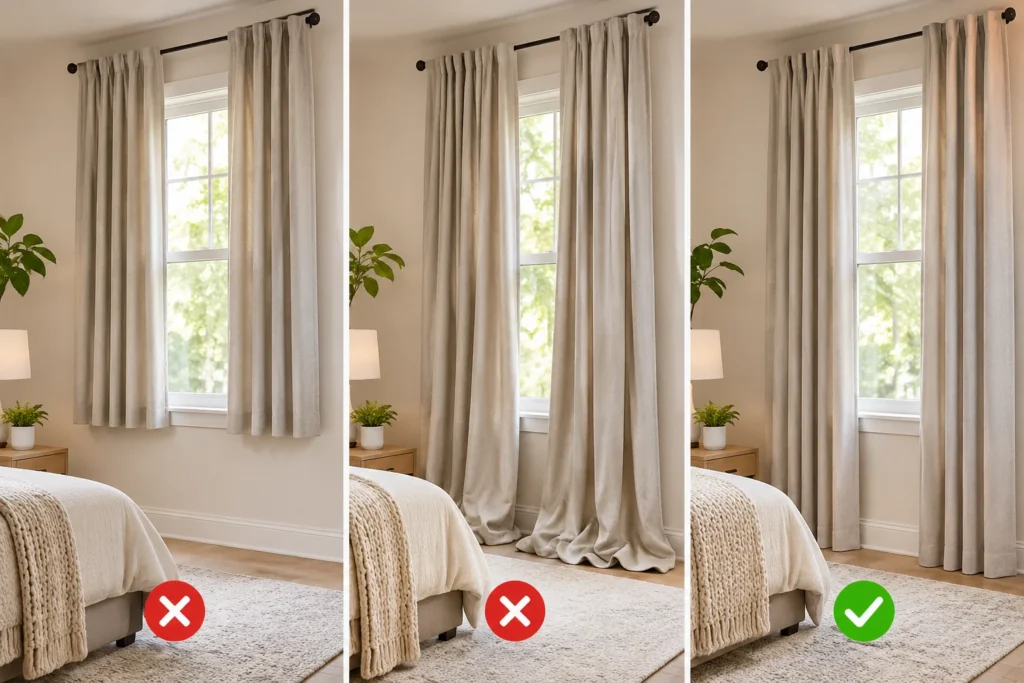
Most curtain sizing mistakes happen before installation. A few additional measurements can prevent awkward gaps, dragging hems, and unnecessary alterations.
- Measuring only the window: Measure from the intended curtain hanging point instead.
- Ignoring hardware: Rings and hooks affect the finished curtain drop.
- Buying the shortest available size: Short panels can create an unfinished appearance.
- Ignoring uneven floors: Measure several positions before ordering.
- Forgetting furniture: Ensure the fabric has sufficient room to hang freely.
- Overlooking shrinkage: Check fabric care instructions before hemming.
- Choosing excessive puddling: Too much fabric can complicate cleaning.
- Ignoring heating clearances: Keep fabric away from heat sources according to manufacturer instructions.
For bedrooms used by young children, consider cordless window coverings and securely mounted hardware. Avoid accessible cords and unnecessarily long fabric.
Best Bedroom Curtains Worth Considering
Once you’ve determined your ideal curtain length, choose a fabric and hanging style that supports your bedroom’s needs. These options provide different approaches to privacy, styling, and window coverage.
As an Amazon Associate, I earn from qualifying purchases. Product scores below are editorial suitability assessments, not verified customer ratings or hands-on test results.
🏆 Best for Bedroom Blackout
NICETOWN 100% Blackout Curtains
★★★★☆ Editorial score: 4.5/5
Available in several sizes, including 84- and 96-inch configurations. I’d shortlist these for bedrooms that need stronger light control and practical floor-length coverage.
🌿 Best for Short Windows
RYB HOME Linen-Textured Semi-Sheer Curtains
★★★★☆ Editorial score: 4.2/5
The 63-inch option offers a shorter alternative for windows above furniture. I’d pair these light-filtering panels with a privacy or blackout shade when stronger coverage is necessary.
✨ Best for Luxury Styling
NICETOWN Velvet Blackout Curtains
★★★★☆ Editorial score: 4.4/5
Velvet panels offer a heavier decorative appearance, with 96-inch options available in selected configurations. I’d consider them for sophisticated floor-length or light-puddle bedroom styling.
Confirm panel dimensions, heading styles, lining materials, and current availability before purchasing.
Frequently Asked Questions
Should bedroom curtains touch the floor?
Bedroom curtains can touch the floor for a refined, tailored appearance, but they do not have to. Leaving approximately ½ inch of clearance is often more practical because it reduces dust accumulation, prevents dragging, and makes opening, closing, and cleaning the curtains easier.
Are 84-inch or 96-inch curtains better for a bedroom?
Choose 84-inch curtains when your effective hanging height is relatively low and 96-inch curtains for higher installations. Neither size is universally better because the correct panel length depends on rod placement, hanging hardware, floor height, and your preferred finishing style.
How far below the windowsill should bedroom curtains hang?
Apron-length bedroom curtains typically extend approximately 4 to 6 inches below the windowsill. This provides additional window coverage while keeping the fabric away from the floor, although nearby furniture, heaters, or other obstacles may require a different finishing point.
Do longer curtains make a bedroom look bigger?
Long curtains can make a bedroom appear taller and more spacious by creating continuous vertical lines. Hanging them above the window frame and choosing colors that complement the walls can strengthen this visual effect without increasing the actual room dimensions.
What curtain length is best for blackout curtains?
Floor-length blackout curtains are a practical option for many bedrooms because they provide extended coverage beneath the window. For better darkness, combine sufficient curtain length with wide panels, overlapping center edges, and hardware that reduces light leakage around the sides and top.
Final Takeaway: Choosing the Perfect Bedroom Curtain Length
Learning how to choose curtain length for a bedroom starts with accurate measurements and a clear understanding of your preferred style. Floor-length curtains offer a versatile solution, while shorter panels remain useful in rooms with furniture or limited clearance.
My preferred choice for everyday bedrooms is a curtain that finishes approximately ½ inch above the floor. It balances elegant styling, easy maintenance, and practical movement.
Before you buy:
- Measure your intended curtain hanging height.
- Choose your desired hem position.
- Account for rings, hooks, or grommets.
- Consider furniture and cleaning requirements.
- Confirm the manufacturer’s panel dimensions.
Take a few minutes to measure carefully before ordering your next set of bedroom curtains. The right curtain length can transform the entire room into a more comfortable, balanced, and visually appealing space.