

Quick Answer
The best bedroom window treatment ideas combine privacy, light control, comfort, and attractive styling. Blackout curtains, sheer panels, Roman shades, cellular blinds, plantation shutters, and layered window coverings are excellent options. Choose blackout treatments for darker sleeping conditions, sheer curtains for soft daylight, and layered coverings for greater flexibility throughout the day.
The right bedroom window treatments can transform an ordinary room into a comfortable and inviting retreat. Beyond decorating your windows, they help manage sunlight, protect privacy, and influence how spacious and relaxing your bedroom feels.
From floor-length curtains to minimalist roller shades, these 21 bedroom window treatment ideas offer practical solutions for different room sizes, decorating styles, and sleeping preferences.
What Are Bedroom Window Treatments?
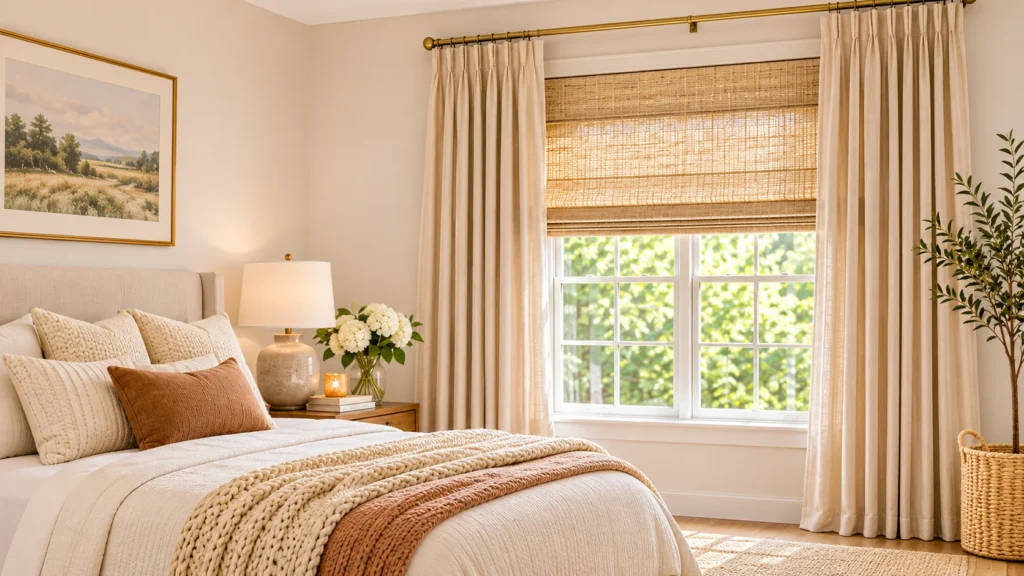
Bedroom window treatments are functional or decorative coverings installed over or around windows to manage light, privacy, temperature, and interior appearance.
They include soft fabric coverings such as curtains and drapes, adjustable blinds, fabric shades, shutters, and decorative window accessories.
The main purposes of bedroom window treatments include:
- Reducing unwanted sunlight and nighttime glare.
- Providing privacy from neighboring properties.
- Creating comfortable sleeping conditions.
- Softening the appearance of bedroom interiors.
- Helping manage unwanted solar heat and heat loss.
- Connecting window styling with bedding, furniture, and wall colors.
Unlike living room window coverings, bedroom treatments often need to balance attractive daytime styling with reliable nighttime privacy and darkness.
Which Bedroom Window Treatment Is Best for Your Needs?
Start by identifying the main problem your window covering needs to solve. Different treatments offer different combinations of privacy, darkness, insulation, and visual appeal.
| Window Treatment | Best For | Main Limitation |
|---|---|---|
| Blackout Curtains | Dark sleeping conditions | Can appear visually heavy |
| Sheer Curtains | Soft natural daylight | Limited nighttime privacy |
| Roman Shades | Elegant, compact styling | Light gaps depend on fit |
| Cellular Shades | Thermal comfort | Less decorative texture |
| Roller Shades | Modern bedrooms | Possible side light leakage |
| Plantation Shutters | Adjustable privacy | Higher upfront cost in many cases |
| Layered Treatments | Day and night flexibility | Requires additional mounting space |
Layered window treatments are particularly useful when you need natural daylight during the day and darker, more private conditions at night.
21 Stylish Bedroom Window Treatment Ideas
1. Install Floor-Length Blackout Curtains
Floor-length blackout curtains are a practical choice for bedrooms exposed to early morning sunlight, streetlights, or bright neighboring buildings.
Choose neutral colors such as oatmeal, taupe, beige, or charcoal to coordinate with your bedroom furniture. Install the curtain rod beyond the window edges where space allows to reduce light leakage.
Best for: Light-sensitive sleepers, primary bedrooms, and daytime sleepers.
2. Create an Airy Look With White Sheer Curtains
White sheer curtains soften direct sunlight while giving bedrooms a light and open appearance. Their delicate fabric works especially well with Scandinavian, coastal, and minimalist interiors.
Use an additional opaque covering if you require privacy after dark, because interior lighting can make the room visible through sheer fabric.
Best for: Bright, airy bedrooms with a separate privacy treatment.
3. Layer Sheer Curtains With Blackout Drapes
Install a double curtain rod or track with sheer panels closest to the window and blackout curtains facing the room.
Open the blackout layer during the day to enjoy filtered sunlight, then close it at bedtime for greater darkness and privacy.
Best for: Bedrooms that need flexible daytime and nighttime light control.
4. Add Textured Roman Shades
Roman shades fold into neat horizontal sections when raised, combining the softness of fabric with the compact appearance of a shade.
Choose linen-look fabric for a natural interior or blackout-lined material when darkness matters. Roman shades work particularly well above desks, dressers, and bedside furniture.
Best for: Traditional, transitional, and compact bedrooms.
5. Choose Minimalist Roller Shades
Roller shades provide a clean, streamlined finish without the volume of conventional curtains.
Select a light-filtering fabric for daytime brightness or an opaque blackout material for sleeping areas. Check the mounting system for side gaps that may allow sunlight into the room.
Best for: Modern, minimalist, and small bedrooms.
6. Improve Thermal Comfort With Cellular Shades
Cellular shades feature honeycomb-shaped pockets that trap air and can reduce heat transfer through windows.
Their actual thermal performance depends on construction, installation, window characteristics, and operating habits. The U.S. Department of Energy’s cellular shade guidance explains how suitable energy-rated window coverings can improve building performance.
Best for: Bedrooms with uncomfortable temperatures near windows.
7. Install Plantation Shutters
Plantation shutters feature adjustable louvers that let you manage visibility and sunlight while creating a timeless architectural appearance.
White shutters suit classic and coastal bedrooms, while natural wood finishes complement rustic interiors. They provide good adjustable privacy but may not create complete darkness.
Best for: Traditional bedrooms and permanent window upgrades.
8. Use Natural Woven Wood Shades
Bamboo and woven wood shades introduce organic texture and earthy tones into the bedroom.
Pair them with linen bedding, wooden furniture, and neutral wall colors for a cohesive natural look. Choose an opaque privacy liner if the woven material allows too much visibility.
Best for: Bohemian, Japandi, rustic, and organic-modern bedrooms.
9. Hang Curtains From a Ceiling-Mounted Track
A ceiling-mounted curtain track draws attention upward and creates a continuous vertical line from ceiling to floor.
This arrangement can make a low-ceiling bedroom appear taller while giving the space a polished, hotel-inspired finish.
Best for: Low ceilings, modern apartments, and luxury bedroom designs.
10. Frame Large Windows With Wall-to-Wall Drapery
Extend curtains across most or all of the window wall to create a dramatic backdrop and soften large expanses of glass.
Choose a fabric that stacks neatly when opened so the curtains do not unnecessarily cover the window during the day.
Best for: Large primary bedrooms and rooms with wide windows.
11. Match Neutral Linen Curtains With Natural Furniture
Linen and linen-blend curtains create a relaxed appearance through their subtle texture and natural-looking folds.
Warm whites, sand, ivory, and oatmeal pair beautifully with oak furniture and muted bedding. Add a separate lining or shade when stronger light control is required.
Best for: Relaxed contemporary and neutral bedrooms.
12. Introduce Patterned Curtains as a Focal Point
Patterned curtains can add visual interest to a bedroom dominated by plain walls, simple furniture, and solid-colored bedding.
Try subtle botanical designs, stripes, checks, or small geometric patterns. Repeat one or two curtain colors elsewhere in the room without matching every accessory.
Best for: Neutral bedrooms that need more personality.
13. Create a Monochromatic Window Treatment
Choose curtains in a shade similar to your wall color to reduce visual contrast and make the window treatment feel integrated into the bedroom.
For example, warm beige curtains against cream walls can create a soft, uninterrupted appearance. Introduce contrast through bedding, rugs, or furniture instead.
Best for: Small bedrooms and calm minimalist interiors.
14. Add Rich Velvet Curtains
Velvet curtains introduce depth, texture, and a luxurious appearance. Deep green, navy blue, burgundy, and warm chocolate tones work well in bedrooms with sophisticated color palettes.
Velvet is relatively heavy, so choose suitable curtain hardware and verify that the fabric or lining provides your required level of light blocking.
Best for: Moody bedrooms, traditional interiors, and luxury styling.
15. Install Top-Down Bottom-Up Shades
Top-down bottom-up shades allow you to uncover the upper part of the window while keeping the lower portion covered.
This arrangement lets daylight enter from above while helping block direct views at street or neighboring window level.
Best for: Ground-floor bedrooms and homes facing nearby buildings.
16. Combine Wooden Venetian Blinds With Curtains
Wooden or faux-wood Venetian blinds provide adjustable light control, while fabric curtains soften their structured horizontal appearance.
Choose a neutral curtain color to balance the texture of the blind slats. Close both treatments at night when additional privacy is needed.
Best for: Bedrooms with natural furniture and layered interior styling.
17. Add Motorized Bedroom Shades
Motorized shades allow you to adjust window coverings using compatible remotes, switches, or smart-home controls.
Some systems support scheduling, making it possible to open shades in the morning and close them at bedtime. Check power requirements, compatibility, and manual operation options before installation.
Best for: Smart homes, high windows, and hard-to-reach window coverings.
18. Use Short Curtains Around Obstructed Windows
Sill-length or apron-length curtains are useful when radiators, desks, cabinets, or other furniture prevent full-length panels from hanging freely.
Select an appropriate length that avoids obstructions and follows any heating appliance clearance requirements.
Best for: Small bedrooms and windows above furniture.
19. Apply Frosted Privacy Window Film
Frosted window film can obscure outside views while allowing some daylight to enter. It is especially useful on windows that face nearby properties.
Unlike blackout coverings, translucent privacy film does not provide substantial darkness. Check the product’s nighttime privacy performance and compatibility with your window glazing.
Best for: Bedrooms requiring additional privacy without bulky fabric.
20. Try Zebra or Day-and-Night Shades
Zebra shades use alternating sheer and opaque fabric bands to provide adjustable daylight and privacy.
They offer a contemporary appearance and can be useful in bedrooms that double as reading or working spaces. However, ordinary zebra shades should not be assumed to provide complete blackout.
Best for: Contemporary bedrooms with changing daytime lighting needs.
21. Create a Hotel-Inspired Layered Window Treatment
Combine full-height decorative curtains with an opaque blackout roller shade or Roman shade behind them.
The inner shade manages direct sunlight, while the outer curtains soften the bedroom and can cover light gaps around the shade edges.
Finish the look with coordinated neutral bedding, warm lighting, and concealed curtain tracks where practical.
Best for: Elegant primary bedrooms and comfortable guest rooms.
Key Insight
Blackout fabric and a blackout bedroom are not the same thing. Even highly opaque material can allow unwanted sunlight around the top, bottom, sides, and center of a window covering. Effective darkness depends on both fabric opacity and installation.
How to Choose Bedroom Window Treatments for Different Room Sizes
Small Bedrooms
Small bedrooms generally benefit from window coverings that minimize visual bulk and preserve usable floor space.
- Choose inside-mounted roller or Roman shades.
- Use light-colored curtains that blend with the walls.
- Hang full-length curtains high when space permits.
- Avoid excessive fabric pooling on the floor.
- Keep curtain hardware simple and proportionate.
If furniture sits close to the window, a compact shade may be more practical than long curtains.
Large and Primary Bedrooms
Larger bedrooms offer more opportunities to use substantial fabric, decorative hardware, and layered coverings.
- Install floor-to-ceiling curtains for visual height.
- Use layered shades and curtains for flexible lighting.
- Choose textured linen or velvet for visual depth.
- Consider wall-to-wall curtain tracks for wide windows.
- Coordinate window treatments across multiple windows.
For bedrooms with several windows, consistent colors and hardware can create a more unified appearance.
Bedrooms With Awkward Windows
Windows behind headboards, above desks, or close to wardrobes may require a more compact solution.
Roman shades, roller shades, or properly fitted shutters can manage privacy without interfering with nearby furniture. Motorized shades may help when a window covering is difficult to reach.
How to Match Window Treatments to Your Bedroom Style
Choose window coverings that complement the materials, colors, and proportions already present in your bedroom.
| Bedroom Style | Suggested Treatment | Color Palette |
|---|---|---|
| Modern | Roller shades or track curtains | White, gray, charcoal |
| Scandinavian | Sheer or linen curtains | Ivory, beige, soft gray |
| Traditional | Roman shades or shutters | Cream, navy, muted green |
| Bohemian | Woven shades and textured curtains | Terracotta, sand, olive |
| Coastal | White shutters and sheer panels | White, pale blue, beige |
| Luxury | Layered full-height drapery | Champagne, taupe, jewel tones |
| Japandi | Natural linen or woven shades | Stone, oatmeal, warm white |
These combinations are design starting points rather than fixed rules. Test fabric samples against your bedroom walls and bedding under both natural daylight and artificial lighting.
How to Measure Bedroom Windows Before Choosing Treatments
Accurate measurements help prevent poorly fitting curtains, awkward fabric lengths, and excessive light gaps.
- Measure the window width: Record the dimensions of the opening and surrounding trim.
- Measure the window height: Include the intended mounting position for the curtain rod or shade.
- Check mounting depth: Inside-mounted shades need sufficient space inside the window frame.
- Identify obstructions: Look for window handles, radiators, furniture, and air-conditioning equipment.
- Allow for curtain fullness: Many curtain styles use a combined fabric width of around 1.5 to 2.5 times the rod width, depending on the heading and desired appearance.
- Check manufacturer instructions: Follow the specific measuring guide for the selected covering before ordering.
Inside-mounted shades create a tidy appearance, while outside-mounted coverings can overlap the window opening and help reduce visible edge gaps.
How to Improve Bedroom Privacy and Light Control
The most flexible approach is to treat daytime privacy and nighttime darkness as separate requirements.
- For daytime privacy: Consider translucent shades, sheer curtains, or adjustable shutters.
- For nighttime privacy: Use opaque curtains, lined shades, or closed shutters with sufficient coverage.
- For darker sleeping conditions: Choose blackout fabrics and minimize gaps around the window.
- For flexible natural light: Use two independent covering layers.
- For bedrooms facing busy streets: Consider top-down bottom-up shades with an additional blackout treatment.
Sheer curtains that appear private during daylight can become much more transparent when bedroom lights are switched on at night. Check the treatment from outside after dark whenever possible.
Common Bedroom Window Treatment Mistakes to Avoid
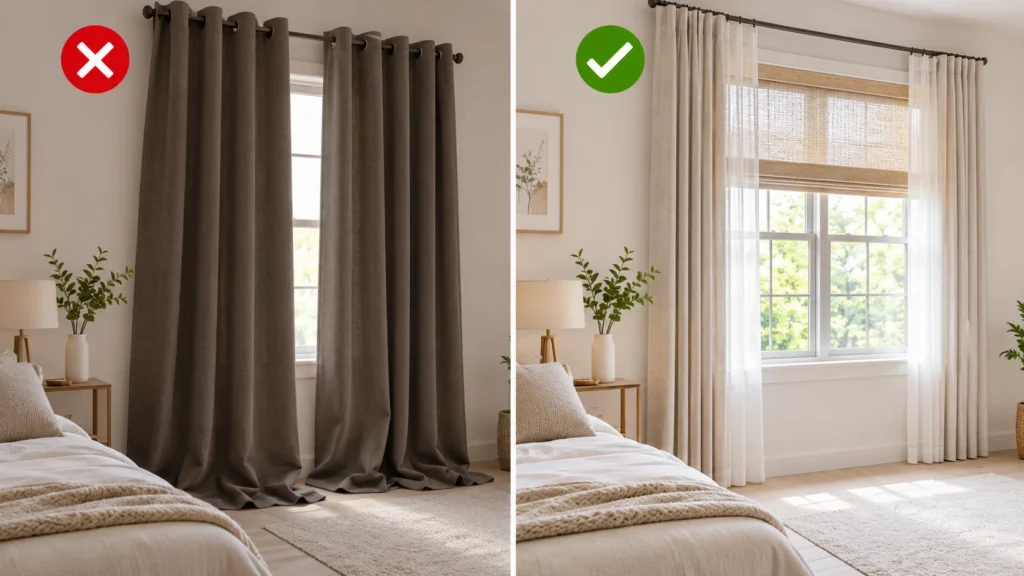
Choosing Appearance Over Function
A beautiful sheer curtain may not provide the nighttime privacy or darkness your bedroom needs. Identify functional requirements before selecting decorative details.
Buying Curtains That Are Too Narrow
Narrow panels may look stretched when closed and leave exposed gaps around the window. Measure the rod width rather than relying only on the glass width.
Mounting Curtains Too Low
Positioning a rod directly against the upper window trim can make some rooms feel visually shorter. A higher mounting position may create better proportions where ceiling height permits.
Ignoring Window Operation
Make sure shades, shutters, and curtain hardware do not interfere with opening, closing, or accessing windows, including windows required for emergency escape.
Assuming All Blackout Treatments Work the Same Way
Blackout performance varies with material construction, lining, mounting position, and gaps. Examine the actual product specifications instead of relying solely on marketing descriptions.
Overlooking Cleaning Requirements
Textured fabrics, elaborate drapery, and horizontal blind slats can require different cleaning routines. Choose materials you can maintain without excessive effort.
Child Safety Warning
Choose cordless window coverings in homes where young children live or visit. Accessible window covering cords present a strangulation hazard. Follow the U.S. Consumer Product Safety Commission’s cordless window covering recommendations and keep children’s furniture away from hazardous cords.
Bedroom Window Treatments Worth Considering
If you are ready to update your bedroom windows, these options illustrate different approaches to darkness, decorative texture, and privacy. Compare dimensions, fabric opacity, operating mechanisms, and installation requirements before purchasing.
As an Amazon Associate, we earn from qualifying purchases.
🌙 For Bedroom Darkness
NICETOWN Blackout Curtains
A practical option for bedrooms exposed to unwanted sunlight. Compare the specific panel dimensions, lining, fabric opacity, and curtain heading before selecting a set.
☀️ For Soft Natural Light
NICETOWN Mira Linen Light Filtering Curtains
Pinch-pleated curtains that introduce decorative texture and filtered daylight. Pair with an opaque covering if greater nighttime privacy is required.
🏡 For Compact Window Styling
NICETOWN Blackout Cordless Roman Shade
A fabric shade option for windows and compatible glazed doors where conventional curtains may be inconvenient. Verify mounting compatibility and coverage before ordering.
Frequently Asked Questions
What is the best window treatment for a bedroom?
Layered window treatments are a versatile choice because they can provide filtered daylight, privacy, and darker sleeping conditions. A combination of sheer curtains and blackout curtains or shades works well for many bedrooms.
Are blinds or curtains better for bedrooms?
Blinds offer adjustable light control and a compact appearance, while curtains provide decorative softness and can offer substantial light blocking when properly fitted. The better choice depends on window dimensions, available space, and privacy requirements.
What bedroom window treatments make a room look bigger?
Light-colored curtains, simple inside-mounted shades, and high-mounted floor-length curtains can make bedrooms appear more spacious by reducing visual clutter and emphasizing vertical proportions.
Can you use curtains and blinds together?
Yes. Combining blinds or shades with curtains offers flexible light control and decorative texture. Install the blind or shade closest to the window and allow enough clearance for the outer curtains.
What window treatments provide privacy without blocking daylight?
Light-filtering shades, frosted privacy film, top-down bottom-up shades, and adjustable shutters can provide privacy while allowing daylight inside. Nighttime privacy depends on the opacity and design of the covering.
Should bedroom curtains touch the floor?
Floor-length curtains that just touch or sit slightly above the floor create a neat, elegant appearance. Shorter curtains may be more practical when furniture, heaters, or other obstructions are positioned below the window.
What color window treatments are best for bedrooms?
Warm white, beige, taupe, soft gray, and muted green are versatile bedroom window treatment colors. Choose a color that complements the walls, bedding, and furniture while supporting the desired mood.
How can I cover bedroom windows without drilling?
Depending on the window construction and product weight, tension rods, compatible no-drill shades, and removable privacy films can provide window coverage without conventional screw-mounted hardware. Follow the manufacturer’s installation and weight limitations.
Final Thoughts
The best bedroom window treatment ideas balance attractive styling with practical everyday needs. Blackout curtains help create darker sleeping conditions, sheer curtains soften daylight, and Roman or cellular shades provide compact alternatives to traditional drapery.
For greater flexibility, consider combining two independent window covering layers. Measure carefully, prioritize privacy and safe operation, and choose materials that complement your bedroom’s existing design.
A thoughtfully selected window treatment can make your bedroom feel more comfortable, cohesive, and inviting throughout the day and night.