

Quick Answer
The easiest way to make bedroom windows look bigger is to hang curtains higher and wider than the window frame, choose floor-length panels, and maximize natural light. Light-colored fabrics, ceiling-mounted curtain tracks, strategically placed mirrors, and minimal furniture near the window can also create the illusion of larger windows without structural renovation.
A small bedroom window can make an otherwise beautifully decorated room feel cramped, dark, or unbalanced. However, replacing the window is not always necessary to improve its appearance.
Learning how to make bedroom windows look bigger starts with understanding how curtain placement, color, lighting, and surrounding furniture influence visual proportions.
These 15 practical decorating ideas can help you create a brighter, more spacious-looking bedroom without changing the actual window opening.
What Makes Bedroom Windows Look Bigger?
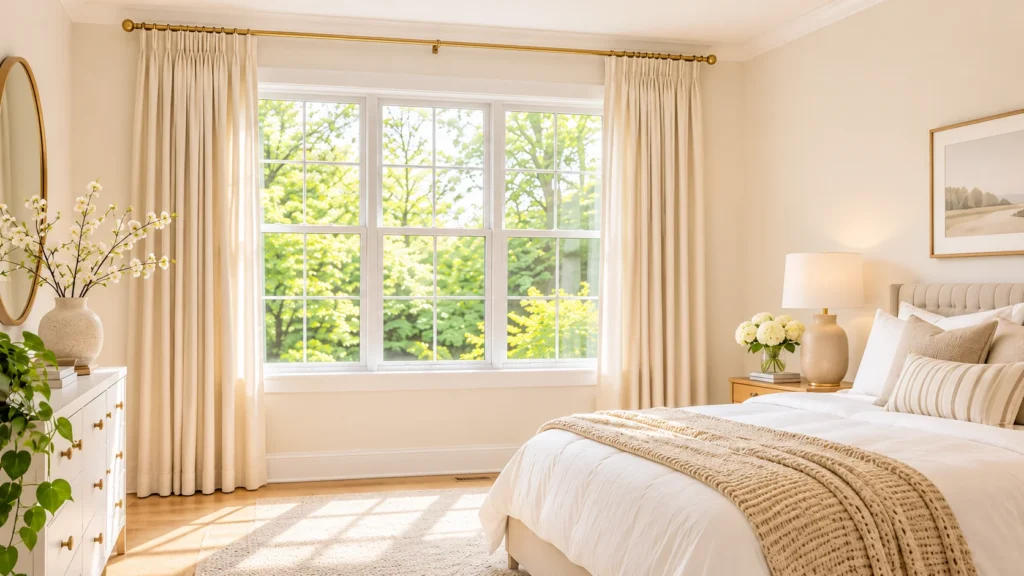
Bedroom windows look bigger when the surrounding window treatments create an impression of greater height and width while allowing more of the existing glass to remain visible.
The eye interprets the curtain arrangement, surrounding wall space, and visible daylight as part of the overall window area. Changing these elements can make a modest window appear more substantial.
Four important design elements influence perceived window size:
- Vertical lines: Draw attention upward and make windows appear taller.
- Horizontal extension: Creates the impression of a wider window opening.
- Natural light: Helps the surrounding bedroom feel brighter and less enclosed.
- Visual continuity: Reduces harsh boundaries between the window, curtains, and walls.
These techniques change how the window is perceived rather than physically increasing its dimensions.
15 Clever Ways to Make Bedroom Windows Look Bigger
1. Hang Curtains Higher Than the Window Frame
Installing the curtain rod above the window frame creates additional visual height and encourages the eye to move upward.
Instead of positioning the rod immediately above the window trim, consider mounting it closer to the ceiling when the room proportions allow.
In bedrooms with ordinary ceiling heights, approximately 4–6 inches above the frame can be a practical starting point. A higher placement may work better when there is sufficient wall space above the window.
Architectural Digest’s curtain installation guide also discusses using elevated curtain placement to improve the apparent proportions of windows and ceilings.
This technique is particularly useful for bedrooms with short windows or low ceilings.
2. Extend the Curtain Rod Beyond the Window
A wider curtain rod creates the impression of a larger window while allowing the open curtains to sit beside the glass instead of covering it.
Start by allowing approximately 6–12 inches of additional space on each side, depending on available wall space and curtain thickness.
For example, a 36-inch-wide window could use a curtain rod with a usable span of approximately 48–60 inches if the surrounding wall allows.
Remember that thicker curtains require additional space when gathered. Decorative finials may also extend beyond the usable rod width.
3. Choose Floor-Length Curtains
Floor-length curtains create an uninterrupted vertical line from the curtain rod toward the floor. This makes the window arrangement appear taller and more elegant.
Choose curtains that:
- Finish just above the floor for a clean appearance.
- Hang evenly on both sides.
- Do not bunch excessively around furniture.
- Match the height of the installed curtain hardware.
If a radiator, desk, or permanent obstruction sits directly below the window, a shorter curtain or Roman shade may be more practical.
4. Use Light-Colored Curtain Fabrics
Light-colored curtains can soften the boundary between the window and surrounding walls, helping the window area feel more open.
Consider shades such as:
- Soft white
- Ivory
- Warm beige
- Light gray
- Oatmeal
- Pale taupe
- Muted cream
These colors work particularly well with neutral bedroom walls. However, a dark curtain can also work in a dark-colored bedroom if it blends with the surrounding surfaces.
The goal is visual harmony rather than simply choosing white fabric.
5. Install Sheer Curtains to Maximize Daylight
Sheer curtains allow daylight to pass through the fabric while softening the appearance of the window. They are especially helpful in bedrooms where heavy curtains make small windows feel crowded.
Choose lightweight materials such as voile or linen-look sheers for an airy appearance.
Keep in mind that sheer curtains alone may provide insufficient nighttime privacy when bedroom lights are on. Combine them with an opaque curtain or blind if privacy is important.
6. Install a Ceiling-Mounted Curtain Track
A ceiling-mounted curtain track removes the visual interruption created by a low-mounted rod and makes the window treatment appear to extend through the full height of the room.
This approach works well in modern, minimalist, Scandinavian, and contemporary bedrooms.
It is especially effective when there is a large section of wall between the window and ceiling.
The ceiling and mounting hardware must be suitable for the combined weight of the track and curtains. Follow the hardware manufacturer’s installation requirements.
7. Match Curtain Color to the Bedroom Walls
Curtains that closely match the wall color create a continuous visual surface. This reduces the contrast that would otherwise define the window as a small, separate rectangle.
For example, warm beige walls paired with oatmeal curtains can produce a softer transition than dark navy curtains against a white wall.
Exact color matching is unnecessary. Similar undertones and comparable brightness are often enough to create a cohesive appearance.
8. Place Mirrors Where They Reflect Natural Light
A well-positioned mirror can reflect the window and redistribute daylight visually, making the bedroom feel more open.
Try placing a mirror on an adjacent or opposite wall where it can capture the window or reflect a bright part of the room.
A tall mirror can also reinforce the vertical lines created by floor-length curtains.
Mirrors do not create additional natural light, but they can improve its distribution and create an impression of greater depth.
Secure large mirrors appropriately and avoid positions that create uncomfortable glare.
9. Use Slim Window Blinds
Slim roller blinds and streamlined Roman shades can make small windows feel less crowded by reducing bulky fabric and hardware.
An outside-mounted shade installed above the window frame can create additional perceived height. Select a design that retracts far enough to expose as much glass as possible during the day.
Inside-mounted blinds generally provide a cleaner architectural appearance, while outside-mounted blinds offer more flexibility for visually enlarging the window area.
10. Keep Window Sills Free of Clutter
Decorative accessories, oversized plants, books, and storage containers can make a small window feel crowded and obstruct part of the daylight.
Keep the window sill relatively clear. If you want to decorate it, choose one or two small objects that do not significantly block the glass.
This is one of the simplest ways to improve window visibility without purchasing new treatments.
11. Choose Curtains With Subtle Vertical Patterns
Vertical stripes and elongated woven textures can guide the eye upward, making the curtain arrangement feel taller.
Consider narrow stripes, subtle pinstripes, or vertically textured fabric rather than large, contrasting patterns.
Bold patterns can still work in a spacious bedroom, but they may dominate the appearance of a small window when the surrounding room is already visually busy.
12. Layer Sheer Curtains With Blackout Panels
Layered curtains combine daytime brightness with nighttime privacy and light control.
Install lightweight sheers behind blackout or room-darkening panels using a double curtain rod or compatible double-track system.
During the day, pull the outer panels away from the glass. At night, close them when greater privacy or darkness is needed.
This arrangement allows the bedroom window to appear open and generous during daylight hours without sacrificing practical sleeping conditions.
13. Move Bulky Furniture Away From the Window
Tall dressers, bookcases, oversized headboards, and cabinets can obscure parts of the window and interrupt the visual flow of curtains.
Where possible, move tall furniture away from the window wall and maintain enough clearance for curtain panels to open completely.
If furniture must sit below the window, choose a low-profile piece that does not overlap the glass or interfere with the window’s operation.
Never block a window needed for emergency escape.
14. Use Simple Window Trim and Hardware
Minimal curtain rods, understated finials, and uncomplicated window trim can make the surrounding area feel less visually crowded.
Choose curtain hardware that complements the bedroom rather than competing with the window itself.
Painting the existing window trim a color similar to the surrounding wall can also soften the visible boundary of a small window.
Keep existing functional trim and weatherproofing intact.
15. Use Wall-to-Wall Curtains for a Wider Appearance
Extending curtains across much of a bedroom wall can create the impression of a broad window arrangement, even when the actual window is relatively narrow.
This technique works especially well when a small window sits in the center of an otherwise empty wall.
Use sufficient fabric to cover the intended area without creating excessively dense folds.
For an off-center window, carefully position the curtain panels so the treatment appears balanced without unnecessarily covering the glass.
Design Tip
Before purchasing new curtains, use removable painter’s tape to mark the proposed curtain rod height and width on the wall. View the arrangement from the bedroom doorway to check whether the new proportions look balanced.
Which Window Treatment Works Best for Your Bedroom?
The right treatment depends on whether your main problem is insufficient window height, limited width, poor natural light, or a lack of surrounding wall space.
| Window Problem | Best Design Approach | Visual Effect |
|---|---|---|
| Short window | High-mounted rod and long curtains | Greater perceived height |
| Narrow window | Extra-wide curtain rod | Greater perceived width |
| Dark bedroom | Light sheers and unobstructed glass | Brighter appearance |
| Low ceiling | Ceiling-mounted curtain track | Longer vertical lines |
| Limited wall space | Slim roller or Roman shade | Less visual clutter |
| Privacy concerns | Layered sheer and opaque curtains | Flexible light and privacy control |
| Small central window | Wall-to-wall curtains | Wider window arrangement |
Start with the solution that addresses your window’s most noticeable limitation. Combining two compatible techniques is often more effective than adding numerous decorative treatments.
How to Measure Curtains to Make Bedroom Windows Look Bigger
Accurate measurements are essential because curtains that are too short, narrow, or bulky can undermine the intended visual effect.
- Measure the window: Record the outside width of the window frame.
- Check available wall space: Measure how much clearance is available on each side of the window.
- Choose the rod width: Add sufficient space for the open curtain panels to gather beside the window.
- Determine mounting height: Mark the proposed rod or track position above the frame.
- Measure the curtain drop: Follow the curtain header’s measurement requirements and determine the desired finishing point near the floor.
- Calculate fabric width: Allow sufficient combined panel width for the desired fullness.
For many conventional curtain styles, a combined fabric width of approximately 1.5–2.5 times the usable rod width is a practical planning range. The appropriate ratio depends on the fabric weight, heading style, and desired fullness.
Example Curtain Measurements
The following hypothetical examples use an extension of 8 inches on each side and a combined fabric fullness of approximately twice the usable rod width.
| Window Width | Usable Rod Width | Combined Panel Width |
|---|---|---|
| 24 inches | 40 inches | 80 inches |
| 36 inches | 52 inches | 104 inches |
| 48 inches | 64 inches | 128 inches |
| 60 inches | 76 inches | 152 inches |
| 72 inches | 88 inches | 176 inches |
These are illustrative design measurements, not universal installation requirements. Adjust them according to your bedroom layout, curtain construction, and available wall space.
For additional measurement guidance, refer to Umbra’s curtain rod measuring and installation guide.
How to Make Bedroom Windows Look Bigger Without Curtains
You can make bedroom windows appear larger without traditional curtains by improving visual continuity, reducing obstructions, and choosing minimalist window treatments.
- Install an outside-mounted roller blind above the window frame.
- Paint the surrounding window trim to coordinate with the walls.
- Position a mirror where it reflects the window.
- Remove bulky furniture from the window area.
- Keep window sills clean and uncluttered.
- Use a streamlined Roman shade that retracts above the glass.
Curtain-free arrangements are particularly useful in bedrooms with desks, built-in furniture, or radiators directly below the window.
How to Make Small Bedroom Windows Look Bigger in a Rental
Renters can improve the appearance of bedroom windows without permanently altering walls or window frames.
Begin by using existing curtain hardware where possible. Replacing heavy, dark panels with appropriately sized lightweight curtains can create a noticeable improvement.
Other rental-friendly options include removable hardware approved for the intended curtain weight, freestanding mirrors, lighter bedding, and rearranging furniture to expose more of the window.
Check your rental agreement before installing new curtain rods or drilling holes. Adhesive mounting systems should only be used on compatible surfaces and within their specified weight limits.
Common Mistakes That Make Bedroom Windows Look Smaller
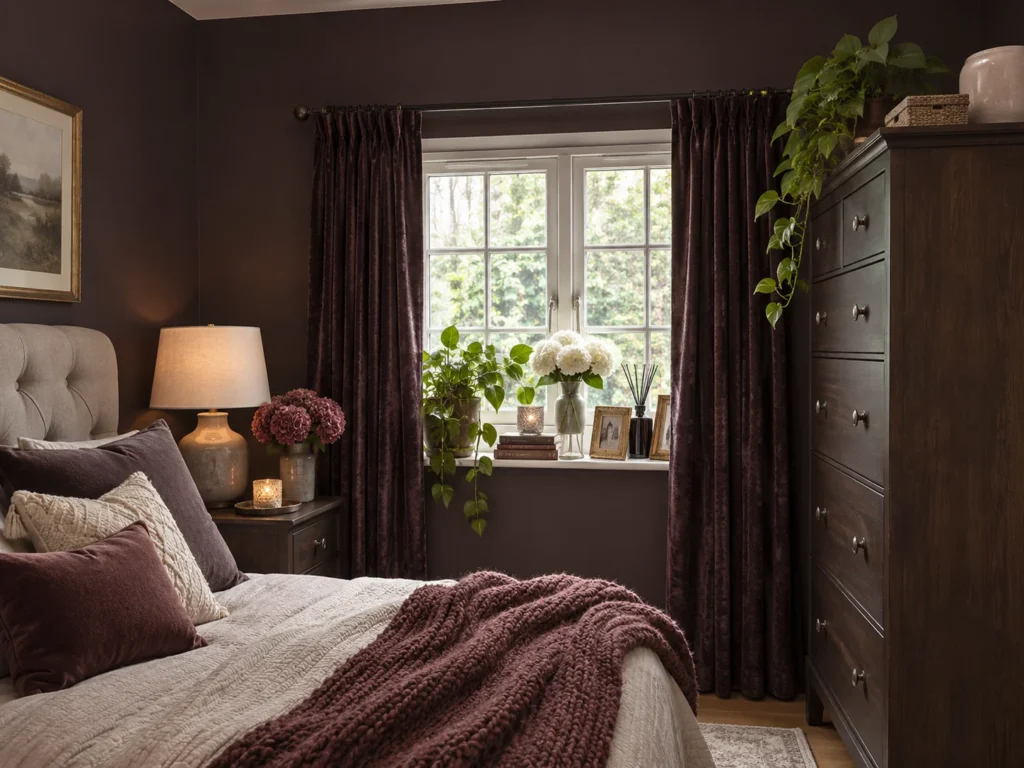
Some decorating choices unintentionally reduce the apparent size of bedroom windows, even when the window treatments themselves are attractive.
- Mounting curtains too low: Draws attention to the actual top of the window.
- Using a narrow curtain rod: Allows open curtain panels to obscure part of the glass.
- Choosing excessively bulky fabrics: Occupies surrounding wall space and creates dense folds.
- Ignoring curtain length: Interrupts vertical lines and can make the arrangement feel incomplete.
- Blocking windows with furniture: Reduces visible glass and obstructs natural light.
- Combining too many patterns: Makes the window area appear visually crowded.
- Ignoring nighttime privacy: Creates a visually attractive but impractical bedroom treatment.
Important Reminder
Do not sacrifice ventilation, emergency window access, privacy, or heater clearance simply to make a bedroom window appear larger. Choose treatments that preserve the window’s intended functions.
Helpful Products for Making Bedroom Windows Look Bigger
The following products address different aspects of window styling, including rod placement, natural light, and layered privacy control.
Affiliate disclosure: As an Amazon Associate, we earn from qualifying purchases.
BEST FOR WIDER CURTAIN PLACEMENT
Umbra Cappa Adjustable Curtain Rod
An adjustable curtain rod with a streamlined design and compatibility with several common curtain headings. It is useful when extending curtains beyond a narrow bedroom window.
BEST FOR AN AIRY APPEARANCE
IKEA LILL Sheer Curtains
Lightweight white sheer curtains with a rod-pocket heading. They soften incoming daylight and suit bedrooms where an open appearance is the priority. Pair with opaque treatments for nighttime privacy.
BEST FOR LAYERED CURTAINS
Umbra Cappa Double Curtain Rod
An adjustable double-rod system designed to accommodate two curtain layers. It allows lightweight sheers and opaque outer panels to work together for daytime brightness and nighttime privacy.
Frequently Asked Questions
Do long curtains make bedroom windows look bigger?
Yes. Floor-length curtains create continuous vertical lines that can make bedroom windows appear taller, particularly when the curtain rod is mounted above the window frame.
What color curtains make small windows look bigger?
White, ivory, cream, beige, and other light neutral colors often create an open appearance. Curtains that closely match the surrounding wall color can also make the window arrangement feel more spacious.
Do blinds or curtains make windows look bigger?
High-mounted, wide curtains are particularly effective for creating the illusion of greater height and width. Outside-mounted blinds may be more practical when furniture or limited wall space prevents the use of long curtains.
How far should a curtain rod extend beyond a small window?
Approximately 6–12 inches on each side is a useful starting range when sufficient wall space is available. Adjust the extension to accommodate the thickness and gathered width of your curtains.
Can blackout curtains make bedroom windows look bigger?
Yes. Blackout curtains can create the same visual enlargement as other curtains when mounted high and wide. Choose panels that can be drawn fully away from the glass during the day.
Do mirrors make small bedroom windows look larger?
Mirrors can reflect daylight and create an impression of additional depth, making the bedroom feel more spacious. However, they do not physically increase the window size or the amount of daylight entering the room.
Can I make bedroom windows look bigger without renovating?
Yes. Changing curtain placement, selecting streamlined window treatments, coordinating wall colors, and rearranging furniture can improve perceived window size without structural alterations.
Final Thoughts
Making bedroom windows look bigger does not require an expensive renovation. Start by improving curtain rod placement, exposing more of the existing glass, and choosing window treatments that complement the room’s proportions.
High and wide curtains, coordinated colors, carefully positioned mirrors, and unobstructed natural light can work together to create a brighter, more spacious-looking bedroom.
Prioritize the changes that suit your window dimensions, privacy requirements, and available space. A well-balanced window treatment can transform the appearance of the entire bedroom.