

Quick Answer
The best multi-purpose living room ideas combine flexible furniture, clearly defined activity zones, and storage that allows the room to change throughout the day. Start with your main everyday activity, then add a compact workspace, dining area, guest sleeping option, or play corner without blocking walkways or sacrificing comfort.
A living room does not have to serve just one purpose. In a smaller home, it might be your office in the morning, a family gathering space in the afternoon, and a relaxing entertainment area at night.
The challenge is making these activities fit together without leaving the room looking like several unrelated spaces squeezed into one.
Successful multi-purpose living room design starts with how you actually use the space. Furniture should be easy to move or transform, frequently used items should have accessible storage, and each activity should have enough room to function comfortably.
How Do You Plan a Multi-Purpose Living Room?
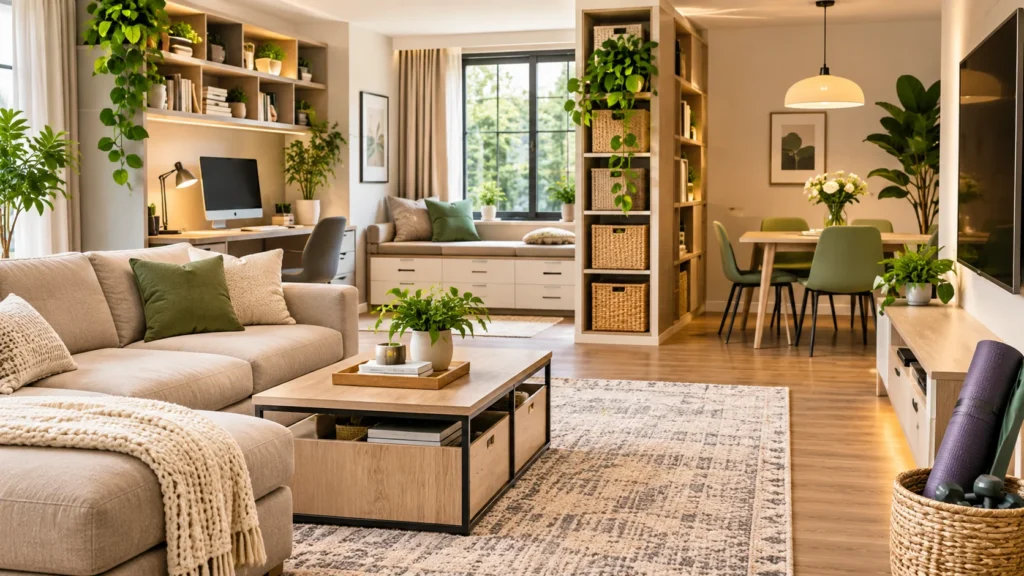
Start by choosing the room’s primary purpose and identifying the additional activities it needs to accommodate. A living room used for relaxation every day and overnight guests twice a month should be arranged differently from one used as a full-time home office.
Before rearranging furniture, follow these steps:
- List your activities. Identify whether the room needs to support working, dining, watching television, exercising, reading, playing, or hosting guests.
- Rank activities by frequency. Give everyday functions the most convenient locations and occasional activities flexible space.
- Measure the room. Record wall lengths, windows, door swings, outlets, and the dimensions of existing furniture.
- Identify circulation routes. Keep natural walking paths between entrances, seating, and adjoining rooms unobstructed.
- Plan storage for each function. Make sure work supplies, toys, bedding, and entertainment accessories can be put away easily.
For help with room measurements and furniture placement, see this living room space planning guide before choosing a layout.
15 Multi-Purpose Living Room Ideas for a More Functional Home
These ideas work individually or in combinations. The best selection depends on room size, available storage, and how frequently each activity occurs.
1. Create a Living Room and Home Office Combination
A compact workspace can fit into a living room without making the entire room feel like an office. Place a narrow desk against an unused wall, near a window, or behind the sofa if enough space remains for movement.
Choose a desk with shallow drawers or a closed cabinet nearby to conceal chargers, notebooks, and office supplies after working hours.
A wall-mounted folding desk can be especially useful when the office is needed only occasionally. However, anyone working at a computer for long periods should prioritize a comfortable, appropriately adjusted chair and screen position rather than relying on a coffee table.
Best for: Remote workers, students, and apartment residents who cannot dedicate another room to office work.
2. Choose a Sofa Bed for an Occasional Guest Room
A sleeper sofa allows the living room to become a guest bedroom without permanently occupying floor space with a bed.
Before selecting one, measure both its closed dimensions and the space needed when the bed is fully extended. Check whether coffee tables or chairs must be moved and where those pieces will go overnight.
Keep spare bedding in a storage ottoman, cabinet, or nearby closet. A curtain or folding screen can add privacy when the room is shared with other household members.
Best for: Small apartments, studios, and homes that accommodate occasional overnight guests.
3. Add a Dining Area Without a Separate Dining Room
A living room can double as a dining space with a compact table that expands when needed.
Consider a drop-leaf table, extendable dining table, or wall-mounted folding table. Place it near the kitchen when possible to simplify carrying food and clearing dishes.
For everyday use, a small table can serve one or two people. When guests visit, expand the surface and bring out folding or stackable seating.
Avoid placing the table where dining chairs would block a main doorway or passage when pulled out.
4. Use Storage Ottomans Instead of Ordinary Coffee Tables
A storage ottoman can function as a footrest, a casual seating option, and a place to conceal everyday clutter.
Some designs also provide a firm tabletop or reversible tray suitable for drinks, books, and snacks.
Choose a size proportional to the sofa, and ensure that the lid or storage compartment opens without requiring major furniture rearrangement.
Store blankets, remote controls, games, or frequently used accessories inside.
This simple change helps the seating area accommodate several activities without introducing another large piece of furniture.
5. Divide the Room Into Functional Zones
Separate activity zones help a multi-purpose living room feel organized even when there are no internal walls.
For example, one corner can support reading, another can accommodate working, and the main seating area can remain dedicated to conversation or entertainment.
Use subtle visual boundaries such as:
- An area rug to define the main seating arrangement.
- An open shelving unit between a desk and sofa.
- A floor lamp to distinguish a reading corner.
- A low cabinet that separates activities while providing storage.
- A folding screen for temporary privacy.
Open dividers preserve visual connection and may allow daylight to pass through. If using tall shelves as dividers, follow the manufacturer’s anchoring instructions to reduce tipping risks.
Best for: Open-plan spaces and households where several people use the living room simultaneously.
6. Design a Family-Friendly Play Corner
A small play zone allows children to use the living room without allowing toys to spread across every seating surface.
Choose a defined corner with soft flooring or a washable rug. Use low storage bins or accessible shelves for toys, books, and creative activities.
Rotate some toys into storage rather than displaying everything at once. This keeps the play area manageable and makes cleanup easier.
Keep heavy objects secure, conceal electrical cords, and avoid placing climbable furniture near windows.
The goal is a space children can use conveniently while adults can restore the room to its usual arrangement afterward.
7. Create a Cozy Reading Nook
A reading corner requires relatively little space but gives the living room an additional function.
Position a comfortable chair near a window or place it beside a floor lamp with adjustable lighting.
Add a small side table for drinks and books. A wall-mounted shelf or narrow bookcase can provide storage without using much floor area.
A reading chair can also become extra seating when visitors arrive, making it particularly useful in compact homes.
8. Choose Modular Seating That Can Be Rearranged
Modular sofas and movable chairs allow a living room to adapt to different gatherings.
For everyday relaxation, position seating around the television or coffee table. For conversation, bring chairs closer together. For children’s activities or exercise, move lightweight pieces to clear open floor space.
Check how individual modules connect and whether they remain stable during normal use.
Also consider the weight and dimensions of each component. A sofa described as modular is not necessarily convenient to move frequently.
For additional furniture arrangement options, explore these living room layout ideas.
9. Make Vertical Storage Work Harder
When floor space is limited, wall storage can accommodate items for several activities without introducing more freestanding furniture.
Floating shelves can hold books and decorative objects. Cabinets can conceal work materials, games, or craft supplies.
Use closed storage for visually busy items and open shelves for things you want to display.
Keep frequently used objects within comfortable reach and follow appropriate mounting instructions for wall shelves and cabinets.
For additional approaches, see these living room storage ideas.
10. Build an Entertainment and Gaming Zone
A living room can support movies, television, and gaming without allowing electronics to dominate the decor.
Choose a media console with enough ventilation and dedicated compartments for controllers, cables, games, and accessories.
Use cable organizers to keep the setup tidy, and arrange seating so the screen remains comfortably visible.
Portable stools or movable chairs can accommodate additional players without permanently crowding the room.
If the room is also used for work, concealed media storage helps visually separate leisure activities from working hours.
11. Use a Foldaway Exercise Area
A living room can accommodate stretching, yoga, or low-impact exercise when enough floor space can be cleared safely.
Use lightweight side tables and movable seating that can be repositioned without difficulty.
Store an exercise mat, resistance bands, or other compact equipment in a dedicated basket or cabinet.
Before exercising, check that there is sufficient clearance from hard furniture edges, glass surfaces, ceiling fixtures, and other people.
For activities involving jumping or heavy equipment, consider floor protection, noise, and whether the room is structurally and practically suitable.
12. Create a Craft or Hobby Station
A hobby area works well when supplies can be accessed quickly and stored away afterward.
A compact desk or folding table can accommodate drawing, sewing, model building, or other small projects.
Use labeled containers, drawers, or a rolling storage cart to keep materials organized.
Choose task lighting suited to detailed work and protect the table surface when using materials that may stain or scratch.
If the living room is shared with children or pets, keep sharp tools and potentially hazardous materials securely stored.
13. Add a Window-Side Breakfast or Coffee Spot
A sunny corner can become a compact place for morning coffee, light meals, or informal conversation.
Pair a small round table with two slim chairs or place a narrow table near a window where circulation permits.
Choose furniture that can also support reading, laptop work, or board games.
Using one table for several activities is often more practical than fitting separate tables into a limited room.
14. Use Curtains or Screens for Temporary Privacy
Temporary dividers help one living room accommodate activities that need different levels of privacy.
A folding screen can conceal a workspace during social gatherings or provide separation for an overnight guest.
A ceiling-mounted curtain may create a softer division in a larger room, provided it can be installed securely.
Position dividers so they do not obstruct ventilation, important light sources, doorways, or exit routes.
This arrangement is particularly useful when the room needs privacy only at certain times.
15. Create a Flexible Space That Changes Throughout the Day
Sometimes the most effective design is not a room divided into several permanent sections. Instead, the same floor area serves different functions at different times.
A practical daily arrangement might look like this:
- Morning: Open a folding desk for focused work.
- Afternoon: Fold the desk away and clear an area for children or hobbies.
- Evening: Return the room to a comfortable seating and entertainment setup.
- Occasional overnight use: Extend the sofa bed and bring out stored bedding.
This approach avoids requiring every function to occupy a permanent area.
Key Insight
A multi-purpose living room does not need enough space for every activity at once. It needs a layout that makes switching between the most important activities simple, comfortable, and repeatable.
Which Multi-Purpose Layout Works Best for Your Room?
Different combinations require different furniture and storage arrangements. Use this comparison to identify a practical starting point.
| Living Room Combination | Useful Furniture | Main Planning Priority |
|---|---|---|
| Living room + office | Compact desk, supportive chair, closed storage | Comfortable working position and reduced distractions |
| Living room + guest room | Sleeper sofa, storage ottoman, privacy screen | Clearance for the fully extended bed |
| Living room + dining | Drop-leaf table, stackable chairs | Room for chairs and convenient access to the kitchen |
| Living room + playroom | Washable rug, low toy storage, movable furniture | Safe play space and easy cleanup |
| Living room + exercise | Lightweight tables, mat storage | Sufficient unobstructed movement space |
If you need two functions at the same time, create separate zones. If the activities happen at different times, furniture that folds, rolls, or converts may be more useful than permanent divisions.
How Can You Make a Small Multi-Purpose Living Room Feel Bigger?
Use appropriately scaled furniture, preserve sightlines, and limit how much space is permanently occupied. A room often feels crowded because too many objects compete for floor space, not simply because its dimensions are small.
Choose Furniture With the Right Proportions
A large sectional may leave insufficient space for a desk or dining table. In a compact room, a smaller sofa and one movable chair may provide greater flexibility.
Measure the furniture before purchasing and check how much room is needed to open drawers, extend tables, or walk behind chairs.
Use a Consistent Color Palette
Repeating a limited set of colors across different zones can make the room feel more visually connected.
Soft neutrals, gentle greens, muted blues, or warm earthy tones can work well, depending on the amount of daylight and the atmosphere you want to create.
Different areas can still have their own accent colors, textures, and lighting without appearing disconnected.
Layer Lighting for Different Activities
General ceiling lighting may work for cleaning and everyday movement, but reading, computer work, and evening relaxation have different lighting needs.
Combine ambient lighting with adjustable task lighting where necessary. Place lamps where they serve a clear activity, rather than scattering them around the room for decoration alone.
IKEA’s small living room space-saving guide demonstrates how multifunctional furniture and flexible arrangements can help compact spaces support more activities.
Practical Tip
Before buying flexible furniture, mark its full operating footprint on the floor with painter’s tape. Test the arrangement with dining chairs pulled out, a desk in use, or a sofa bed extended. This reveals conflicts that are easy to miss when measuring furniture in its closed position.
What Mistakes Should You Avoid in a Multi-Purpose Living Room?
The most common planning problem is trying to make every function permanently available, even when some activities happen only occasionally.
Watch for these mistakes:
- Overcrowding with furniture: Too many tables, chairs, and cabinets reduce the usable floor area.
- Blocking walking routes: Furniture should not make it difficult to move between entrances and frequently used areas.
- Ignoring storage: A flexible room becomes inconvenient when converting it requires moving loose items from one surface to another.
- Buying before measuring: Convertible furniture may need considerably more space when opened.
- Combining incompatible activities: A television next to a permanent office desk can make concentrated work difficult when both are used simultaneously.
- Using unsuitable task furniture: A low coffee table is not a practical substitute for an ergonomic workstation during long work sessions.
- Neglecting lighting and outlets: Workspaces, reading corners, and media equipment need suitable lighting and electrical access.
A practical design should make everyday activities easier, not require a major rearrangement whenever someone wants to use the room differently.
For a more detailed cleanup routine, use this guide on how to organize a living room.
How Do You Keep a Multi-Purpose Living Room Organized?
Give each activity a clear storage location and establish a simple reset routine.
Office accessories can go into a drawer or rolling cart. Children’s toys can return to labeled bins. Guest bedding can stay inside a storage ottoman. Craft materials can be kept together in portable containers.
Use these three habits to maintain flexibility:
- Store supplies near their activity zone. Avoid carrying everyday items across the room to retrieve or put them away.
- Clear temporary setups after use. Folding tables and hobby stations are most useful when they can be restored quickly.
- Review the layout periodically. If a zone is rarely used or constantly gets in the way, reconsider how much permanent space it deserves.
A combination of open and closed storage is particularly useful. Open shelves provide quick access, while cabinets can hide everyday equipment that would otherwise make the room appear busy.
IKEA provides additional examples of combining open and closed living room storage for spaces used for work, relaxation, and social activities.
Which Space-Saving Furniture Is Worth Considering?
For a living room used in several ways, start with furniture that addresses an actual space problem rather than adding more pieces simply because they are multifunctional.
SPACE DIVIDER + STORAGE
IKEA KALLAX Shelving Unit
An open-cube shelving system that can hold books, boxes, and other small items while visually dividing different activity zones. Measure the selected configuration and follow the manufacturer’s safety and anchoring instructions.
COMPACT DINING SOLUTION
IKEA NORDEN Gateleg Table
A folding table design suited to creating an occasional dining or project surface. Its foldable leaves help limit the table’s footprint when not in use. Check the full expanded dimensions before selecting a location.
Affiliate disclosure: Some shopping links above may earn this website a commission from qualifying purchases, at no additional cost to you. Search results, seller availability, and prices may change.
Frequently Asked Questions
Can a small living room serve three different purposes?
Yes. A small living room can accommodate three functions when they do not all require separate permanent areas. For example, the same space can operate as a lounge, workspace, and occasional guest bedroom with a folding desk and sleeper sofa. The arrangement still needs enough clearance to use each function comfortably.
How do you separate a living room and office without walls?
Use an open bookcase, low storage cabinet, area rug, or strategically positioned sofa to distinguish the workspace from the seating area. For temporary privacy, a folding screen may be useful. Maintain clear walking routes and avoid blocking natural light unnecessarily.
What is the most useful furniture for a multi-purpose living room?
It depends on the functions you need. Storage ottomans suit households struggling with clutter, sleeper sofas help with overnight guests, and folding tables work well for occasional dining or hobbies. Choose furniture that solves your most frequent space problem.
Can you fit a dining table and sofa in a small living room?
Often, yes. A compact drop-leaf table, narrow dining table, or wall-mounted folding surface can fit alongside a reasonably sized sofa. Measure the complete dining setup, including the space required to pull chairs out, before finalizing the layout.
How can I make a multi-purpose living room look cohesive?
Repeat a consistent color palette and similar materials across furniture and accessories. Use lighting, rugs, and storage to define different activities without creating sharply contrasting decorative themes. Concealing equipment when it is not in use also helps the room maintain a unified appearance.
Final Thoughts
The best multi-purpose living room ideas make everyday activities more comfortable without overwhelming the available space.
Start with your primary use, then choose flexible furniture and storage that support secondary activities. A living room that doubles as an office, dining space, play area, or guest room does not need to accommodate every function permanently.
When each activity has enough room to work properly and a simple way to pack away afterward, even a compact living room can become a genuinely versatile part of the home.