

Quick Answer
The best bedroom curtain ideas combine attractive fabrics, privacy, light control, and proper window coverage. Choose floor-length linen curtains for a relaxed appearance, blackout curtains for better darkness, or layered sheer curtains for flexible lighting. Coordinate your window treatments with your overall bedroom decor checklist to create a balanced, comfortable space.
Best curtain ideas for different bedrooms:
- Small bedrooms: Choose light-colored, floor-length curtains to create visual height.
- Modern bedrooms: Install neutral ripple-fold or ceiling-mounted curtains.
- Better darkness: Select blackout curtains with generous window coverage.
- Luxury bedrooms: Use velvet, pinch-pleat, or layered curtains.
- Natural interiors: Choose linen, cotton, or textured neutral fabrics.
- Flexible lighting: Combine sheer curtains with opaque outer panels.
Quick styling tip: Start with a curtain rod positioned 4–6 inches above the window and adjust according to your ceiling height.
Finding the right bedroom curtain ideas can completely change how your room looks and feels. I recommend treating curtains as an essential part of bedroom design rather than a finishing accessory.
In this 2026 guide, I’ll explain 21 practical curtain ideas, suitable fabrics, color combinations, measuring techniques, and common mistakes to avoid.
What Are Bedroom Curtain Ideas?
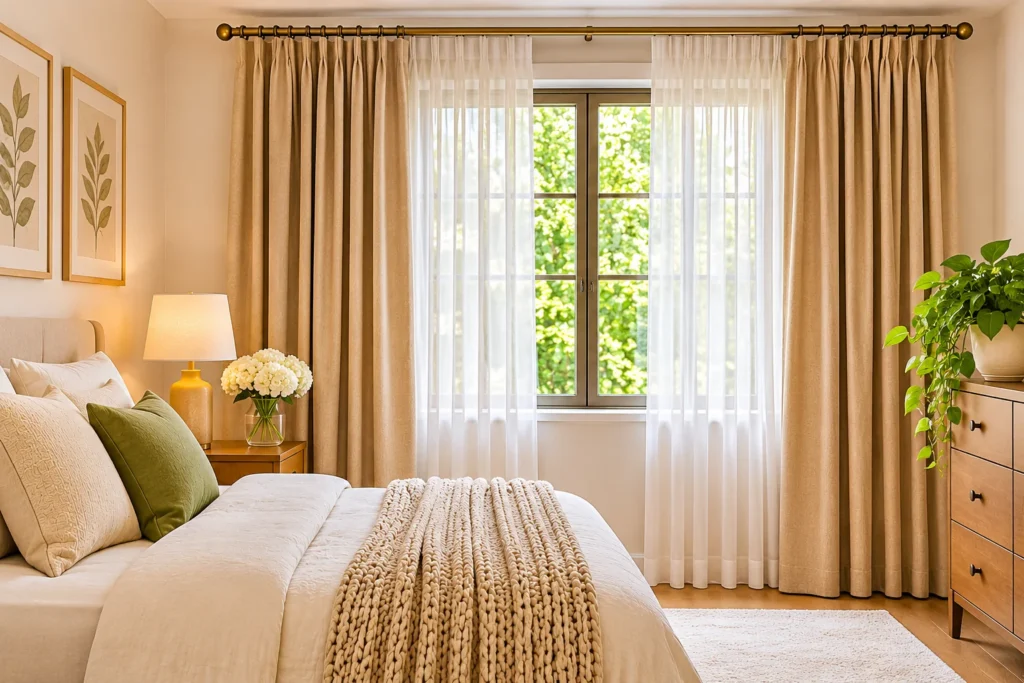
Bedroom curtain ideas are decorative and functional window treatment solutions designed to improve privacy, manage daylight, and complement bedroom interiors.
They include different curtain fabrics, colors, lengths, patterns, hanging systems, and layering techniques.
A well-chosen curtain arrangement can achieve several goals:
- Reduce unwanted morning sunlight.
- Improve nighttime privacy.
- Make ceilings appear taller.
- Introduce texture and visual warmth.
- Coordinate furniture, bedding, and wall colors.
- Help reduce unwanted heat transfer through windows.
The most successful curtain design balances appearance with everyday usability.
21 Best Bedroom Curtain Ideas to Transform Your Space
1. Floor-Length Linen Curtains
Floor-length linen curtains create a relaxed, natural appearance that suits contemporary, Scandinavian, and farmhouse bedrooms.
The slightly uneven texture adds character without overwhelming the room. Choose lined linen curtains when you need additional privacy.
- Best colors: Oatmeal, ivory, beige, and taupe.
- Best for: Relaxed and minimalist interiors.
- Styling tip: Pair with natural wood furniture and cotton bedding.
2. Blackout Curtains for Better Darkness
Blackout curtains help reduce unwanted light from streetlights, sunrise, and neighboring buildings. They are particularly useful for light-sensitive sleepers and night-shift workers.
Remember that blackout fabric alone cannot eliminate every light gap. Proper installation matters just as much.
Extend the curtain coverage beyond the window frame and consider a wraparound rod for better edge coverage.
3. Layered Sheer and Blackout Curtains
Layered curtains provide flexibility throughout the day. Sheer inner panels soften sunlight, while blackout outer curtains offer greater darkness and privacy.
This combination works especially well in primary bedrooms with large windows.
- Install a double curtain rod or track.
- Use white or ivory sheer inner panels.
- Choose coordinated opaque outer curtains.
- Open each layer independently as needed.
For additional inspiration, explore IKEA’s bedroom curtain ideas for combining different window treatments.
4. Ceiling-Mounted Curtains
Ceiling-mounted curtains create a continuous vertical line from ceiling to floor. This arrangement makes windows appear taller and gives bedrooms a polished appearance.
Concealed ceiling tracks are especially attractive in contemporary interiors.
Check ceiling construction and hardware requirements before installing a track. Heavy curtains need properly supported mounting points.
5. White Sheer Bedroom Curtains
White sheer curtains filter daylight and create an airy atmosphere. They work beautifully in bedrooms with neutral walls and light-colored furniture.
However, sheer curtains provide limited nighttime privacy when indoor lights are on.
- Ideal for: Bright, Scandinavian-style bedrooms.
- Pair with: Opaque curtains or cordless shades.
- Avoid: Using sheers alone where full privacy is necessary.
6. Neutral Beige Curtains
Beige curtains offer a warm alternative to plain white. They complement natural wood, cream bedding, woven baskets, and earthy accessories.
Choose a beige shade that shares the undertone of your walls or flooring. Warm beige and cool gray can clash when their undertones differ significantly.
7. Luxury Velvet Curtains
Velvet curtains bring depth, softness, and visual richness to bedroom windows. Their heavier appearance suits traditional, glamorous, and boutique hotel-inspired interiors.
Choose a sturdy curtain rod designed to support the fabric’s weight.
- Elegant colors: Emerald green, navy, burgundy, and charcoal.
- Best pairing: Brass hardware and upholstered headboards.
- Maintenance: Follow the fabric-specific cleaning instructions.
8. Soft Sage Green Curtains
Sage green curtains introduce a subtle connection to nature without making the room feel overly colorful.
Pair them with cream bedding, oak furniture, and warm white walls for a calm, coordinated bedroom.
9. Two-Tone Curtain Panels
Two-tone curtains feature different colors within a single panel. They introduce contrast while keeping the window treatment visually organized.
Choose combinations that repeat existing bedroom colors rather than introducing unrelated shades.
- White and beige for soft contrast.
- Gray and navy for contemporary interiors.
- Cream and sage for natural bedrooms.
- Ivory and terracotta for warm interiors.
10. Pinch-Pleat Curtains
Pinch-pleat curtains use stitched fabric folds to create a structured, tailored appearance. They look particularly elegant in traditional and transitional bedrooms.
Use compatible hooks, rings, or curtain tracks. Proper panel fullness helps maintain the decorative folds.
11. Minimalist Ripple-Fold Curtains
Ripple-fold curtains form smooth, repeating waves across the window. Their simple appearance makes them ideal for modern bedrooms.
They generally require a compatible track and curtain heading system to maintain consistent spacing.
Choose warm white, stone gray, or oatmeal for an understated finish.
12. Floral Patterned Bedroom Curtains
Floral curtains introduce color and personality without requiring major furniture changes. Small botanical patterns suit cottage bedrooms, while larger prints create stronger focal points.
Keep surrounding textiles relatively simple so competing patterns don’t overwhelm the room.
Coordinate printed curtains with these bedroom wall decor ideas for a more cohesive interior.
13. Striped Curtains for Visual Height
Vertical striped curtains can emphasize the height of a bedroom. Subtle stripes work especially well when ceilings feel low.
Choose low-contrast stripes for small rooms and stronger patterns for larger spaces.
14. Thermal-Lined Bedroom Curtains
Thermal-lined curtains can help limit unwanted heat exchange through windows. Their effectiveness depends on fabric construction, window conditions, and installation.
Close them when outdoor temperatures make heat transfer undesirable. Open them when useful sunlight can warm the room.
Visit the U.S. Department of Energy for broader information about residential energy efficiency.
15. Short Curtains for Compact Windows
Short curtains work well where floor-length panels would interfere with desks, radiators, or other furniture.
Choose a neat sill-length or below-sill finish rather than an arbitrary curtain length.
- Measure furniture clearance.
- Keep fabric away from heating appliances.
- Choose lightweight, easy-care materials.
- Maintain access to window handles.
16. Dark Navy Curtains
Navy curtains create sophisticated contrast against white, cream, and pale gray bedroom walls. They can also establish a strong visual focal point.
Balance darker curtains with lighter bedding and adequate bedroom lighting.
17. Natural Cotton Curtains
Cotton curtains offer a familiar, comfortable texture that suits casual bedroom interiors. Their appearance varies from lightweight woven panels to thicker lined designs.
Check whether the fabric can be machine washed. Some cotton curtains may shrink if cleaned incorrectly.
18. Curtains With Decorative Tiebacks
Decorative tiebacks keep curtains open while adding another design detail. Metal holdbacks, fabric bands, and magnetic styles create different appearances.
Choose tiebacks that complement your curtain rod and furniture hardware.
Avoid accessible cord loops in children’s bedrooms or rooms where young children visit.
19. Wall-to-Wall Bedroom Curtains
Wall-to-wall curtains extend across a large section of the bedroom wall rather than covering only the window.
This arrangement can unify multiple windows and soften an otherwise plain wall.
- Use a properly supported continuous track.
- Allow enough room for folded curtain panels.
- Keep switches and ventilation openings accessible.
- Choose a fabric that doesn’t visually overwhelm the room.
20. Curtains Matching the Bedding
Coordinating curtain and bedding colors creates a visually connected bedroom. However, matching every textile exactly can make the room feel flat.
I prefer repeating a shared color while introducing different fabric textures.
For example, oatmeal curtains work beautifully with ivory bedding and a textured beige throw.
21. Curtains Combined With Cordless Roman Shades
Roman shades fold upward into horizontal fabric sections. Combining cordless Roman shades with curtains creates a layered and practical window treatment.
Use the shade for everyday light control and the outer curtains for softness and decoration.
The Consumer Product Safety Commission’s window covering safety guidance recommends cordless options to reduce strangulation risks for children.
Which Curtain Fabric Is Best for a Bedroom?
The best bedroom curtain fabric depends on the desired appearance, privacy, daylight control, and maintenance requirements.
Linen suits natural interiors, velvet creates a luxurious finish, and lined polyester provides practical light control.
| Fabric | Light Control | Best Use | Maintenance |
|---|---|---|---|
| Linen | Low–moderate | Natural interiors | Moderate |
| Cotton | Low–moderate | Casual bedrooms | Easy–moderate |
| Velvet | Moderate–high | Luxury bedrooms | More demanding |
| Sheer voile | Low | Daylight filtering | Generally easy |
| Blackout-lined polyester | High | Dark sleeping spaces | Follow care label |
| Thermal-lined fabric | Moderate–high | Temperature management | Follow care label |
These are general fabric characteristics rather than guaranteed performance ratings. Weave density, lining, and construction can significantly change the results.
What Are the Best Curtain Colors for Bedrooms?
The best bedroom curtain colors complement the walls, bedding, furniture, and natural light. Warm neutrals create softness, while darker shades provide contrast and visual depth.
- White: Bright, clean, and minimalist.
- Beige: Warm, flexible, and timeless.
- Sage green: Natural and understated.
- Light gray: Suitable for cooler contemporary palettes.
- Navy blue: Rich and sophisticated.
- Terracotta: Earthy and welcoming.
- Dusty pink: Soft and romantic.
Consider your flooring and rug before selecting curtain colors. This guide on choosing a bedroom rug color can help coordinate the room’s textiles.
What Curtain Ideas Make a Small Bedroom Look Bigger?
Light-colored curtains, high-mounted rods, and long vertical panels can make small bedrooms appear more spacious. Simple fabrics also reduce visual clutter.
My preferred starting point is a warm white curtain with a slim, uncomplicated curtain rod.
- Hang curtains above the window frame.
- Extend the rod beyond both window edges.
- Choose curtains close to the wall color.
- Avoid oversized, high-contrast patterns.
- Use floor-length panels where space permits.
- Keep curtain hardware visually simple.
Leave enough room for the panels to gather beside the window. This helps expose more glass when the curtains are open.
How Do You Measure Bedroom Curtains Correctly?
Measure bedroom curtains using the planned rod or track width and the distance from the hanging point to the desired hem.
Allow extra fabric width to create attractive folds when the curtains close.
- Measure the window: Record the width and height of the outer frame.
- Plan rod placement: Start around 4–6 inches above the window frame.
- Extend the rod: Allow approximately 6–10 inches on each side where space permits.
- Calculate fullness: Target around 1.5–2 times the usable rod width for standard gathered curtains.
- Measure curtain length: Measure from the actual hanging point to the intended hem.
- Check clearance: Consider furniture, flooring, radiators, and ventilation.
Practical Curtain Measurement Example
Imagine a bedroom window that measures 48 inches wide. Adding 6 inches on each side creates a 60-inch usable rod width.
- Window width: 48 inches.
- Rod width: 60 inches.
- Desired fullness: Approximately 2 times.
- Total flat fabric width: 120 inches.
- Two equal panels: Approximately 60 inches wide each.
Adjust these measurements for the curtain heading style. Tailored pleated systems may require different calculations from standard rod-pocket panels.
How Long Should Bedroom Curtains Be?
Floor-length curtains generally provide the most polished bedroom appearance. Shorter curtains remain practical when furniture or heating equipment occupies the space below windows.
| Curtain Length | Hem Position | Best For |
|---|---|---|
| Sill length | Near window sill | Compact windows |
| Apron length | Below window sill | Casual bedrooms |
| Floating length | About 0.5–1 inch above floor | Everyday use |
| Floor-skimming | Just touches floor | Elegant interiors |
| Puddle length | Extra fabric rests on floor | Formal bedrooms |
I favor slightly floating curtains for everyday bedrooms because they are easier to operate and clean around.
How Can You Style Bedroom Curtains on a Budget?
You don’t need custom-made curtains to achieve a coordinated bedroom. Affordable ready-made panels can look attractive with careful measuring and installation.
- Choose standard curtain sizes whenever possible.
- Use simple metal curtain rods.
- Hem oversized panels to the correct length.
- Add separate blackout lining when appropriate.
- Steam wrinkles according to fabric instructions.
- Reuse existing curtains with updated hardware.
- Choose timeless solid colors instead of short-lived trends.
Prioritize correct width and length before spending money on expensive fabrics.
For a complete room refresh, follow this guide on how to decorate a bedroom around practical improvements.
What Bedroom Curtain Mistakes Should You Avoid?
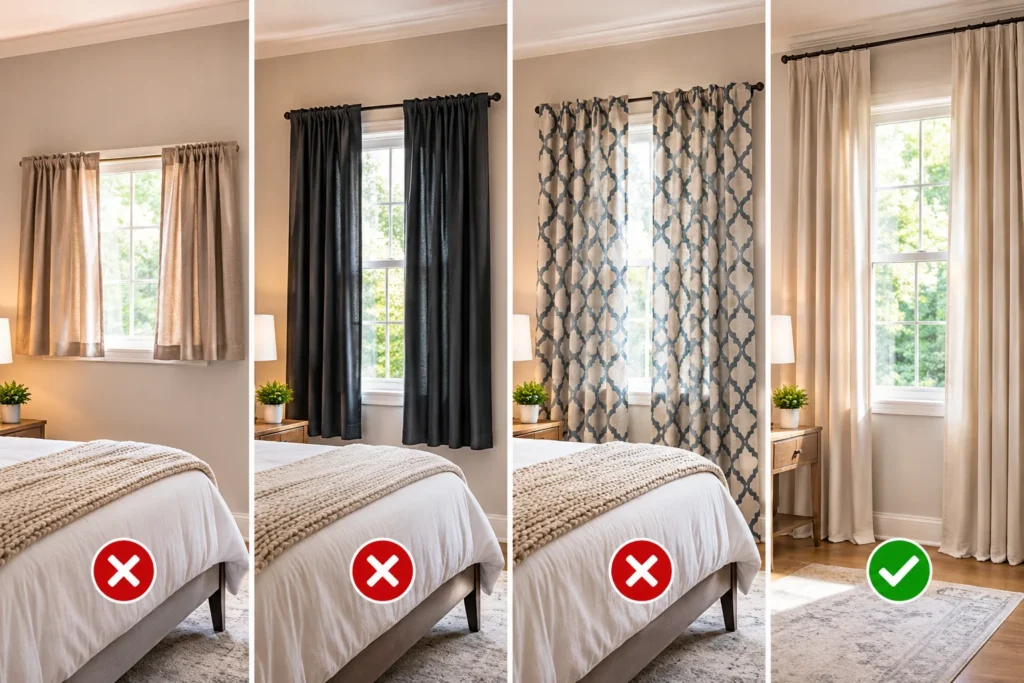
Common bedroom curtain mistakes include incorrect measurements, insufficient fabric fullness, poor light coverage, and unsuitable colors.
- Hanging curtains too low: This can visually shorten the room.
- Buying narrow panels: Insufficient fabric creates a stretched appearance.
- Ignoring nighttime privacy: Sheer curtains may reveal the interior after dark.
- Choosing weak hardware: Heavy curtains require compatible mounting systems.
- Blocking ventilation: Curtains should not obstruct necessary airflow.
- Covering heaters: Maintain manufacturer-specified safety clearances.
- Ignoring care labels: Incorrect washing can damage fabrics and linings.
- Obstructing escape windows: Keep emergency exits accessible.
Measure twice before ordering. A few minutes of preparation can prevent expensive replacement purchases.
Recommended Bedroom Curtains and Accessories
If you’re ready to update your windows, these three curtain options address different bedroom requirements. Confirm the available dimensions, lining, and care instructions before ordering.
Affiliate disclosure: As an Amazon Associate, we earn from qualifying purchases.
🌙 Best for darkness
NICETOWN Grommet Blackout Curtains
★★★★½ 4.5/5 editorial suitability
These curtains feature grommet headings and room-darkening or blackout fabric options. I’d consider them for bedrooms exposed to early morning sunlight or outdoor lighting.
☀️ Best for natural light
NICETOWN Linen Sheer Curtains
★★★★☆ 4/5 editorial suitability
The 52-by-84-inch panel option offers textured, light-filtering fabric with compatible heading choices. I’d pair these curtains with opaque panels for nighttime privacy.
🏡 Best for textured decor
H.VERSAILTEX Linen-Look Blackout Curtains
★★★★½ 4.5/5 editorial suitability
These curtains combine a textured linen-like appearance with blackout lining options. I’d choose this style when natural-looking decor and stronger light control are equally important.
Editorial suitability scores reflect intended use cases rather than verified customer ratings or hands-on product testing. Product specifications may vary between options.
Frequently Asked Questions
What type of curtains is best for a bedroom?
Blackout curtains are suitable for bedrooms requiring greater darkness, while linen and cotton curtains offer a softer decorative appearance. Layering sheer and blackout curtains provides flexible light control throughout the day and stronger privacy at night.
Should bedroom curtains be lighter or darker than the walls?
Light curtains can create an airy appearance, while darker curtains add depth and contrast. Choosing curtains slightly lighter or darker than the walls creates subtle visual separation without overwhelming the bedroom’s existing color scheme.
Should bedroom curtains touch the floor?
Bedroom curtains can touch the floor for an elegant finish or hang approximately half an inch above it. Slightly elevated hems are practical for everyday use because they reduce contact with dust and make floor cleaning easier.
Are sheer curtains suitable for bedrooms?
Sheer curtains are suitable for bedrooms that benefit from soft natural daylight. However, they generally provide limited nighttime privacy, so combining them with opaque curtains or cordless shades creates a more practical window treatment.
What bedroom curtains are in style in 2026?
For a contemporary bedroom in 2026, consider textured linen-look fabrics, ceiling-mounted tracks, neutral colors, structured pleats, and layered curtains. These design choices offer a combination of understated decoration, practical light management, and long-term versatility.
Final Thoughts: Choose Bedroom Curtains That Balance Style and Comfort
The best bedroom curtain ideas improve both the appearance and everyday function of your space. Start by identifying your privacy needs, preferred light levels, and interior design style.
Choose neutral linen curtains for a relaxed bedroom or layered blackout curtains when flexible lighting is important. Measure carefully and select hardware that supports your chosen fabric.
My recommendation is to prioritize fit, functionality, and color coordination before expensive materials. A simple curtain arrangement can look exceptional when installed thoughtfully.
Start with one window, apply the styling ideas that suit your room, and create a bedroom that feels comfortable, coordinated, and welcoming.