

Quick Answer
Curtains are generally better for bedrooms where comfort, darkness and a cozy atmosphere matter most. Blinds are better for compact spaces, adjustable daylight and a clean, modern appearance. Combining cordless blinds with blackout curtains can provide an excellent balance of daytime privacy, nighttime darkness and decorative flexibility.
Choosing between blinds vs curtains for a bedroom involves more than deciding which window treatment looks better. Your choice affects morning sunlight, nighttime privacy, temperature control, available space and how comfortable your bedroom feels.
A beautifully decorated bedroom may still feel uncomfortable if sunlight enters too early or people outside can see through the windows at night. Understanding how different window coverings work makes it easier to avoid these problems.
What Is the Difference Between Bedroom Blinds and Curtains?
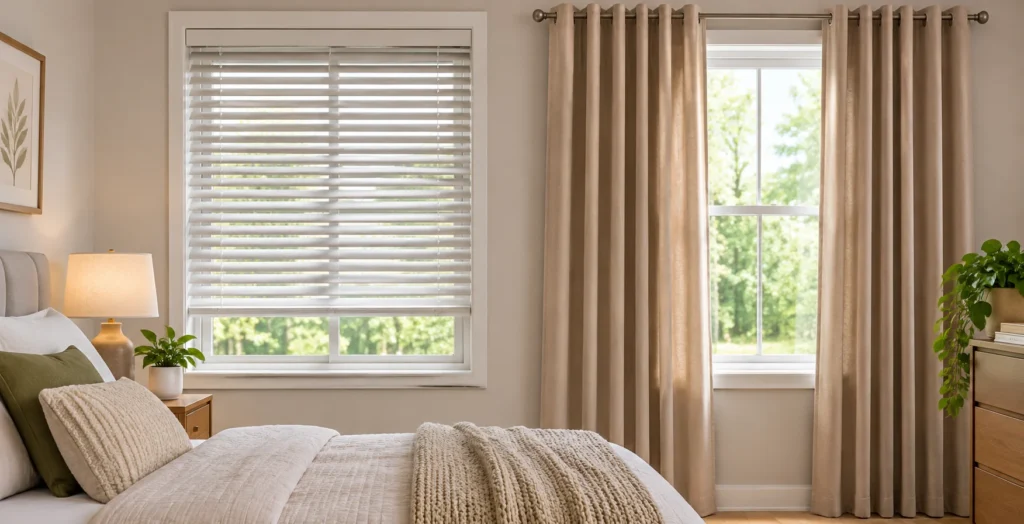
Bedroom blinds are structured window coverings that usually fit inside or directly above a window frame. Curtains are fabric panels that hang from a rod or track and typically cover a wider area around the window.
The main difference is how they manage light, privacy and the appearance of the room.
Bedroom Blinds
Traditional blinds use adjustable slats made from materials such as wood, faux wood, aluminum or vinyl. The slats tilt to regulate sunlight and visibility.
Roller shades, Roman shades and cellular shades are also commonly called blinds, although their construction differs from traditional slatted blinds.
Popular bedroom options include:
- Venetian blinds for adjustable daylight.
- Blackout roller blinds for room darkening.
- Roman shades for a softer appearance.
- Cellular shades for improved thermal performance.
- Vertical blinds for wide windows and sliding doors.
Bedroom Curtains
Curtains consist of fabric panels that move horizontally along a rod or track. They are available in different lengths, fabric weights, colors and levels of opacity.
Common bedroom curtain options include:
- Sheer curtains that diffuse daylight.
- Blackout curtains that reduce unwanted light.
- Thermal curtains designed to improve insulation.
- Linen curtains for a relaxed, natural appearance.
- Velvet curtains for a richer, more decorative finish.
- Room-darkening curtains that reduce brightness without necessarily blocking all transmitted light.
Blinds primarily offer a compact and functional window covering, while curtains can become a major part of the bedroom’s interior design.
Blinds vs Curtains for a Bedroom: Quick Comparison
The following comparison highlights the practical differences that matter when choosing bedroom window treatments.
| Feature | Bedroom Blinds | Bedroom Curtains |
|---|---|---|
| Light control | Precise with adjustable slats | Depends on fabric and position |
| Blackout potential | Excellent with suitable blackout shades | Excellent with blackout lining and proper coverage |
| Privacy | Adjustable, depending on design | Strong with opaque fabric |
| Insulation | Varies; cellular shades can perform well | Good with suitable lining and installation |
| Space requirements | Generally compact | May require extra wall and floor clearance |
| Appearance | Clean and structured | Soft and decorative |
| Cleaning | Dusting or material-specific cleaning | Vacuuming, washing or dry cleaning |
| Installation | Requires accurate window measurements | Requires a suitable rod or track |
| Cost | Depends on material, size and mechanism | Depends on fabric, lining and hardware |
Neither option wins every category. The best bedroom window treatment is the one that addresses your biggest problem without introducing unnecessary maintenance or installation difficulties.
Are Blinds or Curtains Better for Blocking Light?
Properly installed blackout curtains are often a practical choice for bedrooms that need substantial darkness. However, blackout roller shades and blackout cellular shades can perform equally well when their edges are designed to minimize light leakage.
How Blinds Control Bedroom Light
Adjustable slatted blinds allow you to change the direction and amount of incoming sunlight without completely uncovering the window.
This is particularly useful when you want to read, work or relax during the day without direct sunlight reaching your bed or computer screen.
However, traditional blinds can allow light to enter through slat openings, cord holes and perimeter gaps. Blackout roller shades eliminate many of these openings but may still allow light around the sides.
How Curtains Control Bedroom Light
Blackout curtains use opaque fabric or specialized lining to reduce light transmission through the material. Hanging them beyond the edges of the window can also help reduce light entering around the frame.
For better darkness, consider:
- Blackout fabric rather than ordinary decorative fabric.
- A rod or track extending beyond the window edges.
- Sufficient panel width to prevent center gaps.
- Coverage above and below the window opening.
- A mounting system that keeps fabric reasonably close to the wall.
Key Insight
Blackout fabric and a completely dark bedroom are not the same thing. Even opaque material can leave the room bright if light enters through the top, sides, bottom or center of the window covering. Installation quality matters as much as fabric selection.
Which Provides Better Bedroom Privacy?
Opaque curtains generally provide dependable privacy when fully closed, while adjustable blinds offer more flexibility when you want privacy and natural light simultaneously.
Slatted blinds allow you to direct daylight upward or downward. Depending on the window height and outside viewing angle, this may reduce visibility into the room without making it completely dark.
Sheer curtains provide some daytime screening, but they should not be relied on for nighttime privacy when indoor lights are brighter than the outdoor surroundings.
For bedrooms facing streets, sidewalks or neighboring buildings, suitable options include:
- Opaque blackout curtains.
- Blackout roller shades.
- Top-down, bottom-up cellular shades.
- Adjustable slatted blinds combined with curtains.
- Sheer curtains paired with a separate opaque layer.
A ground-floor bedroom may benefit from a top-down, bottom-up shade because it can cover the lower portion of the window while allowing daylight through the upper portion.
Always evaluate privacy from outside the window after dark, where it is safe and practical to do so.
Are Curtains or Blinds Better for Bedroom Insulation?
Thermal curtains and cellular shades can both improve bedroom comfort. Ordinary slatted blinds are generally more useful for managing sunlight than creating an insulating barrier.
Thermal Curtains for Cold Bedrooms
Suitable thermal curtains can reduce some heat exchange near windows, particularly when they cover the window thoroughly and limit air movement around their edges.
Their effectiveness depends on:
- Fabric and lining construction.
- Distance between the curtain and window.
- Coverage around the window opening.
- Window condition and glazing.
- How consistently the curtains are opened and closed.
Avoid covering radiators, heating vents or other equipment in ways that conflict with the manufacturer’s clearance requirements.
Cellular Shades for Temperature Control
Cellular shades feature honeycomb-shaped compartments that create insulating air spaces. Their structure makes them worth considering for bedrooms with uncomfortable window temperatures.
The U.S. Department of Energy’s information on energy-efficient cellular shades explains their role in improving residential thermal performance.
If your bedroom becomes excessively hot in the afternoon, closing a suitable window covering before strong sunlight enters may improve comfort. During colder weather, opening coverings to admit useful sunlight and closing them afterward may also help.
Window coverings cannot fully compensate for damaged window seals, substantial air leakage or poorly performing glazing.
Which Looks Better in a Bedroom?
Curtains usually provide a softer and more decorative appearance, while blinds complement bedrooms that favor clean lines, minimalism and compact furniture arrangements.
Choose Curtains for a Cozy Bedroom
Fabric curtains introduce texture, movement and softness. They can balance hard surfaces such as wooden furniture, painted walls and tiled or hardwood flooring.
Curtains work particularly well with:
- Traditional bedroom interiors.
- Modern farmhouse bedrooms.
- Bohemian decor.
- Hotel-inspired bedrooms.
- Luxury and romantic bedroom styles.
- Neutral and Scandinavian interiors.
Floor-length curtains installed above the window can draw the eye upward and create the impression of greater ceiling height.
Choose Blinds for a Modern Bedroom
Blinds can keep the visual focus on the window, furniture and architectural features without introducing large areas of hanging fabric.
They are especially suitable for:
- Minimalist bedrooms.
- Small apartments.
- Contemporary interiors.
- Bedrooms with limited wall space.
- Windows positioned above desks or dressers.
Roman shades offer a useful middle ground because their fabric construction provides softness without requiring full-length curtain panels.
Are Blinds or Curtains Better for Small Bedrooms?
Blinds are often more practical for small bedrooms because they can fit within the window recess without using valuable space beside the window.
Consider blinds when:
- The bed sits close to the window.
- A desk or dresser occupies the space below the window.
- The room has narrow walkways.
- There is little space for curtains to stack when open.
- The window is close to a room corner.
However, curtains can also make a small bedroom look larger when their color, length and mounting position are chosen carefully.
Light-colored curtains mounted near the ceiling can create a sense of height, while a rod extending beyond the window may make the window appear wider.
The deciding factor is not simply room size. It is whether hanging fabric interferes with furniture, circulation or everyday window operation.
Which Is Easier to Clean and Maintain?
Blinds can be convenient for routine surface cleaning, while washable curtains may be easier to clean thoroughly. Maintenance requirements vary considerably by material.
Cleaning Bedroom Blinds
Hard-surface blinds can often be cleaned with a microfiber cloth, soft brush or vacuum attachment suitable for the material.
Horizontal slats may require individual dusting, especially in bedrooms where windows are frequently open.
Fabric roller shades and cellular shades need different cleaning methods. Follow the manufacturer’s instructions to avoid damaging the fabric, folds or operating mechanism.
Cleaning Bedroom Curtains
Some cotton and polyester curtains are machine washable, while velvet, delicate linen and certain blackout-lined fabrics may require specialized cleaning.
Check the care label before washing. Heat, harsh detergents and unsuitable drying methods can damage certain blackout coatings or cause fabric shrinkage.
If easy maintenance is your priority, compare washable curtains with smooth, accessible blinds rather than assuming one category is always easier to clean.
Are Blinds Cheaper Than Curtains?
Basic ready-made blinds and simple curtain panels can both be affordable. Neither window treatment is consistently cheaper across all window sizes, materials and installation requirements.
The total cost of blinds may include:
- Window measurements and customization.
- Blind or shade material.
- Mounting brackets and operating mechanisms.
- Blackout or insulating features.
- Professional installation when required.
The total cost of curtains may include:
- One or more fabric panels.
- Blackout or thermal lining.
- Curtain rods or ceiling tracks.
- Brackets, rings and other accessories.
- Alterations or installation.
Compare complete installed costs for the same window rather than comparing the price of a single curtain panel against an entire blind assembly.
For a large bedroom window, ready-made curtain panels may be economical. For a narrow standard-sized window, a simple cordless blind may cost less.
Pros and Cons of Bedroom Blinds
| Advantages | Disadvantages |
|---|---|
| Compact installation | May require precise measurements |
| Flexible light control with slatted designs | Light may enter around edges or slats |
| Clean, modern appearance | Hard blinds may feel less cozy |
| Suitable for furniture beneath windows | Slats and mechanisms may become damaged |
| Available in cordless designs | Some designs require detailed dusting |
Pros and Cons of Bedroom Curtains
| Advantages | Disadvantages |
|---|---|
| Soft and inviting appearance | May require additional wall clearance |
| Excellent decorative flexibility | Fabric can collect dust |
| Effective blackout options available | Poor installation may allow light leakage |
| Thermal lining options | Heavy curtains require suitable hardware |
| Easy to change the room’s appearance | Some fabrics require specialized cleaning |
Can You Use Blinds and Curtains Together in a Bedroom?
Yes. Combining blinds and curtains allows each window covering to perform a different function. This is particularly useful when you need adjustable daylight during the day and substantial darkness at night.
Blinds can sit close to the window and manage everyday light or privacy. Curtains provide an additional decorative or blackout layer.
1. Venetian Blinds With Blackout Curtains
Use adjustable slats during the day and close blackout curtains at bedtime. This combination is particularly useful for bedrooms exposed to streetlights or early morning sunlight.
2. Blackout Roller Blinds With Sheer Curtains
Blackout roller blinds provide the main light-blocking layer, while sheer curtains soften the appearance of the window.
This combination suits modern bedrooms where heavy decorative curtains would feel excessive.
3. Cellular Shades With Linen Curtains
Cellular shades offer functional light and temperature management, while linen curtains introduce a relaxed, natural texture.
4. Roman Shades With Floor-Length Curtains
This pairing creates a more decorative, layered appearance. Coordinate colors and patterns so the two coverings complement rather than compete with each other.
Before installing both layers, check window depth, handle clearance, curtain rod placement and how the window opens. The coverings should not obstruct any required emergency exit.
Which Window Treatment Is Best for Different Bedrooms?
Use the following recommendations to match your window covering to the actual needs of your bedroom.
| Bedroom Type | Suitable Option |
|---|---|
| Small bedroom | Roller blinds or Roman shades |
| Master bedroom | Layered curtains and blinds |
| Children’s bedroom | Cordless blackout shades or hand-drawn curtains without accessible cords |
| Modern bedroom | Cordless roller blinds |
| Luxury bedroom | Floor-length lined curtains |
| Cold bedroom | Cellular shades or thermal curtains |
| Sunny bedroom | Suitable solar-control shades or lined curtains |
| Bedroom for daytime sleeping | Blackout shades with perimeter light control and overlapping curtains |
| Rental bedroom | Approved removable shades or suitable tension-rod curtains |
These recommendations are starting points rather than universal rules. Window dimensions, installation restrictions and personal preferences may change the best choice.
Child Safety Warning
Accessible window covering cords can present a serious strangulation hazard. The U.S. Consumer Product Safety Commission recommends cordless window coverings where young children are present. Keep beds, cribs and climbable furniture away from window cord hazards.
How to Choose Between Bedroom Blinds and Curtains
Follow these six steps before deciding which window treatment to install.
Identify your main priority.Decide whether darkness, privacy, insulation, decoration or space-saving is the most important requirement.
Measure your window.Measure the opening, frame depth, nearby wall space and available mounting height. Check the manufacturer’s measurement instructions before ordering blinds.
Evaluate sunlight exposure.Notice when direct sunlight enters the room. East-facing windows commonly receive morning sunlight, while west-facing windows commonly receive afternoon sunlight.
Check furniture and window clearance.Make sure the treatment will not interfere with your bed, dresser, window handles, heating equipment or required escape openings.
Compare the complete cost.Include all fabric panels, hardware, lining, customization and installation requirements.
Choose one or two functional layers.Install a single covering when it meets your needs. Combine blinds and curtains when one layer cannot adequately provide both daytime and nighttime functionality.
Common Bedroom Window Treatment Mistakes

Avoiding these mistakes can improve bedroom comfort without unnecessarily increasing your budget.
Choosing Appearance Over Function
Beautiful sheer curtains may complement your bedroom decor but fail to provide adequate nighttime privacy. Determine practical requirements before selecting colors and patterns.
Ignoring Light Gaps
Blackout material alone does not prevent light leakage. Check perimeter coverage and the location where curtain panels meet.
Ordering Incorrect Blind Measurements
Inside-mounted blinds require suitable recess depth and accurate dimensions. Follow the supplier’s instructions regarding deductions instead of assuming that every blind uses the same measuring method.
Using Sheer Curtains for Nighttime Privacy
Sheer fabric may reveal silhouettes or interior details after dark. Add an opaque curtain or shade when reliable privacy is necessary.
Overlooking Child Safety
Choose cordless designs in bedrooms where young children live or visit. Avoid accessible loops and pull cords.
Blocking Furniture or Heating Equipment
Long curtains can interfere with furniture, vents and heaters. Check clearances before selecting curtain length or mounting positions.
Recommended Bedroom Window Covering Options
If you are comparing specific window coverings, these two product types illustrate different approaches to bedroom light control. Check current dimensions, installation requirements and specifications before ordering.
FOR FABRIC BLACKOUT COVERAGE
IKEA MAJGULL Blackout Curtains
Blackout curtain panels with heading tape and flexible mounting options. A suitable example for bedrooms that need substantial light reduction and a softer decorative finish.
FOR COMPACT WINDOW COVERAGE
IKEA FÖNSTERBLAD Blackout Roller Blind
A cordless blackout roller blind design that offers a streamlined alternative to long curtains. Check frame dimensions and perimeter gaps to determine its suitability for your bedroom.
For additional options, you can compare bedroom blackout curtains and cordless window shades on Amazon.
Affiliate disclosure: As an Amazon Associate, we earn from qualifying purchases.
Frequently Asked Questions
Are blinds or curtains better for sleeping?
Blackout curtains and well-fitted blackout shades are both suitable for sleeping. Choose the option that minimizes unwanted light, including leakage around the window covering’s edges.
Is it better to have both blinds and curtains in a bedroom?
Both can be useful when you need adjustable daylight, nighttime privacy and additional blackout coverage. A single window covering is sufficient when it already meets your requirements.
Do curtains make a bedroom look bigger than blinds?
High-mounted, floor-length curtains can create an impression of height, while compact blinds can make a room feel less cluttered. The effect depends on window placement, colors and available space.
Which is better for a dusty bedroom?
Smooth-surface blinds can be convenient for frequent dust removal. Machine-washable curtains may also be practical because they can be cleaned thoroughly. Choose materials that suit your cleaning routine.
Can blinds completely darken a bedroom?
Specialized blackout shades with effective side and perimeter light control can achieve substantial darkness. Standard slatted blinds or loosely fitted roller blinds may allow noticeable light leakage.
Are curtains better than blinds for noise reduction?
Heavy curtains may absorb some sound within a bedroom, but ordinary curtains and blinds should not be considered soundproofing solutions. Window sealing and glazing are more important for reducing significant outdoor noise.
Should bedroom blinds match the curtains?
They do not need to match exactly. Coordinating undertones, textures and complementary colors usually creates a more cohesive appearance than selecting unrelated patterns.
Final Verdict: Blinds vs Curtains for a Bedroom
Choose curtains if your main priorities are a cozy atmosphere, decorative flexibility and effective blackout coverage. Choose blinds if you prefer compact installation, adjustable daylight and a streamlined appearance.
For bedrooms with demanding privacy and light-control requirements, combining cordless blinds with suitable blackout curtains can offer the advantages of both.
The best choice is the window treatment that supports your sleeping habits, fits your window correctly and complements the way you use your bedroom every day.