

Quick Answer
The best floating shelf ideas for bedrooms combine practical storage, attractive decoration, and efficient use of wall space. Floating bedside shelves, corner shelves, wooden shelves, and picture ledges help organize essentials without occupying valuable floor space. Choose designs that complement your bedroom furniture, color scheme, and storage requirements.
Best floating shelf ideas for bedrooms:
- Floating bedside shelves: Replace bulky nightstands and maximize floor space.
- Corner floating shelves: Turn unused corners into functional storage areas.
- Natural wooden shelves: Add warmth, texture, and visual interest.
- Floating picture ledges: Display artwork and personal photographs.
- Staggered floating shelves: Create an attractive decorative wall arrangement.
- Floating desk shelves: Organize bedroom workspaces efficiently.
Important installation tip:
- Prioritize safety: Use suitable mounting hardware, follow manufacturer instructions, and avoid placing heavy objects directly above sleeping areas.
Bedroom walls offer valuable storage space that often goes unused. Floating shelves transform empty walls into attractive and functional areas without making your bedroom feel crowded.
In this guide, I’ll share 21 floating shelf ideas for bedrooms, including practical storage solutions, modern decorating techniques, and small-bedroom shelving arrangements. You’ll also learn how to choose, position, style, and install floating shelves safely.
What Are Floating Shelves in a Bedroom?
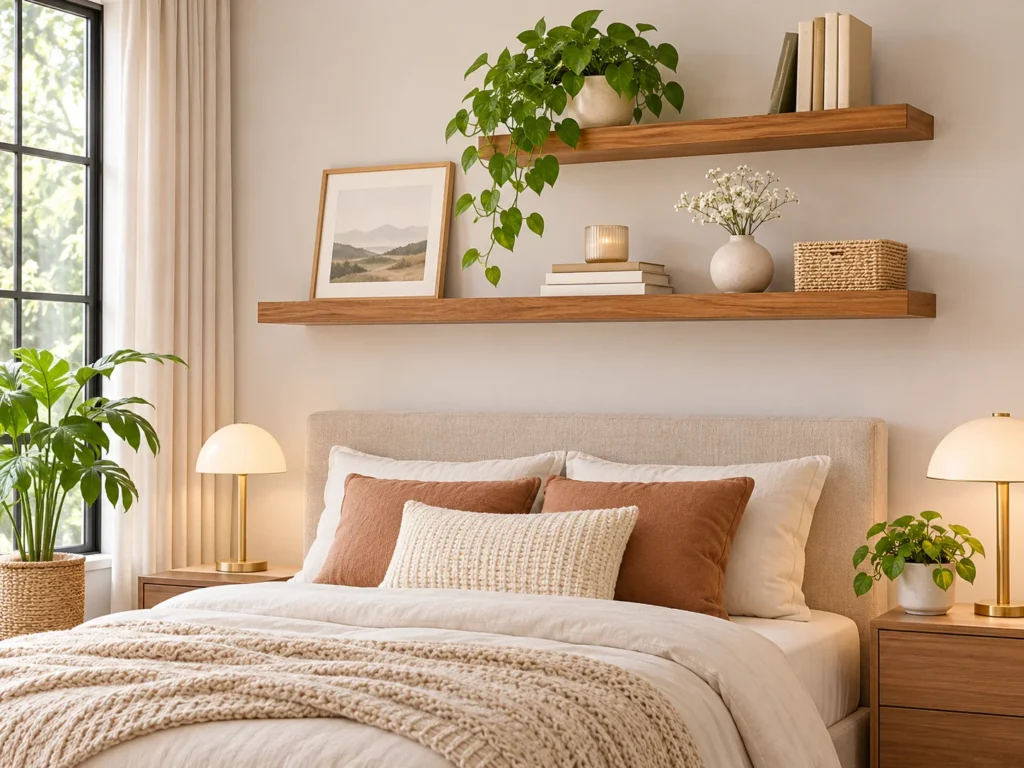
Floating shelves are wall-mounted shelves that use concealed brackets or hidden mounting hardware. Their design creates the appearance of shelves floating against the wall without visible supports.
Unlike traditional bookcases and storage cabinets, floating shelves leave the floor underneath open. This makes them particularly useful in bedrooms with limited space.
Common uses for bedroom floating shelves include:
- Storing books and bedtime essentials.
- Displaying framed photographs and artwork.
- Organizing skincare products and accessories.
- Displaying small indoor plants.
- Replacing traditional nightstands.
- Creating decorative wall arrangements.
- Organizing bedroom workspaces.
I recommend deciding whether your shelves will primarily serve a decorative or practical purpose before purchasing them. Shelves intended for heavy books require different dimensions and mounting support than decorative picture ledges.
21 Best Floating Shelf Ideas for Bedrooms
The following bedroom floating shelf ideas work with different room sizes, decorating styles, and storage requirements. Choose the designs that complement your bedroom while solving practical organization problems.
1. Replace Nightstands With Floating Bedside Shelves
Floating bedside shelves provide convenient storage without occupying valuable floor space. They’re especially useful in small bedrooms where traditional nightstands feel too bulky.
A shelf around 12 to 18 inches wide can accommodate a phone, book, and small decorative accessory. Choose the depth according to your everyday needs.
- Position the shelf near mattress height.
- Install a wall-mounted reading light.
- Choose a finish that matches your bedroom furniture.
- Keep the surface organized and uncluttered.
2. Install Floating Corner Shelves
Corner floating shelves transform awkward bedroom corners into useful storage areas. They make excellent use of spaces that traditional furniture cannot occupy efficiently.
Install two or three shelves vertically for an attractive display. Use them for lightweight plants, decorative accessories, photographs, or small personal belongings.
3. Choose Natural Wooden Floating Shelves
Natural wooden floating shelves introduce warmth and texture into bedroom interiors. Oak, walnut, and pine finishes work particularly well with neutral bedding and natural fabrics.
Match your shelf finish with existing furniture or introduce a contrasting wood tone. Repeating similar wood finishes throughout the room helps create a coordinated appearance.
4. Create a Staggered Floating Shelf Arrangement
Staggered floating shelves create visual interest by positioning shelves at different heights and horizontal locations. This arrangement works especially well on large bedroom walls.
Experiment with painter’s tape before drilling mounting holes. Balanced spacing helps the finished arrangement feel intentional rather than random.
5. Display Artwork on Floating Picture Ledges
Floating picture ledges provide a flexible way to display framed artwork and photographs. Their raised front edges help retain appropriately sized picture frames.
Combine different frame sizes while maintaining a consistent color palette. Picture ledges also allow you to update your artwork without drilling additional holes for every frame.
6. Add Minimalist White Floating Shelves
White floating shelves blend naturally into light-colored bedroom walls. They complement minimalist, Scandinavian, and contemporary bedroom designs.
Keep the styling simple with a small vase, framed photograph, or decorative book. Leaving some empty shelf space creates a cleaner appearance.
7. Use Black Floating Shelves for Contrast
Black floating shelves create a striking contrast against white, beige, and light gray bedroom walls. They work particularly well in modern and industrial-inspired interiors.
Repeat black accents through picture frames, lighting fixtures, or furniture handles. This helps the shelving arrangement feel connected to the rest of the bedroom.
8. Create a Floating Shelf Reading Corner
Floating bookshelves can transform an unused bedroom corner into a comfortable reading area. They keep favorite books accessible without requiring a large bookcase.
Choose shelves deep enough to support your books properly. Confirm their installed weight capacity before filling them.
- Add a comfortable reading chair.
- Include an adjustable reading lamp.
- Keep frequently read books within reach.
- Use a soft throw blanket for additional comfort.
9. Install Floating Shelves Above a Dresser
The wall above a dresser offers valuable space for decorative shelving. Floating shelves keep accessories organized while preserving the dresser surface for everyday use.
Choose shelf widths that complement the dresser underneath. Leave enough clearance for mirrors, lamps, and taller decorative objects.
10. Organize a Bedroom Desk With Floating Shelves
Floating shelves above a bedroom desk help organize stationery, notebooks, and work accessories. They also free up valuable desktop space.
Position the shelves high enough to provide comfortable working clearance. Avoid arrangements that interfere with your monitor or seating position.
11. Add Floating Shelves With LED Lighting
LED lighting beneath floating shelves introduces soft ambient illumination into bedrooms. It highlights decorative objects and creates a cozy evening atmosphere.
Choose warm-white lighting between approximately 2700K and 3000K for a softer appearance. Follow the lighting manufacturer’s installation instructions.
The U.S. Department of Energy provides information about energy-efficient lighting technologies.
12. Install Rustic Floating Wooden Shelves
Rustic floating shelves add natural texture and character to bedroom walls. Visible wood grain complements farmhouse, cottage, and vintage-inspired decorating styles.
Pair rustic shelves with simple ceramic accessories, neutral bedding, and natural fabrics. Avoid overcrowding the shelves with competing decorative elements.
13. Create an Indoor Plant Display
Floating shelves offer an attractive location for small indoor plants. Green foliage introduces natural color and softens plain bedroom walls.
Position plant shelves where suitable natural light is available. Use waterproof trays beneath pots to protect shelf surfaces from moisture.
The University of Minnesota Extension provides helpful information about growing and maintaining indoor plants.
14. Use Long Horizontal Floating Shelves
Long horizontal floating shelves create continuous visual lines across bedroom walls. This arrangement can make narrow walls appear more expansive.
Choose a shelf length proportionate to the available wall space. Longer shelves may require additional mounting support depending on their construction.
15. Create a Floating Shelf Gallery Wall
Combining floating picture ledges with framed artwork creates a flexible bedroom gallery wall. You can update the display whenever your decorating preferences change.
Mix different frame sizes while maintaining consistent colors or materials. Leave enough open space to distinguish individual artwork pieces.
16. Install Floating Shelves Beside a Mirror
Small floating shelves beside a bedroom mirror provide convenient storage for grooming accessories and decorative items. They can also serve as an alternative to a bulky dressing table.
Place matching shelves on both sides of the mirror for symmetry. Store frequently used belongings within comfortable reach.
17. Choose Floating Shelves With Hidden Drawers
Floating shelves with integrated drawers combine decorative display surfaces with concealed storage. They’re especially useful for keeping small bedroom essentials out of sight.
Use these shelves beside the bed or near a dressing area. Confirm drawer clearance and mounting requirements before purchasing.
18. Create a Monochromatic Floating Shelf Display
A monochromatic shelf display uses different shades of the same primary color. This decorating approach creates a calm and coordinated bedroom appearance.
For example, combine cream-colored shelves with ivory ceramics, beige books, and light wooden accessories. Different textures prevent the display from appearing flat.
19. Install Floating Shelves Inside Bedroom Alcoves
Bedroom alcoves provide natural locations for built-in-looking floating shelves. They transform recessed wall spaces into practical storage areas.
Measure the alcove at several heights before ordering shelves. Wall widths may vary, especially in older homes.
20. Use Floating Shelves for Jewelry and Accessories
Compact floating shelves help organize jewelry boxes, watches, sunglasses, and personal accessories. They keep everyday belongings accessible without cluttering furniture surfaces.
Use small trays and decorative containers to separate items. Store valuable jewelry in a secure location rather than on exposed shelves.
21. Combine Floating Shelves With Bedroom Wallpaper
Floating shelves installed against wallpaper create an attractive layered wall feature. Simple shelf designs work particularly well with patterned wallpaper.
Choose shelf colors that complement the wallpaper’s existing color palette. Keep decorative accessories minimal when the background already features detailed patterns.
Which Floating Shelves Are Best for Different Bedrooms?
The best bedroom floating shelves depend on room size, wall construction, storage requirements, and decorating preferences. Shallow shelves suit decorative displays, while deeper shelves offer more practical storage.
Use this comparison table as a starting point when planning your bedroom shelving arrangement. The dimensions are suggested guidelines rather than universal product specifications.
| Shelf Type | Suggested Size | Best For |
|---|---|---|
| Floating bedside shelf | 12–18 inches wide | Bedtime essentials |
| Picture ledge | 3–5 inches deep | Artwork and photographs |
| Corner floating shelf | 8–12 inches along each wall | Small bedrooms |
| Floating bookshelf | 8–12 inches deep | Books and reading areas |
| Long floating shelf | 36–48 inches wide | Large decorative walls |
| Floating drawer shelf | 15–24 inches wide | Hidden storage |
Measure the belongings you intend to store before choosing your shelves. Shelf depth, mounting requirements, and installed weight capacity matter more than appearance alone.
Where Should You Put Floating Shelves in a Bedroom?
The best places for floating shelves in bedrooms include bedside walls, unused corners, dressing areas, and walls above desks or dressers. Choose locations that remain accessible without interfering with everyday movement.
- Beside the bed: Keep phones, books, and bedtime essentials accessible.
- Above the dresser: Display decorative objects and personal accessories.
- Above a desk: Organize notebooks and office supplies.
- Inside alcoves: Create attractive built-in-style storage.
- In empty corners: Maximize otherwise unused wall space.
- Beside a mirror: Organize grooming and dressing accessories.
I prefer placing shelves intended for heavier belongings away from sleeping areas. This reduces falling-object risks and helps maintain a visually peaceful wall behind the bed.
How Do You Style Floating Shelves in a Bedroom?
Style bedroom floating shelves by combining different object heights, complementary colors, and natural textures. Leave intentional empty space to create a balanced and organized display.
Follow the Rule of Three
Grouping three complementary decorative objects often creates an attractive arrangement. Try combining a tall vase, a small framed photograph, and a horizontal stack of books.
The rule of three is a flexible decorating guideline rather than a requirement. Adjust your arrangement according to available shelf space.
Combine Different Heights and Textures
Decorative objects with different heights make shelves more visually interesting. Combining materials such as wood, ceramic, paper, and fabric adds depth.
Place taller accessories beside shorter objects to create variation. Avoid arrangements that feel overcrowded or unstable.
Maintain a Consistent Color Palette
Choose decorative accessories that complement your bedroom’s existing colors. Repeating two or three main colors can create a coordinated appearance.
- White and beige for minimalist bedrooms.
- Natural wood and cream for cozy bedrooms.
- Black and gray for modern interiors.
- Green and earthy colors for nature-inspired spaces.
Leave Enough Empty Space
Empty space helps individual decorative objects stand out. Start by leaving approximately one-third of the shelf surface open.
For example, a 36-inch shelf could include around 24 inches of decorative objects and 12 inches of empty space. Adjust this arrangement according to your preferences.
How Can Floating Shelves Make a Small Bedroom Look Bigger?
Floating shelves can make small bedrooms feel more spacious by reducing the need for bulky furniture and preserving visible floor space. Shallow shelves and light-colored finishes also help reduce visual clutter.
- Replace traditional nightstands with compact floating shelves.
- Choose shelf colors that match surrounding walls.
- Use vertical storage arrangements in empty corners.
- Avoid deep shelves beside narrow walking areas.
- Keep decorative accessories simple and minimal.
- Choose shelves proportionate to the room’s dimensions.
Adding too many shelves can make a small bedroom appear crowded. Focus on useful storage locations instead of covering every available wall.
What Is the Best Material for Bedroom Floating Shelves?
Solid wood is an attractive choice for bedroom floating shelves because of its natural appearance. Engineered wood offers affordable decorative options, while metal and acrylic suit contemporary interiors.
| Material | Advantages | Considerations |
|---|---|---|
| Solid wood | Natural appearance and warmth | May be heavier or more expensive |
| MDF | Affordable with a smooth finish | Sensitive to prolonged moisture |
| Metal | Modern industrial appearance | May feel visually cold |
| Acrylic | Transparent and visually lightweight | Can scratch during use |
| Engineered wood | Available in many decorative finishes | Quality varies by construction |
Material alone does not determine shelf strength. Bracket construction, mounting hardware, wall structure, and correct installation influence the safe installed load capacity.
How High Should Floating Shelves Be in a Bedroom?
Floating shelf height depends on intended use, furniture placement, and personal accessibility. Decorative shelves often work around eye level, while bedside shelves are generally most convenient near mattress height.
| Shelf Location | Suggested Placement |
|---|---|
| Beside the bed | Approximately mattress height |
| Decorative wall shelf | 54–60 inches from the floor as a starting point |
| Above a dresser | Approximately 16–24 inches above the surface, if suitable |
| Above a desk | Enough clearance for the monitor, lighting, and comfortable movement |
| Between stacked shelves | 12–16 inches for typical decorative objects |
These measurements are planning suggestions, not mandatory installation standards. Adjust them according to furniture dimensions, shelf contents, and individual accessibility requirements.
How Do You Install Floating Shelves Safely?
Safe floating shelf installation requires appropriate mounting hardware, suitable wall construction, and compliance with the manufacturer’s instructions. Never assume that all shelves have the same weight capacity.
Tools You May Need
- Measuring tape.
- Spirit level.
- Pencil.
- Suitable stud or service detector.
- Drill and appropriate drill bits.
- Manufacturer-approved mounting hardware.
- Screwdriver.
- Suitable eye protection.
Step-by-Step Installation Guide
- Identify the wall construction: Determine whether the wall consists of drywall, plaster, masonry, or another material.
- Check the manufacturer’s instructions: Review approved mounting methods, hardware requirements, and load limits.
- Choose the mounting location: Confirm that the shelves will not obstruct furniture or movement.
- Locate suitable supports: Identify wall studs or other approved attachment points where required.
- Check for concealed services: Avoid drilling into electrical wiring, plumbing, or other hidden installations.
- Mark the mounting positions: Use a measuring tape, pencil, and spirit level.
- Install the mounting brackets: Follow the manufacturer’s specific fastening instructions.
- Secure the floating shelf: Attach the shelf to its mounting system and install locking hardware where required.
- Inspect the installation: Confirm that the shelf is secure before placing belongings on it.
Retailers such as The Home Depot offer mounting hardware and home improvement tools for different wall types.
Consult a qualified installer if you are uncertain about wall construction, concealed services, or suitable mounting hardware. Avoid improvised installation methods.
Common Floating Shelf Decorating Mistakes to Avoid
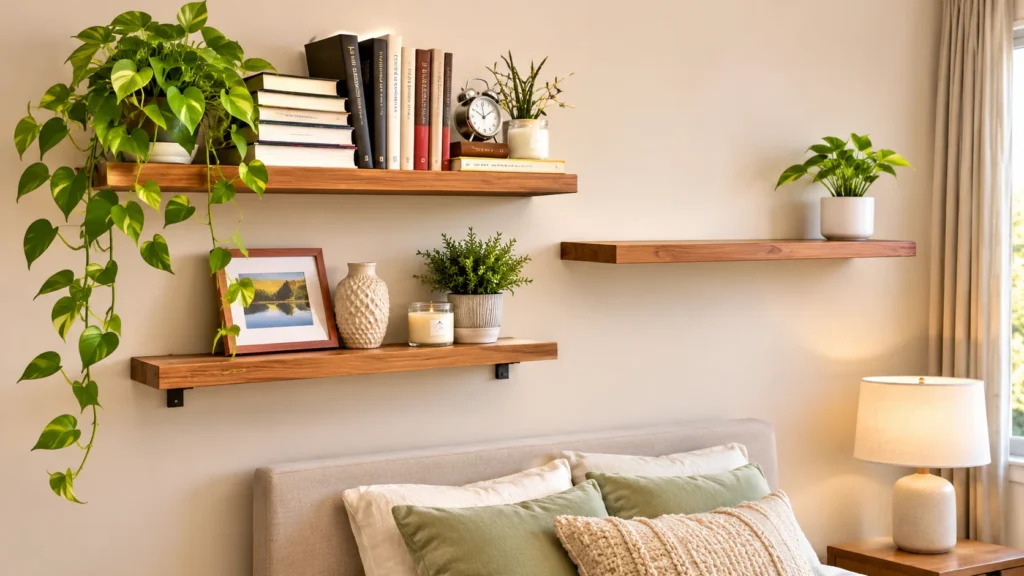
Most floating shelf problems arise from poor installation, unsuitable shelf dimensions, or excessive decoration. Careful planning helps prevent unnecessary adjustments later.
- Overloading shelves: Never exceed the manufacturer’s installed load capacity.
- Choosing excessive depth: Deep shelves can obstruct movement in narrow bedrooms.
- Installing shelves too high: Frequently used items should remain comfortably accessible.
- Ignoring wall construction: Different wall materials require different mounting hardware.
- Overdecorating shelves: Too many accessories create unnecessary visual clutter.
- Ignoring furniture proportions: Shelf dimensions should complement surrounding furniture.
- Placing heavy objects above beds: Use alternative storage locations to reduce falling-object risks.
- Using unsuitable plant containers: Protect wooden shelves from water and moisture damage.
- Ignoring lighting: Consider how natural and artificial light affect the shelf display.
Best Floating Shelves for Bedrooms in 2026
Choosing the right floating shelf becomes easier when you identify its intended purpose. These three established product designs offer different solutions for bedroom decoration and organization.
Affiliate disclosure: As an Amazon Associate, we earn from qualifying purchases. The following recommendations are based on product design and intended use rather than hands-on testing. Check current specifications and mounting requirements before purchasing.
🏆 Best for minimalist bedrooms
IKEA LACK Wall Shelf
The IKEA LACK wall shelf features a simple rectangular design with concealed mounting hardware. I’d consider it for minimalist bedrooms where clean lines and understated decorative storage are priorities.
📚 Best for creative book storage
Umbra Conceal Floating Bookshelf
The Umbra Conceal bookshelf features a discreet support system that becomes hidden by appropriately positioned books. I’d choose this design for a compact bedroom reading corner or creative wall display.
🖼️ Best for artwork displays
IKEA MOSSLANDA Picture Ledge
The IKEA MOSSLANDA picture ledge features a raised front edge designed for displaying suitable picture frames. Its flexible arrangement makes it an attractive option for changing bedroom artwork throughout the year.
Frequently Asked Questions About Floating Shelf Ideas for Bedrooms
Are floating shelves a good idea for bedrooms?
Yes, floating shelves provide practical storage and decorative display space without occupying valuable floor area. They work particularly well in small bedrooms, unused corners, and beside beds. Choose suitable shelf dimensions and secure mounting hardware according to your intended storage requirements.
What should you put on floating shelves in a bedroom?
Bedroom floating shelves can hold framed photographs, lightweight books, small indoor plants, decorative ceramics, jewelry organizers, and bedtime essentials. Choose accessories that complement your bedroom’s color scheme while remaining stable and within the manufacturer’s recommended installed weight capacity.
Is it safe to install floating shelves above a bed?
Installing shelves directly above a bed introduces a potential falling-object hazard. A safer approach is to position storage shelves beside the bed or on another wall. Avoid placing heavy books, plants, or decorative objects directly above sleeping areas.
How far apart should floating shelves be in a bedroom?
A vertical gap of approximately 12 to 16 inches provides a useful starting point for decorative floating shelves. Taller books, plants, and accessories may require additional space. Measure the intended shelf contents before deciding on the final installation positions.
Do floating shelves make a bedroom look bigger?
Floating shelves can make bedrooms feel more spacious by reducing the need for bulky storage furniture and keeping the floor visible. Light-colored shelves, shallow designs, and minimal decorations generally create a cleaner appearance, especially in small bedrooms.
Final Thoughts: Transform Your Bedroom With Floating Shelves
The best floating shelf ideas for bedrooms combine practical storage, beautiful decoration, and efficient use of wall space. A thoughtfully arranged shelf can make your bedroom feel more organized, comfortable, and personal.
Start with an empty wall or a location where additional storage would solve an everyday problem. Choose shelf materials, dimensions, and finishes that complement your existing furniture.
- Use floating bedside shelves to maximize floor space.
- Choose natural wood for a warm bedroom atmosphere.
- Install picture ledges for flexible artwork displays.
- Use corner shelves to organize unused spaces.
- Keep decorative arrangements simple and balanced.
- Prioritize secure installation and appropriate weight limits.
You don’t need to cover every empty wall with shelves to create an attractive bedroom. Sometimes, one carefully positioned floating shelf with a few meaningful accessories makes the biggest difference.
Ready to refresh your bedroom? Choose your favorite floating shelf idea, measure the available wall space, and create a stylish arrangement that reflects your personal taste and everyday storage needs.