

Quick Answer
To match sofa and wall colors, identify your sofa’s undertone, choose a complementary or contrasting wall shade, and balance light and dark values. Consider your flooring, rug, and lighting before testing paint samples. Start with a versatile palette from these best living room colors if you need inspiration.
Five essential color-matching rules
- Check undertones: Compare warm, cool, and neutral tones before choosing paint.
- Choose contrast: Use different lightness levels to separate the sofa from the wall.
- Consider flooring: Include wood, tile, and rug colors in the palette.
- Repeat accents: Connect your colors through cushions, curtains, and artwork.
- Test real samples: Compare paint beside the sofa in daylight and evening lighting.
Simple starting combinations
- Gray sofa: Warm greige, soft white, or muted blue walls.
- Beige sofa: Sage green, creamy white, or earthy taupe walls.
- Brown sofa: Warm ivory, muted olive, or dusty blue walls.
- Navy sofa: Warm white, sand, or pale gray walls.
A beautiful sofa can look completely out of place against the wrong wall color. Even two attractive shades may clash when their undertones, lighting, or contrast do not work together.
I prefer building a living room palette around the furniture you already own. This 2026 guide explains nine practical steps, reliable sofa-and-wall combinations, and common mistakes worth avoiding.
What Does Matching Sofa and Wall Colors Mean?
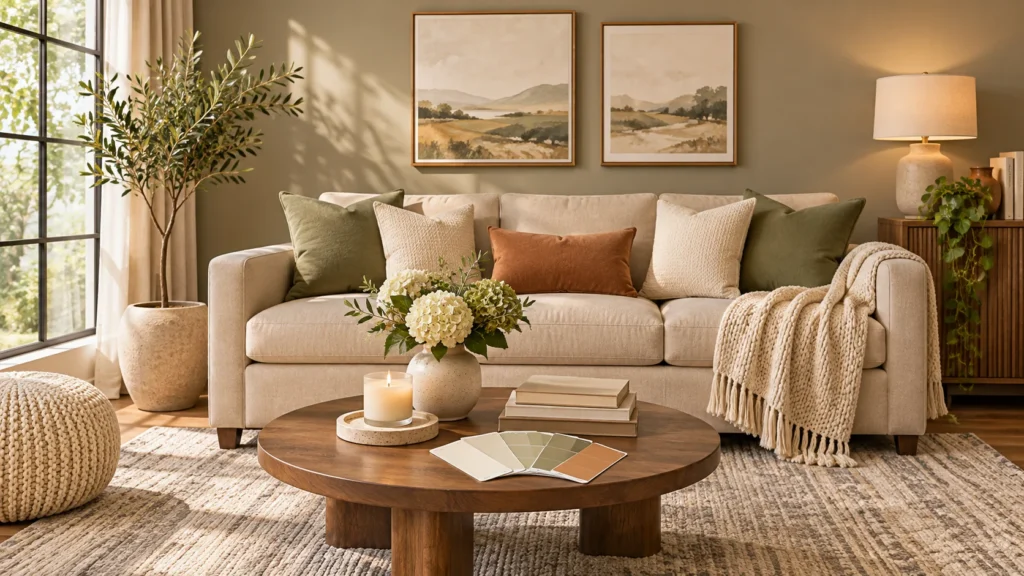
Matching sofa and wall colors means choosing shades that create a balanced relationship between your upholstery and surrounding walls. The colors do not need to be identical.
A coordinated room usually combines compatible undertones, intentional contrast, and repeated accent colors. These elements make separate furnishings feel like part of one design.
There are three useful approaches:
- Tonal harmony: Combine related shades, such as an oatmeal sofa with warm cream walls.
- Soft contrast: Pair a gray sofa with muted sage or warm greige walls.
- Bold contrast: Place a light sofa against deep navy, olive, or charcoal walls.
None is automatically better. The right approach depends on your preferred mood and the natural light entering your room.
How Do You Match Sofa and Wall Colors Step by Step?
Start with the sofa because it is often more expensive and difficult to replace than paint. Then work outward toward walls, flooring, and smaller accessories.
Step 1: Identify Your Sofa’s Main Color
Look at your upholstery in natural daylight before choosing paint. Fabric can appear lighter, darker, warmer, or cooler than its product photograph.
Examine a large area of the sofa rather than judging a shadowed corner. Pay special attention to textured upholstery, which may contain several colored threads.
- Gray: Check whether it leans blue, green, violet, or brown.
- Beige: Look for yellow, peach, pink, or gray influences.
- Brown: Determine whether it appears caramel, reddish, chocolate, or gray-brown.
- Cream: Notice whether it looks buttery, ivory, or nearly white.
- Colored upholstery: Identify whether the shade is bright, muted, warm, or cool.
Use a removable cushion or fabric swatch when comparing paint samples. This makes subtle differences easier to see.
Step 2: Match or Balance the Undertones
An undertone is the subtle color influence beneath a shade’s dominant appearance. For example, two gray fabrics may differ because one leans blue while the other leans brown.
Compatible undertones often create the smoothest combinations. However, deliberate warm-and-cool contrast can also work when other room elements connect the palette.
- Warm sofa: Start with cream, beige, warm greige, clay, or muted olive.
- Cool sofa: Try soft gray, cool white, dusty blue, or blue-green.
- Mixed undertones: Compare balanced greige, taupe, and restrained off-whites.
For an easy comparison, hold a potential wall color beside pure white and your sofa fabric. The differences often become more noticeable.
Sherwin-Williams explains this technique in its guide to understanding paint undertones.
Step 3: Decide Between Harmony and Contrast
Harmony creates a soft, connected appearance. Contrast separates the sofa visually and can make it a stronger focal point.
Choose the approach according to how you want the living room to feel.
- Calm and minimal: Combine similar neutral color families.
- Fresh and airy: Pair a darker sofa with lighter walls.
- Cozy and dramatic: Use darker walls behind lighter upholstery.
- Playful and colorful: Introduce muted complementary colors.
For example, a caramel leather sofa with muted teal walls can feel rich without becoming overly bright. Repeat the teal in artwork or a patterned rug.
Step 4: Balance Light and Dark Colors
Lightness creates visual separation even when two colors share a similar undertone. This is particularly helpful with neutral upholstery.
A medium-gray sofa against a slightly darker gray wall may look flat. A pale warm gray wall or much deeper charcoal backdrop offers clearer contrast.
- Dark sofa: Test warm white, ivory, light greige, or pale sage walls.
- Light sofa: Consider taupe, olive, medium blue, or other deeper shades.
- Medium-tone sofa: Compare noticeably lighter or darker wall samples.
Here is one useful test: take a photograph and view it in grayscale. If the sofa disappears into the wall, consider adjusting their lightness.
Step 5: Build a Simple Three-Color Palette
A living room becomes easier to coordinate when you limit the main palette. I recommend choosing one dominant color, one supporting color, and one accent.
The popular 60-30-10 rule offers a flexible starting point rather than a strict measurement.
- 60% dominant color: Walls and other large background surfaces.
- 30% supporting color: Sofa, rug, or substantial curtains.
- 10% accent color: Cushions, artwork, ceramics, and smaller details.
Imagine cream walls, a camel sofa, and olive-green accents. This combination uses related warm tones while adding enough green to create interest.
You can explore more restrained options in this guide to neutral living room colors and palettes.
Step 6: Coordinate Walls With Flooring and Rugs
Flooring can change how both your sofa and wall paint appear. Wood, tile, carpet, and rugs all contribute visible color to the room.
Check permanent finishes before making a final decision.
- Honey oak flooring: Compare warm white, cream, muted sage, and balanced greige.
- Gray flooring: Try soft white, warm greige, or muted blue with suitable textile accents.
- Dark walnut flooring: Consider ivory, pale taupe, soft green, or warm neutral walls.
- Terracotta flooring: Test creamy white, restrained sand, and muted olive.
A patterned rug can connect colors that otherwise seem unrelated. Look for a rug that contains a little of the sofa color and a quieter version of the wall color.
Step 7: Consider Natural and Artificial Lighting
Lighting can change the appearance of paint and upholstery throughout the day. Never rely exclusively on a showroom or online photograph.
Benjamin Moore’s warm and cool color guidance explains how different lighting conditions affect undertones.
- North-facing room: Check whether cool gray or blue walls become too subdued.
- South-facing room: Compare warm and cool samples in stronger natural light.
- East-facing room: Inspect colors after the brighter morning period.
- West-facing room: Watch how golden afternoon light changes warm shades.
Evening lighting matters just as much. Warm-colored bulbs may emphasize yellow and orange notes that seem subtle during daylight.
For more practical details, review Sherwin-Williams’ room-orientation guide.
Step 8: Test Paint Samples Beside the Sofa
Choose two or three promising shades and examine larger samples in the actual room. Small printed chips are useful for shortlisting, but they are not enough for a final decision.
Follow this testing process:
- Place each sample close to the sofa without blocking the upholstery.
- Compare colors near the window and in a shaded corner.
- Check the samples against flooring and trim.
- Observe them in morning, afternoon, and evening light.
- Choose the color that stays attractive in your normal living conditions.
Benjamin Moore also recommends sampling paint under different lighting conditions in its living room paint color guide.
Remember that removable samples may use a different finish from your final wall paint. Confirm the chosen color with the intended paint product before covering the entire room.
Step 9: Repeat Colors Through Accessories
The final step connects your sofa and walls through smaller decorative pieces. You do not need identical cushions, curtains, and artwork.
Instead, repeat selected colors in a controlled way.
- Cushions: Include the wall color or a related shade in one or two covers.
- Rugs: Choose patterns containing both upholstery and wall colors.
- Artwork: Repeat the accent color without matching every object.
- Curtains: Use a lighter or darker variation of the main palette.
- Wood and metal: Repeat one or two finishes to strengthen visual continuity.
For further decorating ideas, follow this living room styling guide. It covers textiles, artwork, rugs, and lighting.
Which Wall Colors Go Best With Different Sofa Colors?
The best wall shade depends on the sofa’s exact undertone, not just its general color name. Use these combinations as a shortlist for testing.
| Sofa Color | Wall Colors to Try | Overall Look |
|---|---|---|
| Gray | Warm white, greige, sage | Balanced and modern |
| Beige | Cream, olive, taupe | Warm and natural |
| Brown leather | Ivory, sage, dusty blue | Classic and grounded |
| Cream | Mushroom, olive, muted blue | Soft and sophisticated |
| Navy blue | Warm white, sand, pale gray | Fresh and contrasting |
| Green | Ivory, beige, soft taupe | Organic and calm |
| Black or charcoal | Warm white, light greige, clay | Defined and contemporary |
These are illustrative color families rather than exact paint formulas. Always compare the final shades against your upholstery and existing finishes.
Should Your Sofa Be Lighter or Darker Than the Walls?
Your sofa can be lighter or darker than the walls. What matters is creating enough separation for the intended look.
- Lighter walls and darker sofa: Creates clear furniture definition and an open-feeling background.
- Darker walls and lighter sofa: Makes pale upholstery stand out against a rich, cozy backdrop.
- Similar wall and sofa tones: Produces a soft tonal scheme when textures and shades vary.
For example, a cream sofa looks striking against muted olive walls. The same sofa against warm ivory walls creates a gentler effect.
Neither combination is wrong. Choose according to your room’s lighting and preferred atmosphere.
How Do You Match Neutral Sofas Without Making the Room Look Flat?
Use variations in depth, texture, and temperature rather than matching every neutral exactly. Neutral rooms benefit from subtle contrast.
Consider an oatmeal sofa against warm white walls. Walnut furniture, a textured ivory rug, and olive cushions can make the palette feel more layered.
- Combine smooth upholstery with woven, knitted, or textured fabrics.
- Mix light and medium neutral shades.
- Add natural wood for visual warmth.
- Use small dark accents for definition.
- Repeat a muted accent color in two or three places.
If your palette still feels cold, explore warmer options in this guide to warm living room colors.
What Sofa and Wall Color Matching Mistakes Should You Avoid?
Most unsuccessful combinations come from choosing colors separately rather than viewing the room as one palette. Avoid these common problems.
- Ignoring undertones: A pink-beige sofa may clash with strongly yellow wall paint.
- Matching everything exactly: Identical-looking surfaces can reduce visual depth.
- Forgetting the floor: Existing wood or tile may change how the combination feels.
- Choosing only from screens: Digital colors cannot reliably reproduce every paint and fabric shade.
- Skipping evening tests: Artificial lighting can reveal unexpected warmth or coolness.
- Using too many competing accents: Several unrelated strong colors can distract from the main furniture.
Before buying paint, compare your complete palette from the doorway. A little distance makes competing colors and poor contrast easier to notice.
What If Your Sofa and Wall Colors Already Clash?

You may not need to repaint or replace the sofa. Textiles, lighting, and accessories can create a better relationship between existing colors.
Try these adjustments before making expensive changes.
- Add a connecting rug: Choose a pattern containing both the sofa and wall colors.
- Change cushion covers: Introduce a compatible neutral or repeated accent.
- Review the lighting: Check whether warm or cool bulbs exaggerate an unwanted undertone.
- Use artwork strategically: Select a piece that brings the main colors together.
For example, a cool-gray sofa against warm beige walls may feel disconnected. A rug combining gray, cream, and subtle tan can help bridge the two.
Which Products Help You Match Sofa and Wall Colors?
Large paint samples are often more useful than buying extra decorations before choosing a color. These tools address different stages of the process.
Product suitability scores below are editorial assessments, not verified customer-review ratings. Check current specifications and availability before purchasing.
🏆 Best for movable samples
Samplize Peel-and-Stick Paint Samples
★★★★☆ 4/5 editorial suitability
These repositionable samples use real manufacturer paint and come in large formats. I’d start here when comparing several wall colors beside a sofa without applying wet paint.
🎨 Best for brush-on testing
Sherwin-Williams Color To Go Paint Samples
★★★★☆ 4/5 editorial suitability
These tinted paint samples let you test color on a surface. I’d consider them for final color comparisons after narrowing the shortlist, while allowing for finish differences.
🔎 Best for flat-surface scanning
Datacolor ColorReader EZ
★★★☆☆ 3/5 editorial suitability
This Bluetooth color-matching device suggests close paint matches for scanned colors. I’d reserve it for smooth, solid-colored surfaces because textured sofa fabrics may produce less reliable readings.
Affiliate disclosure: We may earn a commission from qualifying purchases made through affiliate links, at no extra cost to you. Amazon links open search results rather than guaranteed individual product listings.
Frequently Asked Questions
1. What wall color goes with almost any sofa?
Warm white, balanced greige, and soft neutral beige are flexible starting points for many sofa colors. However, no single wall color works with every fabric. Compare its undertone against your sofa, flooring, and existing trim before choosing a final shade.
2. Should your sofa match your walls exactly?
No. Your sofa and walls only need to coordinate. Similar colors can create a calm tonal effect, while contrasting colors help furniture stand out. Use differences in lightness, texture, or saturation to keep the room visually interesting.
3. What color walls look good with a gray sofa?
Warm white, greige, muted sage, and soft blue often work with gray upholstery. The ideal choice depends on whether the sofa has warm or cool undertones. A warm gray sofa may suit creamier paint, while blue-gray upholstery often works with cooler shades.
4. Can you use dark walls with a dark sofa?
Yes. Dark walls and a dark sofa can create a sophisticated, enveloping living room. Separate the surfaces with texture, lighter cushions, artwork, and suitable lighting. Compare their undertones to avoid an unintended clash.
5. How many colors should a living room have?
Three main color groups provide a manageable starting point: a dominant color, a supporting color, and an accent. You can include lighter and darker variations within each group. The goal is visual connection, not a rigid limit on every shade.
Final Thoughts: Create a Color Combination That Feels Right
Learning how to match sofa and wall colors becomes easier when you stop looking for one perfect paint name. Focus instead on undertones, lightness, flooring, and the atmosphere you want to create.
Start with your sofa, compare two or three real paint samples, and evaluate them throughout the day. Then use rugs, cushions, and artwork to connect the palette.
Your next step: Place your sofa fabric beside three wall-color samples today. Choose the combination that looks balanced in your actual room, not just in a photograph.