

Quick Answer
To declutter a living room, remove trash and items that belong elsewhere, sort the remaining belongings by what you use or value, then clear one surface or storage area at a time. Give everything you keep an accessible home, remove donations promptly, and use a short daily reset to prevent new piles.
A living room collects belongings from every part of daily life: mail, cups, toys, chargers, blankets, books, and unfinished projects. The challenge is rarely finding a prettier basket. It is deciding which things deserve space in the room and making the useful ones easy to put away.
This living room decluttering guide follows a practical order, from the easiest decisions to the more complicated ones. You can finish it over a weekend or divide the steps into short sessions without emptying the entire room.
What Should You Check Before Decluttering Your Living Room?
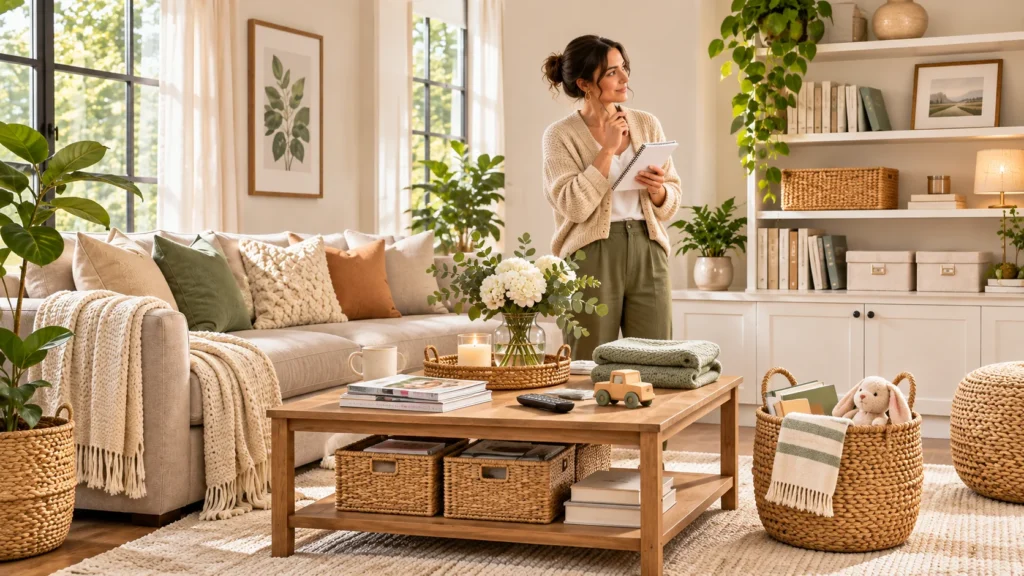
First, identify what the living room needs to support and where clutter is collecting. That prevents you from removing useful belongings or buying storage that does not solve the problem.
- Daily activities: Is this mainly a television room, family play space, reading area, or a combination?
- Problem spots: Look at the coffee table, sofa, TV unit, shelves, floor, and hidden drawers.
- Shared belongings: Identify objects that belong to other household members before deciding to discard them.
- Available storage: Check which cabinets, baskets, and drawers already have room.
- Time and energy: Choose one surface or zone if a whole-room session feels unrealistic.
Prepare four containers labeled Keep Here, Belongs Elsewhere, Donate or Sell, and Recycle or Discard. A small temporary decision box is fine for genuinely difficult items, but give it a review date so it does not become permanent clutter.
How Do You Declutter a Living Room in 12 Steps?
Work through these steps in order, finishing one small area before opening another. Start with items requiring little thought and leave sentimental decisions until the room already feels easier to manage.
1. Decide What Belongs in This Room
List the activities that actually happen here, then match belongings to those activities. A remote, favorite throw, and current book may deserve convenient homes; a stack of office paperwork may belong at a desk instead.
Do not remove something simply because it looks imperfect. A shared family room should work for the people using it, not imitate an empty showroom.
2. Collect Obvious Trash and Recycling
Walk the room once with a trash bag and a separate recycling container. Collect wrappers, empty packaging, worn-out flyers, and items that are clearly beyond use.
Check beneath the sofa and around the coffee table. Avoid sorting meaningful papers during this first pass; put them in one temporary location. Completing an easy sweep creates usable space for the decisions ahead.
3. Return Objects That Belong Elsewhere
Gather dishes, laundry, shoes, school materials, and misplaced bathroom or kitchen items. Put them in the Belongs Elsewhere container, then return them in one trip.
If you repeatedly find the same objects here, ask whether they need a legitimate home nearby. For example, a small paper tray may be more practical than expecting everyone to carry incoming mail upstairs immediately.
4. Clear the Coffee Table and Side Tables
Remove everything from one tabletop, wipe it, and return only what serves a regular purpose or has real decorative value.
Give remotes a designated spot and move old receipts, unused coasters, and stray cables to their correct categories. Leave enough open surface for a drink or book. A tray can group necessities, but it should not become a place to hide undecided items.
5. Review Books, Magazines, and Paper Piles
Separate current reading from outdated magazines, duplicate catalogs, and papers requiring action. Keep essential documents in a suitable filing location rather than mixing them with entertainment items.
If you enjoy displaying books, keep the collection intentionally; you do not need to discard favorites for a minimalist appearance. Recycle ordinary paper according to local rules, and shred documents containing sensitive information before disposal.
6. Sort the TV Unit, Electronics, and Cords
Match chargers, remotes, controllers, adapters, and cables to the devices you still own. Label useful extras and separate equipment you no longer use.
Check whether an old device contains personal information before selling or recycling it. Do not bury powered adapters under soft furnishings or route cables where people walk.
For larger layout issues, the functional living room guide covers practical traffic routes and equipment placement.
7. Edit Throws, Pillows, and Decorations
Keep textiles that are comfortable, in good condition, and used or enjoyed. Launder or repair what needs attention, and donate clean, usable extras if appropriate.
Then review candles, picture frames, souvenirs, and seasonal objects. Preserve meaningful pieces while giving them enough visible space to stand out. A room can remain warm and personal without displaying every decoration at once.
8. Give Toys and Hobbies Clear Boundaries
Group puzzles, games, craft supplies, and toys by activity. Check for missing pieces and remove items no one uses, with household members involved where appropriate.
Choose a manageable amount that can be returned to a shelf or basket without forcing the lid closed. Store frequently used activities low and within safe reach; reserve high shelves for adult-managed items.
Labeling a few broad categories is often simpler than creating a separate container for every object.
9. Empty and Refill One Drawer or Shelf at a Time
Hidden storage needs editing too. Take everything out of a single compartment, sort duplicates and forgotten items, wipe the space, then return only the belongings assigned to it.
Finish before opening the next drawer. Put heavier items on low shelves, and keep tall cabinets and bookcases properly secured; the U.S. Consumer Product Safety Commission’s Anchor It campaign explains furniture tip-over prevention.
10. Reassess Unnecessary Furniture
Once small clutter is gone, look at spare stools, side tables, display stands, and chairs that are rarely used. A furniture piece may be useful in another room or ready to donate.
Removing one unnecessary table can restore more walking space than adding another storage basket.
If the room is compact, the small living room layout guide offers ways to protect floor space without sacrificing seating.
11. Assign Every Remaining Item a Convenient Home
Organize only after deciding what stays. Keep remotes near seating, games near the activity area, and frequently used blankets where they are easy to retrieve.
Choose containers by actual item size and available shelf dimensions, not appearance alone. If putting something away requires moving several other objects, the system is too complicated.
Leave some unused room in drawers and baskets so everyday tidying remains easy.
12. Remove Outgoing Items and Test the Room
Set a specific day to deliver donations, list items for sale, and take recycling to the correct collection point. Do not leave outgoing bags beside the sofa indefinitely.
Walk through the room, sit in your usual places, and try opening storage compartments. Notice anything that still lacks a logical home. Adjust the setup before purchasing additional furniture or organizers.
How Do You Decide What to Keep When You Feel Stuck?
Keep an item when it has a clear use, brings meaningful enjoyment, or serves a purpose you genuinely expect to need.
If you are unsure, ask these questions rather than applying an arbitrary rule about how recently you used it:
- Would I choose to make room for this item today?
- Do I already own something that performs the same job?
- Is it useful in this living room, or does it belong elsewhere?
- Can I retrieve and put it away without creating another pile?
- Am I keeping it for myself, or only because I feel guilty discarding it?
Seasonal decorations and keepsakes are exceptions to daily-use tests. Give them a deliberate storage location and reasonable space limit.
If someone else owns an object, agree on its next home rather than discarding it without permission.
What If You Have Only 15 Minutes?
Choose one visible zone, such as the coffee table or TV stand.
Spend the first few minutes removing trash and dishes, the next several minutes returning misplaced objects, and the remaining time deciding what stays on that surface.
End by putting away your sorting containers. A completed small area is more useful than several half-emptied drawers.
If possible, repeat with a different zone on your next session. Do not measure success by how many bags you fill; measure it by whether the room becomes easier to use and reset.
How Can You Keep the Living Room Clutter-Free?
Use a brief evening reset that follows the same path each day. Take dishes out, return remotes and toys, fold blankets, clear the coffee table, and check the floor.
The goal is not a perfect photograph but a room that is ready for tomorrow.
Give shared household members simple responsibilities that match how they use the space. Review papers when they arrive, not after a stack grows.
Before buying another organizer, check whether unused items could leave instead.
If you want to refine the appearance after decluttering, the living room styling guide covers arranging the belongings you have chosen to keep.
Handle broken devices and loose batteries separately from ordinary recycling. The EPA’s used household batteries guidance explains why certain batteries require special collection rather than household trash or curbside recycling; follow your local disposal rules.
Only consider storage products after the decluttering decisions are complete. These two options suit different remaining needs:
For Small Essentials
IKEA KUGGIS Box With Lid
★★★★☆ 4.7/5 on IKEA
A lidded, stackable box for media accessories, papers, or hobby supplies. The 10¼ × 13¾ × 6-inch version suits a measured shelf; check dimensions before ordering.
For Throws and Hidden Storage
SONGMICS 15-Inch Storage Ottoman
★★★★☆ 4.8/5 on SONGMICS
A folding faux-leather ottoman that combines a footrest with concealed storage. Useful when blankets need a home, provided another furniture piece will not crowd the walkway.
As an Amazon Associate, we earn from qualifying purchases. Ratings cited above come from the named brands’ product pages and may change; Amazon search results may show different sellers or models.
Frequently Asked Questions
Should I declutter or clean the living room first?
Remove trash and unnecessary items first, then clean accessible surfaces as you work. Deep cleaning before sorting often means moving the same piles repeatedly.
Do I need to buy storage containers before I start?
No. Begin with boxes or baskets already in your home. Once you know what is staying, measure the available storage space and buy only what solves a specific problem.
How do I declutter a living room shared with children?
Create a few easy-to-reach categories for current toys and activities. Involve children in age-appropriate choices, and avoid discarding other people’s belongings without discussing them.
What should I do with sentimental decorations?
Keep the pieces you most enjoy displaying and safely store other meaningful items if space permits. Rotating displays is an option; you do not need to treat sentiment as clutter.
Can I declutter without becoming a minimalist?
Yes. Decluttering is about making deliberate choices and improving usability, not meeting a fixed limit on belongings or following a particular decorating style.
What if clutter comes back every week?
Look for the recurring source: mail, toys, laundry, or objects without a home. Make that category easier to put away, assign shared responsibilities, and use a brief daily reset.
Final Takeaway
A decluttered living room is not necessarily an empty one. It is a space where the belongings you keep support daily life and have places to go afterward.
Start with the coffee table or another obvious trouble spot, complete that small area, and build from there. Better decisions now make everyday tidying simpler later.