

Quick Answer
For the best living room speaker placement, position your main left and right speakers at seated ear height, equally spaced from your primary listening position. Start with an equilateral triangle for stereo listening. For a 5.1 home theater, place the center speaker near the TV, surround speakers slightly behind the seating area, and the subwoofer where bass sounds balanced. Adjust the setup to suit your room rather than following measurements blindly.
Great sound depends on more than expensive speakers. Even a capable audio system can produce muddy bass, unclear dialogue, or an uneven stereo image when its speakers sit in unsuitable locations.
The challenge is that living rooms are not dedicated recording studios. Sofas, windows, cabinets, doorways, and family activities all compete for space. Fortunately, a few positioning principles can improve everyday listening without completely rearranging your furniture.
Where Should Speakers Be Placed in a Living Room?
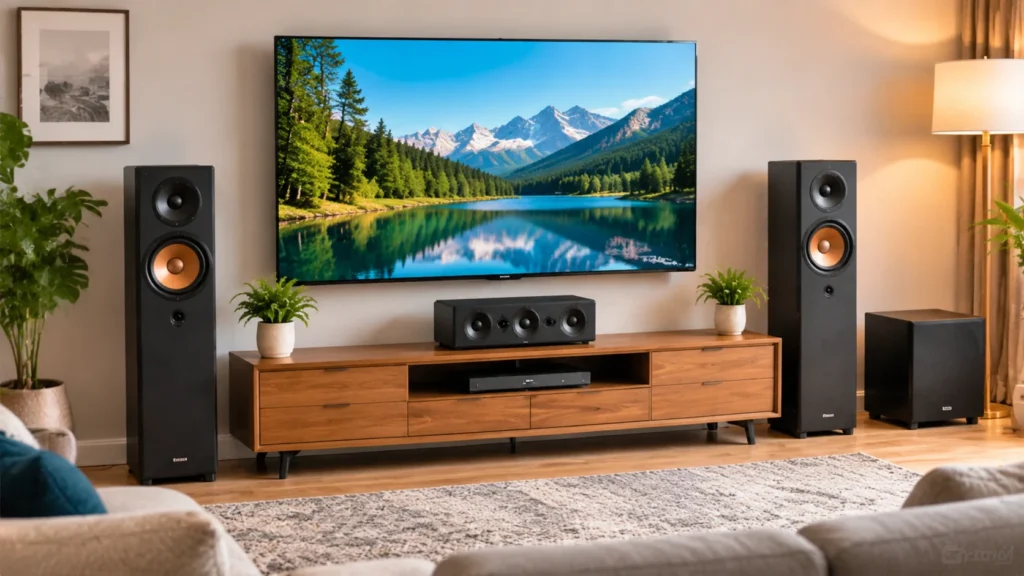
The best starting position places the main speakers in front of your seating area, with their sound directed toward the listener. Ideally, the speakers and your usual seat form a balanced triangle.
Focus on four important relationships:
- Speaker spacing: Keep the left and right speakers sufficiently separated to create a clear stereo image.
- Listening distance: Begin with approximately equal distances from each speaker to your preferred seat.
- Speaker height: Position the tweeters near seated ear height whenever practical.
- Wall clearance: Follow manufacturer guidance and adjust spacing to manage excessive bass and reflections.
For example, if your front speakers sit approximately 7 feet apart, try a listening position around 7 feet from each speaker. This is a starting geometry, not a strict requirement.
If you are still arranging your room, the living room furniture arrangement guide can help coordinate seating, circulation, and entertainment furniture.
How Do You Position Stereo Speakers for the Best Sound?
For a two-speaker stereo setup, begin with symmetrical positioning and adjust one variable at a time. Stereo imaging depends heavily on the relative arrival of sound from the left and right channels.
1. Create a Listening Triangle
Imagine a triangle connecting both speakers and your usual listening position. An equilateral triangle, with three approximately equal sides, is a useful initial layout.
Position each speaker on opposite sides of the TV or audio cabinet. Keep their heights similar and avoid placing one noticeably farther from your seat.
When the room makes perfect symmetry impossible, prioritize roughly equal listening distances before fine-tuning the remaining details.
2. Set the Speakers at Ear Height
The tweeters of conventional bookshelf speakers generally work best near your ears when seated. Depending on your sofa and posture, this may require stands, suitable shelving, or carefully positioned cabinet supports.
Floorstanding speakers normally incorporate their intended listening height into their design. Avoid raising them unnecessarily without checking the manufacturer’s instructions.
3. Experiment With Toe-In
Toe-in means turning speakers slightly inward toward the listening position. It can help stabilize vocals in the center and change the balance of direct sound and wall reflections.
Begin with the speakers facing mostly forward. Rotate them inward gradually while listening to a familiar vocal recording. Stop when the voice sounds centered without making the presentation excessively narrow or bright.
Practical Tip
Use one familiar recording when comparing speaker positions. Changing the recording, volume, and placement simultaneously makes meaningful comparisons difficult.
How Should You Arrange a 5.1 Surround Sound System?
A 5.1 system uses five main audio channels and a low-frequency effects channel, usually reproduced by a subwoofer. Correct positioning creates a more convincing sense of movement around the listener.
The following table provides practical starting points based on conventional surround sound geometry.
| Speaker | Starting Position |
|---|---|
| Front left/right | 22–30° to either side of the forward listening direction |
| Center | Directly in front, aligned with the TV |
| Left/right surrounds | Approximately 110–120° from the forward direction |
| Subwoofer | Test several accessible positions for balanced bass |
These angles are measured from the listening position, with straight ahead defined as zero degrees. For system-specific diagrams, see the official Dolby speaker setup guidance.
Place the Center Speaker for Clear Dialogue
Position the center channel directly above or below the television, as close to the screen’s horizontal center as practical. Aim it toward the seated listeners if the cabinet position is unusually low or high.
Do not push the speaker behind a cabinet lip or block its front grille. Obstructions can interfere with dialogue clarity.
For a comfortable screen-and-speaker arrangement, also consider the viewing recommendations in the living room TV placement guide.
Position Surround Speakers Beside or Slightly Behind the Sofa
In a conventional 5.1 layout, surrounds normally sit to the sides and somewhat behind the listener, rather than directly behind the sofa as a matched rear pair.
Use the recommended angles as a reference. If the sofa touches the back wall, wall mounts may help achieve a reasonable sideward position without consuming floor space.
For 7.1 systems, the two additional rear surround channels sit farther behind the listening area, creating a distinction between side and rear effects.
Where Is the Best Place for a Subwoofer?
The best subwoofer position is where low frequencies sound balanced at the listening seats, not necessarily where the cabinet looks most symmetrical.
Room boundaries can strengthen certain bass frequencies while reducing others. Consequently, a subwoofer may sound powerful near one wall but uneven or boomy in a corner.
A practical testing method is the subwoofer crawl:
- Temporarily position the subwoofer near your normal listening seat.
- Play a repeating bass-heavy passage or suitable low-frequency test signal at a moderate volume.
- Move around potential subwoofer locations and listen for relatively even bass.
- Place the subwoofer in a promising location and listen again from the sofa.
- Adjust crossover, level, and phase using your equipment’s instructions.
Do not assume that placing the subwoofer beside the television is automatically best. Furniture and room dimensions can change the result substantially.
How Far Should Speakers Be From Walls and Furniture?
There is no universal wall-clearance measurement that suits every speaker. Cabinet design, port location, room dimensions, and manufacturer recommendations all matter.
Begin by allowing some breathing room around the speaker and keeping the front unobstructed. Experiment with moving it forward or backward in small increments while checking the bass response.
Placing speakers very close to corners can produce excessive low-frequency energy in some rooms. Conversely, pulling them farther into the room may improve clarity but reduce available floor space.
Bookshelf speakers should also sit on stable, appropriately sized supports. Avoid unstable furniture, loose shelves, and arrangements where children or pets could easily knock speakers over.
How Do You Handle Small or Awkward Living Rooms?
When space is limited, the goal is a balanced compromise rather than perfect textbook geometry.
- Narrow rooms: Reduce front speaker spacing if necessary while maintaining a centered listening position.
- L-shaped rooms: Optimize the primary seating area instead of trying to cover every corner equally.
- Sofas against walls: Place surrounds to the sides where possible and avoid forcing them directly behind listeners at very close range.
- Open-plan rooms: Use the main seating zone as the reference point, since room boundaries may be asymmetric.
- Rooms with fireplaces: Prioritize safe speaker positioning and avoid exposing equipment to excessive heat.
When planning the television and seating positions together, these living room layouts with a TV offer useful furniture configurations.
Small changes can be more effective than a complete redesign. Moving a chair, adjusting speaker direction, or changing the distance from a wall may noticeably improve the listening experience.
How Can You Reduce Echo and Improve Sound Clarity?
Speaker positioning works together with room acoustics. Hard floors, bare walls, and large glass surfaces reflect sound, potentially reducing the clarity of music and dialogue.
Try simple improvements before investing in specialized acoustic panels:
- Add a rug between the speakers and seating area where practical.
- Use curtains or other soft furnishings around large reflective surfaces.
- Avoid placing speakers deep inside enclosed shelving.
- Keep speaker grilles clear of decorations and furniture.
- Experiment with seating distance from the rear wall.
These changes do not guarantee professional acoustic treatment, but they can reduce some problematic reflections and make a shared living space more comfortable.
What Speaker Placement Mistakes Should You Avoid?
The most common mistakes involve mismatched positioning, blocked sound paths, or making too many adjustments at once.
- Speakers too close together: Stereo separation becomes limited.
- Unequal positioning: The soundstage may pull toward one side.
- Blocked center channel: Dialogue may become less intelligible.
- Surround speakers in the wrong location: Effects may appear to come from unexpected directions.
- Excessive corner placement: Bass can become uneven or overpowering.
- Ignoring calibration: Speaker levels and timing may remain poorly balanced.
Important
Always use mounts rated for your speaker’s weight and the wall construction. Secure cables away from walking paths, and keep electronics ventilated according to manufacturer instructions.
How Do You Fine-Tune Speaker Placement Step by Step?
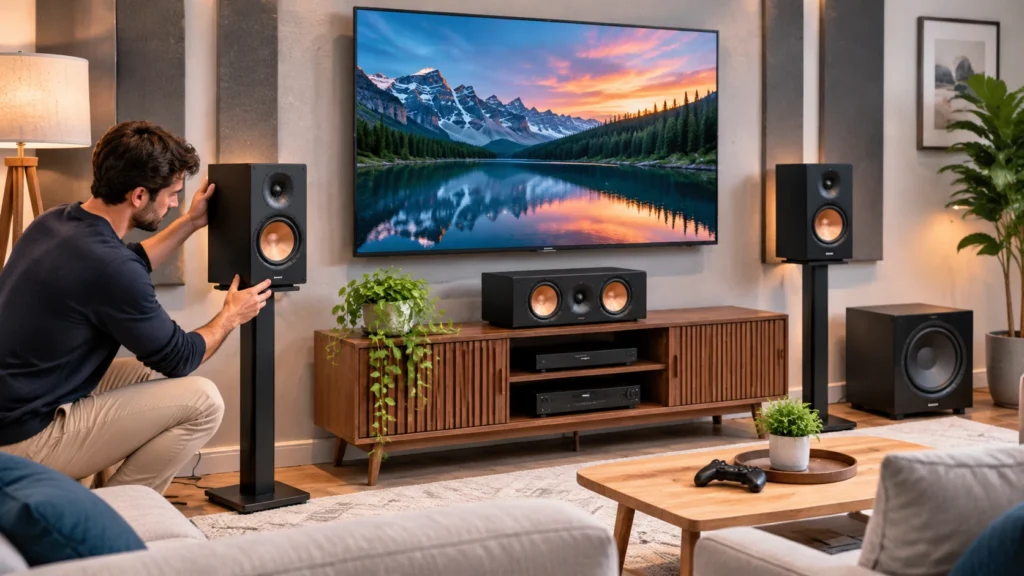
Once the basic arrangement is established, use a consistent listening test to refine the setup.
- Choose the main seat: Identify the listening position that matters most.
- Set front-speaker geometry: Match heights and approximate distances.
- Adjust direction: Experiment with toe-in while listening to centered vocals.
- Check bass: Move speakers or the subwoofer if low frequencies seem uneven.
- Verify channel connections: Confirm that left, right, center, and surround channels play from their intended locations.
- Run calibration: Use your AV receiver’s measurement system, if available, and review the resulting settings.
- Retest with familiar material: Compare dialogue, music imaging, and surround effects at normal listening levels.
Automatic room correction can help balance timing, levels, and frequency response, but it cannot fully compensate for speakers aimed in the wrong direction or placed in inappropriate locations.
For further practical guidance, see Crutchfield’s home theater speaker placement guide.
Useful Equipment for Better Speaker Positioning
Speaker stands and isolation supports may help when existing furniture prevents stable placement at an appropriate listening height. These are optional positioning accessories, not substitutes for arranging your speakers correctly.
FLOOR-STAND OPTION
Kanto SP26PL Speaker Stands
These 26-inch floor stands support compatible bookshelf speakers weighing up to 30 pounds per stand. Their cable routing and rotating top plates make them worth considering when a TV cabinet cannot provide suitable spacing or positioning. Check speaker dimensions and stability before purchasing.
DESKTOP ISOLATION OPTION
IsoAcoustics ISO-155 Stands
These adjustable isolation stands are designed for compatible medium-sized speakers or monitors. Their 155 mm by 190 mm footprint and adjustable positioning options may help with cabinet-top placement. Verify dimensions, weight limits, and compatibility with your speakers.
Affiliate disclosure: As an Amazon Associate, we may earn from qualifying purchases made through eligible links, at no additional cost to you.
Frequently Asked Questions
Should living room speakers face straight ahead or toward the sofa?
Start with the speakers facing forward, then experiment with a slight inward angle. The best direction depends on speaker design, room reflections, and your listening position.
Can I put bookshelf speakers inside a TV cabinet?
You can use suitable shelving if the speakers remain stable, ventilated, and unobstructed. Deep enclosed cabinets can cause unwanted reflections and should generally be avoided unless the speakers are designed for that installation.
Do rear speakers need to be behind the sofa?
Not always. Conventional 5.1 systems use side surround speakers, generally positioned slightly behind listeners. A 7.1 system adds separate rear surround channels farther behind the seating area.
Is it bad to place speakers near a wall?
Not necessarily. Some speakers are designed for wall-adjacent installation. However, wall proximity affects bass and reflections, so follow manufacturer recommendations and adjust placement based on the sound.
Does speaker placement matter at low listening volumes?
Yes. Speaker spacing, height, and direction still affect stereo imaging, dialogue localization, and tonal balance even when playback volume is relatively low.
Can room calibration fix poor speaker positioning?
Room calibration can improve channel levels, timing, and some frequency-response problems. It cannot completely correct unsuitable speaker locations or remove physical obstructions.
Final Thoughts
Effective living room speaker placement starts with balanced front-speaker geometry, suitable listening height, and an unobstructed sound path. Surround speakers and subwoofers require additional attention because their positions interact strongly with seating and room boundaries.
Begin with proven placement principles, then make small adjustments while listening to familiar recordings. A practical arrangement that works consistently in your actual living room is more valuable than a theoretically perfect layout that interferes with everyday use.