

Quick Answer
The easiest way to manage toy storage in living rooms is to combine low, child-accessible baskets for everyday favorites with closed furniture storage for visual clutter. Keep only the toys your family currently uses in the room, group them by type, and give each group a simple home. Choose stable, age-appropriate storage before focusing on appearance.
A living room can be a comfortable place for both adults and children without keeping every toy on display. The challenge is finding storage that works during playtime and still lets the space feel calm afterward.
These ideas cover baskets, shelving, furniture with hidden compartments, and easy routines. You can adapt them to a small apartment, an open-plan family room, or a living room that serves as your child’s main play area.
What Should You Check Before Adding Toy Storage?
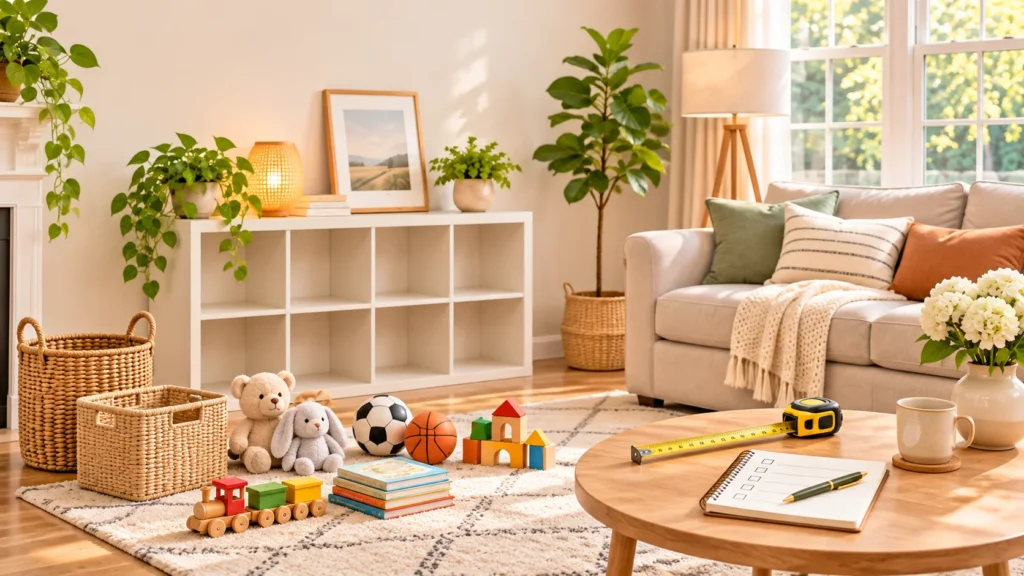
Start with the toys, not the furniture. Gather the toys currently left in the living room and sort them into everyday favorites, occasional toys, items that belong elsewhere, and things ready to donate or discard.
Next, notice where play already happens. A basket beside the sofa is useful if children build blocks on the rug; a cabinet across the room may be inconvenient even if it looks more polished.
- Available floor space: Measure the storage footprint and keep doorways and walking routes clear.
- Child’s reach: Put independently used toys in low, accessible containers.
- Toy size: Choose shallow compartments for small pieces and roomy bins for plush toys.
- Visibility: Decide which toys can remain on display and which should disappear after playtime.
- Safety: Consider sharp edges, heavy lids, climbing temptations, and tip-over risks.
If the room has several daily uses, the planning approach in our functional living room guide can help you protect seating, circulation, and activity zones.
14 Toy Storage Ideas That Work in Living Rooms
The best setup is usually a mix of two or three approaches rather than fourteen separate organizers. Choose ideas based on what your children actually use and what your room can comfortably hold.
1. Use Soft Baskets for Quick Cleanup
Fabric or soft-sided woven baskets are useful for stuffed animals, larger blocks, and other toys that do not need precise sorting. Keep one near the main play area so children can return items without carrying them across the room.
2. Hide Toy Bins Inside a Closed Media Console
A media cabinet with doors can conceal games, building sets, and art supplies without adding another piece of furniture. Place toys on the lower shelves and use smaller bins inside the cabinet to prevent everything from becoming one mixed pile.
Check door hardware, cables, ventilation for electronics, and furniture stability before assigning a section to children.
3. Add Low Cube Shelves With Matching Bins
Cube shelves make categories easy to see and keep separate. Fabric bins soften the appearance, while an open cube can display a few favorite books or attractive toys.
4. Choose a Storage Ottoman With Child-Safe Access
A storage ottoman can hold toys while serving as a footrest. It is especially helpful in smaller rooms where a separate toy cabinet would take up valuable space.
Select a design that avoids a heavy, freely falling lid and cannot accidentally trap a child. A lightweight removable top or a suitably designed opening may be preferable to an old-fashioned trunk.
5. Put Shallow Drawers in the Coffee Table
Drawers are useful for puzzles, coloring books, cards, and compact toys. Shallow compartments prevent small items from being buried below larger toys and keep the tabletop available for family activities.
6. Tuck a Basket Beneath a Side Table
An open lower shelf or space beneath a side table can accommodate a basket without changing the room’s layout. This works well for one small category, such as board books or toy vehicles.
7. Create a Play Corner With One Defined Storage Unit
Instead of spreading toys around the sofa, establish a play corner with a small rug, a low organizer, and one or two baskets. A defined area provides a natural place to play and a visible boundary for cleanup.
8. Use a Bench With Open Baskets Below
A bench can provide seating and a place for removable toy baskets. Open compartments are often simpler for children than a deep compartment under a hinged seat.
9. Give Books a Low, Front-Facing Display
Picture books are easier for young readers to choose when their covers are visible. A low book ledge, shallow basket, or accessible shelf can hold a modest rotating selection beside the reading spot.
10. Keep Small Toy Sets in Separate Handled Containers
Blocks, dolls’ accessories, and pretend-play pieces are easier to manage when each set has its own container. A handled bin can travel from the cabinet to the rug and back in one trip.
Keep small components away from younger children for whom they present a choking risk, even when older siblings use the same living room.
11. Use a Rolling Cart for Supervised Activities
A small cart is useful for drawing materials, craft supplies, or school-age activities that move between rooms. When playtime ends, it can roll into a closet or dedicated storage area.
12. Dedicate Part of an Existing Closet to Toys
If a nearby closet has unused lower space, add a few bins for toys that appear only occasionally. This keeps the main room from needing oversized furniture.
13. Blend Storage With Your Living Room Style
Choose a limited set of finishes that complement the room: natural baskets with warm wood, neutral fabric cubes with painted cabinetry, or matching containers inside a streamlined console.
14. Rotate Toys Instead of Storing Everything at Once
Keep a manageable selection of toys in the living room and move less-used sets to another safe storage area. Swap them when interest changes rather than following an inflexible schedule.
Which Storage Type Suits Your Family?
Compare each option by access and visibility, not just capacity. A beautiful cabinet that nobody can use easily will not solve the daily mess.
| Storage | Best for | Main tradeoff |
|---|---|---|
| Open baskets | Fast, independent cleanup | Some toys remain visible |
| Cube storage | Multiple toy categories | Needs stable placement and anchoring |
| Closed console | Hidden everyday storage | Doors may slow access |
| Coffee table drawers | Small, flat activities | Limited capacity |
| Closet bins | Rotated or occasional toys | Less convenient during play |
For many families, one low basket plus one concealed storage area is enough to start. Add more only if a specific toy category still lacks a sensible home.
How Do You Organize Living Room Toys Step by Step?
Build a simple system that matches the cleanup habits your household can actually maintain.
- Collect everything in one place. Check under the sofa, behind cushions, and in nearby corners so you can see the real volume.
- Reduce the selection. Move broken, outgrown, rarely used, or unrelated items out of the living room; deal with them appropriately afterward.
- Make broad categories. Use labels such as books, blocks, pretend play, and soft toys rather than a separate bin for every tiny collection.
- Assign the closest practical home. Put high-use toys beside the main play area and occasional toys in closed storage or a closet.
- Label for the child’s age. Picture labels help pre-readers; simple words can work for older children.
- Try the system for a week. If one bin always overflows or nobody returns toys to a cabinet, change the setup rather than blaming the family.
For floor planning beyond storage, the living room space planning guide covers furniture footprints and routes through the room.
How Can You Make Toy Storage Safer?
Prioritize stability and safe access over hidden storage. Young children may pull, climb, lean into bins, or close lids unexpectedly, so a normal adult storage piece is not automatically a suitable toy organizer.
- Anchor furniture: Secure bookcases, cabinets, and other furniture with shelves, doors, or drawers according to appropriate instructions. The U.S. Consumer Product Safety Commission’s Anchor It! program explains why anchoring matters.
- Avoid falling lids: Use lidless bins when practical. For a chest, check for a secure lid support or a lightweight removable lid, and avoid designs that can latch a child inside. See the American Academy of Pediatrics’ toy box safety guidance.
- Keep risky items separate: Put age-inappropriate small parts, batteries, magnets, and sharp supplies where younger children cannot reach them.
- Check the surrounding space: Keep cords, unstable lamps, sharp corners, and blocked exits out of the play area.
Safety Note
Do not repurpose an old, self-latching trunk as a child’s toy chest. A container that looks attractive in the living room may create an entrapment or falling-lid hazard.
What Works Best in a Small Living Room?
In a small room, use existing furniture before adding a new storage tower. A shallow basket under a table, drawer space in a console, or a dual-purpose ottoman can reduce visible clutter without narrowing the walkway.
Keep the play area compact and flexible. A lightweight basket can mark the toy zone while remaining easy to move when guests arrive. Avoid placing new bins in front of doors, along the main walking route, or where they obstruct access to seating.
Consider a one-in, one-out approach for large toys. If a bulky play set enters the room, relocate another large item instead of expecting the floor to absorb both.
How Do You Keep the Room Tidy Between Playtimes?
A simple daily reset is more sustainable than expecting a shared room to remain spotless. Before dinner or bedtime, return toys to their assigned bins, check beneath the coffee table, and clear the main walking path.
Ask children to help with age-appropriate tasks: putting books in a basket, returning blocks to one bin, or carrying soft toys back to the play corner. When cleanup consistently takes too much effort, reduce the number of available toys or simplify the categories.
The goal is not a living room that never shows signs of children. It is a room that can switch between family play and adult relaxation without a lengthy reorganization.
Related Product
Soft, Open-Top Toy Storage Baskets
A lightweight, lidless basket is a practical starting point for keeping frequently used toys accessible while making cleanup easier.
As an Amazon Associate, we earn from qualifying purchases.
Frequently Asked Questions
How can I hide toys without buying more furniture?
Use the lower shelf of an existing console, an available cabinet compartment, or a basket beneath a side table. Reorganize what is already there before buying a new piece.
Are open baskets better than lidded toy boxes for toddlers?
Open baskets are often easier for toddlers to access and avoid the hazard of a falling chest lid. Choose lightweight materials, check for loose parts, and supervise children as appropriate.
How many toys should stay in the living room?
There is no universal number. Keep enough for regular play while making it possible to return everything to its assigned home without overflowing containers.
Can a living room look stylish with visible toy storage?
Yes. Choose a few coordinated baskets, keep toys grouped by type, and reserve some shelves or surfaces for adult belongings. Storage can look intentional without hiding every toy.
What is the easiest way to store LEGO and other small pieces?
Use smaller handled containers or shallow bins by set or broad category. Keep these pieces inaccessible to children below the recommended age for the toy.
What if my child never puts toys away?
Move the container closer to the play area, simplify the categories, and model a short cleanup together. If putting toys away still takes many steps, the storage may be too complicated.
Conclusion
Effective toy storage in living rooms starts with fewer toys in circulation, easy-to-reach containers, and furniture that serves more than one purpose. Begin with one basket and one concealed storage spot, test the cleanup routine, and adjust it as your family’s needs change. Safety and everyday convenience should guide every choice.