

Quick Answer
To choose a comforter, match its warmth level to your sleeping temperature, select a suitable fill material, and check its size, construction, fabric, and washing instructions. Down offers excellent warmth without much weight, while down alternative usually costs less and is easier to maintain. Your comforter should also work with your other bedding layers.
Your 6-step comforter buying checklist
- Choose warmth: Pick lightweight, all-season, or extra-warm insulation based on your bedroom temperature.
- Select filling: Compare natural down, synthetic alternatives, wool, and cotton.
- Check insulation: Review fill power, fill weight, and warmth ratings where available.
- Measure your bed: Compare actual comforter dimensions rather than relying only on size labels.
- Inspect construction: Look for secure stitching, consistent filling, and a comfortable outer shell.
- Confirm maintenance: Choose care instructions that fit your washing machine and routine.
A comforter can look wonderfully fluffy in a product photo and still feel completely wrong at bedtime. I’ve found that the most useful approach is to compare how a comforter performs, not just how inviting it looks.
This guide explains the nine details worth checking before you buy. You’ll learn how to balance warmth, weight, softness, cost, and everyday care.
What Is a Comforter, and How Does It Work?
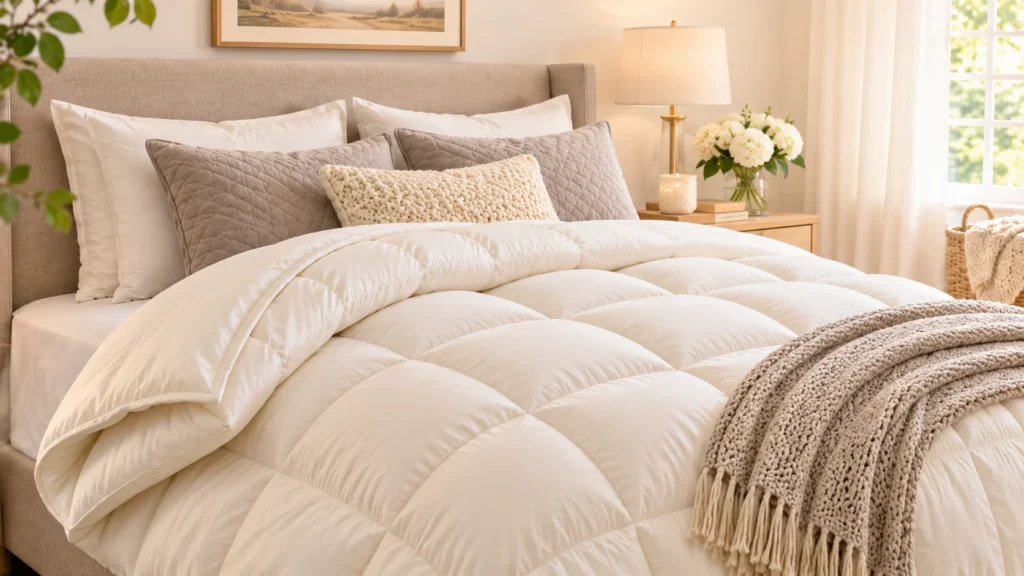
A comforter is a thick bedding layer made from an outer fabric shell filled with insulating material. The filling traps air, helping retain body warmth while you sleep.
Most comforters contain down, synthetic fiber, wool, or cotton. Their warmth depends on the fill, its amount, construction, and how effectively the bedding traps air.
Unlike an ordinary blanket, a comforter usually has stitching that holds its insulation in place. This creates the familiar quilted or puffy appearance.
- Outer shell: The fabric surrounding the insulation.
- Fill: The material responsible for most of the warmth.
- Stitching: The construction that keeps filling distributed.
- Loft: The thickness and fluffiness created by trapped air.
A comforter and duvet insert can serve similar purposes. However, a duvet insert is typically designed for use inside a removable duvet cover.
1. How Do You Choose the Right Comforter Fill?
The best comforter fill depends on your preferred warmth, weight, budget, and cleaning routine. Down feels light for its insulation level, while synthetic filling offers an accessible alternative.
Down Comforters
Down consists of soft insulating clusters found beneath the outer feathers of ducks and geese. These clusters create tiny air pockets that retain warmth.
One advantage is the excellent warmth-to-weight ratio. You can get substantial insulation without the heavy feeling of some synthetic comforters.
- Best for: People wanting lofty, lightweight warmth.
- Main advantage: Excellent insulation relative to weight.
- Possible drawback: Higher prices and more demanding drying requirements.
- Buying tip: Check down percentage, fill power, construction, and sourcing certification.
Down Alternative Comforters
Down alternative usually uses polyester fibers to imitate the softness and loft of natural down. It’s a practical choice when you prefer animal-free filling or easier maintenance.
These comforters often cost less. However, some synthetic fills need more material to provide comparable warmth.
- Best for: Budget-conscious buyers and frequent washing.
- Main advantage: Wide availability and straightforward care options.
- Possible drawback: Some designs retain more heat or gradually flatten.
- Buying tip: Examine fiber quality, warmth rating, and wash instructions.
Wool and Cotton Comforters
Wool can manage moisture effectively and may suit people who dislike a clammy sleeping environment. Cotton-filled comforters generally provide a flatter, less cloudlike feel.
Neither material automatically guarantees cooler sleep. Construction, shell fabric, filling density, and room conditions still matter.
2. Down vs. Down Alternative: Which Comforter Is Better?
Down is generally preferable when lightweight insulation and long-term loft matter most. Down alternative often makes more sense when price, animal-free materials, and frequent washing come first.
| Feature | Natural Down | Down Alternative |
|---|---|---|
| Typical filling | Duck or goose down clusters | Polyester fibers |
| Warmth-to-weight ratio | Generally excellent | Generally lower |
| Loft | Often high and resilient | Varies with fiber quality |
| Price | Usually higher | Usually lower |
| Cleaning | Requires careful washing and drying | Often machine washable |
| Best priority | Lightweight warmth | Convenience and value |
My practical rule is to avoid choosing by fill name alone. A well-made synthetic comforter can be more useful than a poorly constructed down option.
3. What Comforter Weight Should You Choose?
Choose comforter weight based on your actual sleeping environment, not just the season outside. A well-heated winter bedroom may need less insulation than a cool room in spring.
Lightweight Comforters
Lightweight comforters suit warm climates, heated sleepers, and people who regularly wake up sweaty. They provide a covering without excessive insulation.
All-Season Comforters
An all-season comforter aims to balance moderate warmth and year-round convenience. It often works well in bedrooms with relatively stable temperatures.
Extra-Warm Comforters
Extra-warm designs contain more insulation or use construction that retains more heat. They’re useful for cold rooms and people who frequently feel chilly.
- Warm room: Start with lightweight insulation.
- Moderate room: Consider an all-season design.
- Cold room: Compare extra-warm comforters.
- Changing seasons: Use interchangeable layers or separate seasonal comforters.
There’s no universal temperature cutoff for these labels. Manufacturers may classify warmth differently.
For additional guidance, review the Sleep Foundation’s down comforter buying information.
4. What Fill Power Is Best for a Down Comforter?
Fill power measures how much volume one ounce of down occupies under standardized conditions. Higher fill power generally means greater loft and insulation potential for the same weight of down.
It doesn’t directly measure the finished comforter’s warmth. Fill weight and construction also influence the result.
| Fill Power | General Character | Buying Consideration |
|---|---|---|
| 450–550 | Lower loft | Value-oriented options |
| 550–650 | Moderate loft | Everyday down comforters |
| 650–750 | High loft | Lightweight premium insulation |
| 750+ | Very high loft | Premium warmth-to-weight performance |
These ranges describe general down quality, not fixed warmth categories. A 700-fill-power lightweight comforter can be cooler than a 600-fill-power winter version.
What’s the Difference Between Fill Power and Fill Weight?
Fill power describes the loft of down, while fill weight tells you how much filling is inside. You need both details for a meaningful comparison.
For example, imagine two queen comforters containing 700-fill-power down. One has 20 ounces of filling, while the other has 35 ounces.
The second contains substantially more down, assuming comparable construction and dimensions. It will generally provide more insulation.
These are illustrative specifications, not actual product measurements.
5. How Do You Choose the Correct Comforter Size?
Choose comforter dimensions by measuring your mattress width, length, and thickness. Then decide how much fabric you want hanging over the sides.
Size labels aren’t perfectly standardized across brands. A queen comforter from one manufacturer may be noticeably narrower than another.
| US Mattress Size | Typical Mattress Dimensions | What to Check |
|---|---|---|
| Twin | 38 × 75 inches | Side coverage and bed height |
| Full | 54 × 75 inches | Full versus full/queen dimensions |
| Queen | 60 × 80 inches | Coverage for two sleepers |
| King | 76 × 80 inches | Width and mattress thickness |
| California King | 72 × 84 inches | Extra mattress length |
How Much Should a Comforter Hang Over the Bed?
A useful starting point is approximately 12–18 inches of side overhang, depending on mattress thickness and styling preference. Taller beds may need more coverage.
Here’s a simple example: A 60-inch-wide queen mattress with a 90-inch-wide comforter provides 15 inches of overhang on each side. Actual coverage changes when the comforter is puffed up or tucked.
For a more polished bedroom setup, coordinate comforter dimensions with your bed frame size and height.
6. Which Comforter Construction Is Best?
Comforter construction affects how evenly insulation stays distributed. Baffle-box construction is especially useful for lofty down, while sewn-through stitching works well for many lighter designs.
Baffle-Box Construction
Baffle-box comforters have fabric walls between the outer layers. These walls create compartments that allow filling to expand without being compressed along every stitched seam.
This design often benefits thick, warm down comforters. It typically costs more to manufacture.
Sewn-Through Construction
Sewn-through comforters stitch the outer fabric layers directly together. The resulting compartments keep filling from drifting across the entire comforter.
The stitching may create thinner insulation areas along seams. However, this construction can work perfectly well for moderate or lightweight bedding.
- Baffle box: Consider for lofty, premium down insulation.
- Sewn through: Good for many lightweight and affordable comforters.
- Box stitching: Helps limit large-scale filling movement.
- Edge finishing: Inspect seams for secure, consistent stitching.
Pay attention to corner loops if you plan to add a duvet cover. They help attach compatible inserts to the cover and reduce shifting.
7. What Is the Best Fabric for a Comforter Shell?
Cotton is a versatile comforter shell material because it feels comfortable and allows moisture vapor to pass through. Polyester shells may offer affordability and easy maintenance.
Fabric weave also affects texture. Crisp percale feels different from smoother sateen, even when both use cotton.
- Cotton percale: Crisp texture and breathable feel.
- Cotton sateen: Smoother surface with a softer drape.
- Polyester microfiber: Often affordable, soft, and easy to maintain.
- Lyocell: Smooth fabric with useful moisture-management properties.
Does Thread Count Matter for Comforters?
Thread count measures the number of threads woven into a square inch of fabric. For down comforters, the shell should be tightly woven enough to help prevent down leakage.
A quality 300-thread-count cotton shell can perform well. An extremely high advertised number doesn’t automatically mean better softness or durability.
Look at fiber quality, weave, finishing, and fabric feel together. Those details tell you more than thread count alone.
8. What Should Hot Sleepers and Cold Sleepers Look For?
Hot sleepers usually benefit from lighter insulation and breathable covers. Cold sleepers may prefer extra-warm filling, especially when their bedroom stays cool overnight.
Different comforters can work better for different people sharing the same bedroom. Personal temperature preferences matter more than a single all-purpose recommendation.
For Hot Sleepers
- Start with lightweight or summer-weight comforters.
- Consider breathable cotton shells.
- Avoid choosing insulation by puffiness alone.
- Use fewer additional blankets when appropriate.
- Check return policies in case the comforter sleeps too warm.
For Cold Sleepers
- Compare extra-warm and winter-weight comforters.
- Look for even insulation across the bed.
- Consider baffle-box construction with high-loft down.
- Account for the temperature of your bedroom.
- Add a removable blanket for unusually cold nights.
When partners have very different warmth preferences, two individual comforters can be easier than compromising on one. This approach also reduces nightly blanket tugging.
You can make the entire bedroom more inviting with a few thoughtful changes. Our bedroom decorating guide covers the surrounding layout, lighting, and textiles.
9. How Do You Check Comforter Quality Before Buying?
Inspect the filling information, stitching, shell, care label, and return policy before placing an order. Clear specifications often matter more than dramatic marketing claims.
As of 2026, buyers can also look for independent certifications that address specific sourcing or textile-testing concerns.
Check Certifications Carefully
The Responsible Down Standard addresses animal welfare and down supply-chain traceability. Learn about these requirements through Textile Exchange.
OEKO-TEX Standard 100 identifies textiles tested for specified harmful substances. Its official certification information explains the testing scope.
Neither certification automatically proves superior warmth, comfort, or durability. Match each label to the concern it actually addresses.
Inspect These Details Before Ordering
- Fill composition: Look for percentages rather than vague descriptions.
- Warmth information: Check stated warmth category and fill specifications.
- Shell material: Confirm the actual fiber composition.
- Construction: Review stitching and compartment design.
- Care label: Check machine size, washing, and drying requirements.
- Return policy: Confirm whether opened bedding qualifies for returns.
- Warranty: Check coverage and exclusions rather than assuming lifetime protection.
How Much Should You Spend on a Comforter?
Spend according to the insulation, construction, and expected use you need. A higher price can reflect premium materials, but it doesn’t guarantee a better fit for your bedroom.
Instead of chasing the highest-priced comforter, decide which features matter most to you.
- Budget priority: Focus on washable down alternative, secure stitching, and adequate dimensions.
- Midrange priority: Compare better shell fabrics, improved filling, and reliable construction.
- Premium priority: Evaluate high-loft down, baffle-box construction, sourcing, and long-term care.
I recommend checking the actual specifications of two similarly priced products side by side. That small comparison often exposes differences that product photography hides.
What Common Comforter Buying Mistakes Should You Avoid?
The biggest mistake is choosing a comforter mainly for its fluffy appearance. Warmth, size, cleaning requirements, and construction have a greater effect on daily satisfaction.
- Buying the thickest option: More insulation can cause uncomfortable overheating.
- Confusing fill power with warmth: Fill weight also affects insulation.
- Ignoring dimensions: A standard size label doesn’t guarantee adequate overhang.
- Overvaluing thread count: Fabric quality and weave also matter.
- Skipping care instructions: Some comforters need large-capacity machines or specialized cleaning.
- Trusting every cooling claim: Check construction and insulation instead of relying on marketing terms.
- Ignoring return conditions: Bedding policies sometimes exclude opened or used items.
A comforter should improve your nightly routine, not make it complicated. The most sensible purchase often has fewer impressive-sounding features and better practical specifications.
How Should You Wash and Maintain a Comforter?
Always follow the manufacturer’s care label, because washing requirements vary by material and construction. Proper drying is especially important for maintaining loft and preventing retained moisture.
- Read the label: Confirm permitted washing and drying methods.
- Check machine capacity: Make sure the comforter can move freely.
- Use suitable detergent: Follow the manufacturer’s recommendations.
- Rinse thoroughly: Avoid detergent buildup in the filling.
- Dry completely: Follow approved heat settings and check for damp sections.
- Fluff gently: Redistribute filling after drying.
- Store dry: Use a breathable storage bag when appropriate.
A removable duvet cover can protect an insert from everyday dirt. It may also reduce how frequently the insert itself needs laundering.
For general cleaning guidance, consult the American Cleaning Institute, alongside your product’s specific instructions.
Which Comforter Should You Buy? Three Options to Consider
If you’re ready to narrow your choices, these three recognizable product lines offer different starting points. Check the current size, warmth, material, and care specifications before purchasing.
🏆 Premium Down Option
Brooklinen Down Comforter
★★★★☆
This down-filled collection offers multiple warmth configurations and a cotton shell. I would shortlist it for someone prioritizing loft and lightweight warmth, then compare the exact filling specifications before ordering.
💰 Budget-Friendly Alternative
Bedsure All-Season Down Alternative Comforter
★★★★☆
A synthetic-fill design intended for versatile everyday use. I would compare this first for value and easy care, while checking whether its warmth level suits a hot sleeper.
🛏️ Multiple Warmth Choices
The Company Store Legends Hotel Premium Down Comforter
★★★★☆
This premium down comforter line offers different warmth levels and a cotton shell. I would consider it when choosing a specific insulation level matters more than finding the lowest price.
Note: The stars above are general editorial fit indicators, not verified customer-review averages or hands-on test scores. Amazon links open search results, so confirm the exact seller and model before buying.
Frequently Asked Questions About Choosing a Comforter
What is the best comforter for year-round use?
An all-season comforter with moderate insulation is a practical choice for bedrooms with stable temperatures. Consider a breathable shell and filling that matches your preferred weight. If your room changes dramatically between summer and winter, separate seasonal comforters may provide better comfort.
Is down or down alternative better for allergies?
Down alternative avoids animal-derived filling and may be easier to wash frequently. However, allergies can involve dust mites or other bedding contaminants rather than down itself. Check material sensitivities, cleaning instructions, and product information before deciding which option suits your needs.
Should I buy a king comforter for a queen bed?
A king comforter can provide more side coverage on a queen bed, especially with a thick mattress. However, it may hang too low or create excess fabric. Compare actual measurements against your desired overhang instead of choosing a larger size automatically.
Is 700 fill power good for a down comforter?
Yes, 700 fill power generally represents high-loft down with excellent warmth-to-weight potential. However, the finished comforter’s warmth also depends on how much down it contains, its dimensions, and construction. Check the fill weight and stated warmth category before ordering.
How long should a good comforter last?
A well-made comforter can last for many years when properly maintained. Lifespan depends on filling, construction, washing frequency, and daily use. Replace it when insulation becomes persistently uneven, filling leaks excessively, or it no longer provides the warmth and comfort you need.
Final Verdict: How Do You Choose the Best Comforter?
The best comforter isn’t necessarily the thickest, most expensive, or fluffiest option. It’s the one that matches your body temperature, bedroom conditions, maintenance routine, and preferred sleeping feel.
Start with the fill and warmth rating, then check dimensions, shell fabric, construction, and cleaning instructions. Compare actual specifications before judging appearance.
If you’re undecided, a moderate-weight, machine-washable down alternative is a practical starting point. Choose premium down when lightweight loft and insulation performance justify the extra cost for you.
Once you’ve selected the right comforter, use our bedroom decor checklist to coordinate the rest of your space.
Before buying, write down your mattress dimensions, usual bedroom temperature, preferred fill, and washing requirements. Those four details can quickly narrow a crowded product list.