

⚡ Quick Answer
A living room looks expensive when it has a calm color palette, layered lighting, matching hardware, and only a few well-chosen pieces. You don’t need new furniture. Editing what you own and fixing the details most people skip gets you there in a weekend.
How to do it, in order
-
1
Pick one neutral wall color and stop mixing white shades -
2
Add three light sources instead of one overhead bulb -
3
Match your metal finishes and clear the clutter off every surface
Mistakes that make a room look cheap instead
-
✓
Mixing gold, silver, and black hardware in one room -
✓
Hanging curtains too short or too close to the window frame
Ashraful has walked into a lot of living rooms that had expensive furniture but still looked flat. It’s rarely the sofa. It’s the mismatched lamp, the curtains stopping mid-window, and the coffee table covered in mail. Fix those, and a room built on secondhand finds can look pulled together and high-end.
This guide breaks the process into color, texture, lighting, hardware, and clutter, in the order they matter most. You’ll finish knowing exactly what to change first.
📌 Key Takeaways
-
→
Color consistency matters more than the color you actually pick. -
→
Three layers of lighting read as high-end faster than any single fixture. -
→
Mixed metal finishes are one of the most common signals of a budget room. -
→
Floor-to-ceiling curtains add height to a room without adding square footage. -
→
A clear coffee table costs nothing and changes how the whole room reads.
Start With One Consistent Wall Color
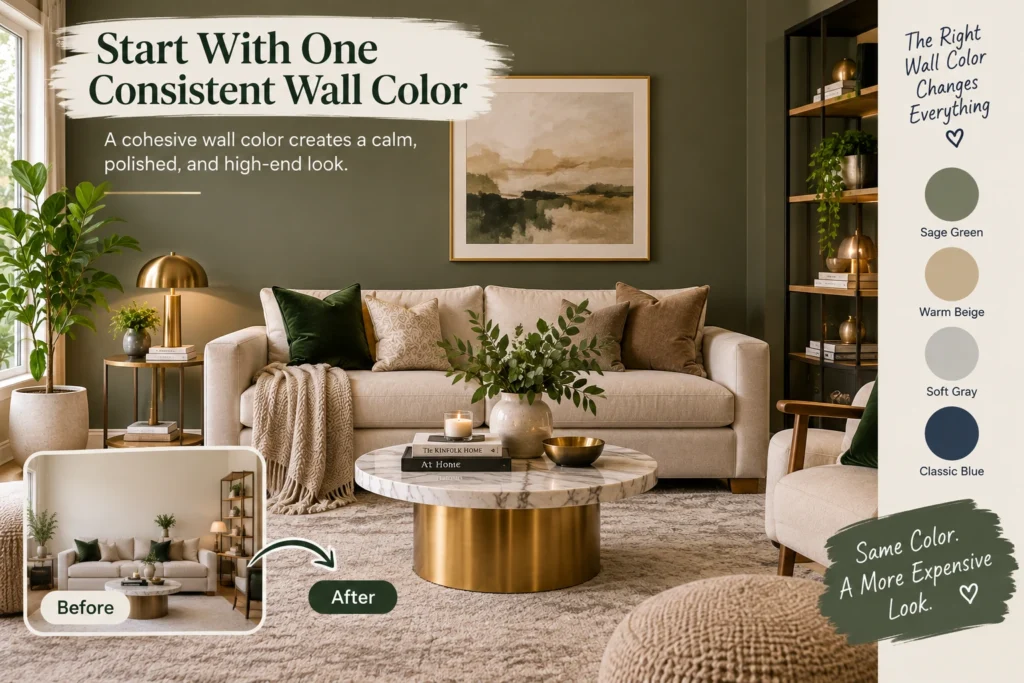
A room looks expensive when the walls act as a calm backdrop, not a competing feature. Pick a single neutral, like a warm white, greige, or soft taupe, and use it everywhere in the room, including trim.
Cool designers back this up with real data. A study published in Frontiers in Psychology followed 443 university students living in six identical buildings that differed only in interior wall color, and blue interiors came out on top, with green and violet close behind. Red and orange, by contrast, scored worst for both mood and study performance. That’s the same logic that makes a single calm neutral read as “designed” instead of accidental.
You might be thinking bold color makes more of a statement. It can, but only in one place. Interior designers often reach for deep navy or a rich emerald as a dramatic backdrop, paired with lighter furniture and textiles so the room doesn’t feel heavy. One dark wall, paired with light furniture, still counts as “one consistent choice.”
✅ Tip
Paint trim and walls the same color for a room under 9 feet tall. The unbroken color makes the ceiling feel higher.
So if your walls are a mix of “builder white,” a cream accent wall, and white trim, that mismatch is costing you more than any missing furniture piece would.
Layer Textures Instead of Buying More Things
Once the walls are settled, texture is what makes a room feel finished. Expensive-looking rooms mix at least three textures: something soft, something structured, and something with a bit of shine.
Where to add texture first
Interior designers often reach for second-hand, vintage, or antique pieces here, since they tend to bring better craftsmanship and more distinctive design at a lower cost than buying new. A worn wood side table or a brass lamp from a thrift store adds more texture than a new, mass-produced piece at three times the price.
Rugs and curtains do the heaviest lifting for texture. Choosing cushions in a mix of velvet, silk, and linen instantly elevates a plain sofa, and even a mid-sized rug adds real warmth to a room. Curtains matter just as much as the rug. Thick, floor-length curtains in linen or faux silk create a more dramatic, sophisticated look than a short, thin panel.
Here’s why that matters: a bare sofa with no texture always reads as unfinished, no matter how much it cost. So if your sofa is a single flat color, one textured throw and two contrasting pillows fix that in minutes.
Fix the Lighting Before Anything Else Gets Added
A single overhead bulb is the fastest way to make any room look like a rental. Expensive-feeling rooms use three layers: ambient light from the ceiling, task light for reading, and accent light for mood.
A statement chandelier or pendant light instantly makes a ceiling feel intentional, and affordable versions with a genuinely luxurious look are easy to find at mainstream home stores. Pair it with a floor lamp that has a sleek metal finish, plus a dimmer switch so the room can shift from bright to soft in the evening.
⚠️ Warning
A torn, yellowed, or dusty lampshade undoes an otherwise expensive-looking room. Check every shade in the room before you buy anything new.
Would a room with three soft light sources ever look cheap? Almost never, even with budget furniture. That’s why lighting comes before shopping for anything else.
Match Every Metal Finish in the Room
Mixed hardware is one of the clearest signals of a budget room, and it’s usually free to fix. Every visible metal finish, from lamp bases to picture frames to drawer pulls, should match or intentionally coordinate.
Keeping every piece of hard furniture the same color or finish, rather than a mix of wood types and tones, ties the whole room together and makes it look far more expensive. Black frames throughout, or brushed brass throughout, both work. What doesn’t work is one of each.
Here’s a quick reference for the swaps that make the biggest visual difference without a large budget.
None of these swaps require new furniture, just adjusting what’s already in the room.
Clear the Clutter, Then Add One Statement Piece
A cluttered surface reads as chaotic no matter how nice the individual items are. Every tabletop, from the coffee table to the console, should have at least one intentional decorative piece, since a bare surface looks unfinished and an overloaded one looks cheap.
Once the clutter is gone, add exactly one piece that draws the eye: a large piece of art, an oversized mirror, or a single sculptural lamp. Wall paneling is another option that instantly evokes the grandeur of older, high-end properties, and it can be added with a simple batten framework for a competent DIYer.
📋 Quick Summary
Declutter every surface first. Then choose one focal piece, whether that’s art, a mirror, or paneling, so the eye has somewhere clear to land.
What Most People Get Wrong About an Expensive-Looking Room
Myth 1: You need new, expensive furniture. Most of the changes above cost nothing or close to it. Paint, decluttering, and fixing lighting matter more than the price tag on the sofa.
Myth 2: More decor equals more luxury. The opposite is usually true. Editing a room down to a cohesive, matching color scheme, rather than piling on unmatched extras, is what makes a small living room look expensive.
Myth 3: Bold colors always look high-end. Bold color only works when it’s the single dominant choice in the room, paired with neutral furniture. Two bold colors fighting each other reads as busy, not luxurious.
Conclusion
An expensive-looking living room comes down to consistency: one wall color, one metal finish, and layered lighting instead of a single bulb. None of that requires a full furniture budget.
One thing to do right now: clear everything off your coffee table except one tray or a small stack of books. It takes two minutes and changes how the whole room reads.
Frequently Asked Questions
How can I make my living room look expensive on a budget?
Start with a single neutral wall color, declutter every surface, and add layered lighting with a floor lamp and dimmer. These changes cost little or nothing and matter more than new furniture.
What colors make a living room look expensive?
Neutral tones like warm white, greige, or soft taupe are the safest choice, since they act as a calm backdrop. Deep navy or emerald also work well as a single dramatic wall paired with lighter furniture.
Does furniture placement affect how expensive a room looks?
Yes. Furniture sized correctly for the room, with a TV unit that fits the TV and clear walking paths, reads as intentional. Oversized or undersized pieces make a room feel mismatched, regardless of cost.
Why does my living room still look cheap after decorating?
Mixed metal finishes and short curtains are the most common causes. Check whether your lamp, frames, and hardware match, and whether curtains hang from near the ceiling to the floor.
How do I make a small living room look expensive?
Keep the color scheme cohesive and edit out anything that doesn’t match. A small room with one consistent palette and matching accent tables looks far more expensive than one packed with mismatched pieces.
Do curtains really make that much of a difference?
Yes. Hanging curtains close to the ceiling and letting them fall to the floor makes windows, and the whole room, look taller. Short curtains sitting above the sill are one of the biggest giveaways of a low-budget room.
What’s the cheapest way to add texture to a living room?
A faux fur or knit throw draped over the sofa, plus two or three cushions in a different fabric, adds texture for very little money. Secondhand rugs and side tables work just as well.
Further reading: Homes & Gardens: high-style living room ideas for less, Ideal Home: budget living room tricks, and Chitkara University: the psychology of color in interior design.