

Quick Answer
The best ambient lighting ideas combine soft, evenly distributed light with adjustable brightness. Start with a diffused ceiling light or an uplighting floor lamp, then add warm lamps around the room to reduce dark corners and glare; for the bigger picture, see these living room design basics.
Five changes that make the biggest difference
- Use warm-white bulbs: Start around 2700K–3000K for a welcoming evening atmosphere.
- Diffuse the light: Frosted glass and fabric shades soften the view of bright bulbs.
- Light separate zones: Put gentle light near seating, walls, and unused corners.
- Add dimming control: Choose compatible dimmable bulbs, fixtures, and controls.
- Hide harsh sources: Bounce light off walls or ceilings when possible.
Try this tonight
- Switch off the overhead: Turn on two lamps at different heights and assess the room from your sofa.
- Fix the darkest corner: Move one lamp before buying another fixture.
A living room can look beautiful in daylight and still feel uncomfortable after sunset. Usually, the issue isn’t the furniture; it’s where the light falls.
I prefer ambient lighting that quietly supports the whole room instead of demanding attention. These 15 ideas cover renter-friendly lamps, ceiling solutions, hidden LEDs, and simple choices that improve everyday comfort.
What Is Ambient Lighting, and Why Does It Matter?
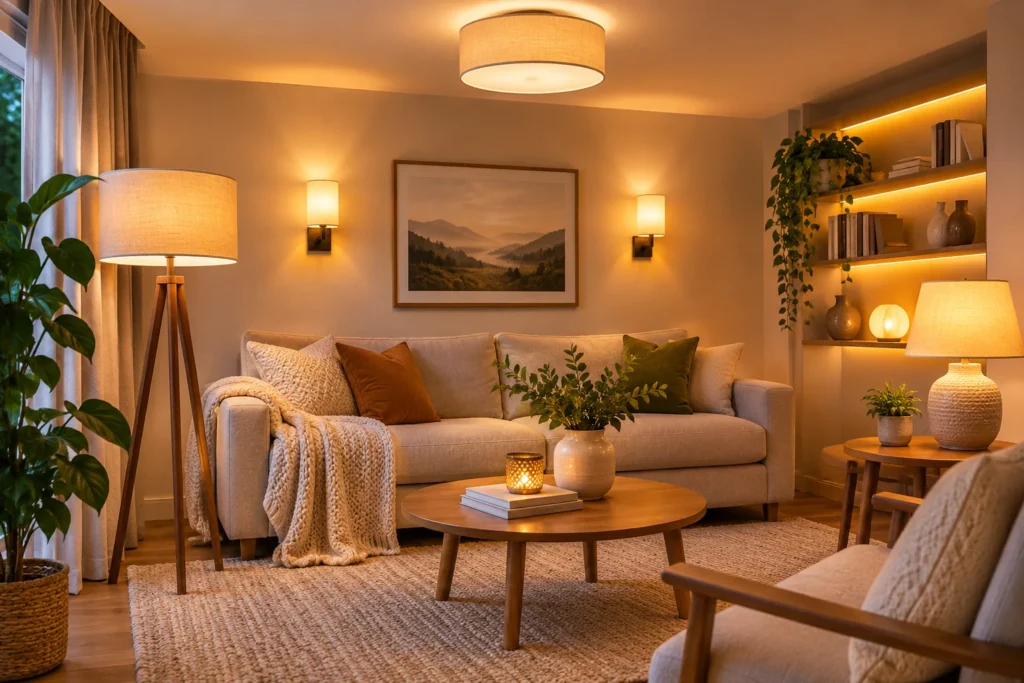
Ambient lighting is the general illumination that helps people see and move around a space. It establishes the room’s overall brightness before you add focused or decorative light.
A ceiling fixture can provide ambient light, but it isn’t the only option. Several shaded lamps or indirect fixtures can make a room feel evenly lit without a harsh central glow.
- Ambient light: Provides the general background illumination.
- Task light: Focuses light where you read, work, or complete detailed activities.
- Accent light: Draws attention to artwork, textures, or architectural features.
The Illuminating Engineering Society’s task-ambient definition explains why general light can remain softer when focused task lighting supports specific activities. You don’t have to make every square foot equally bright.
Which Ambient Lighting Ideas Work Best in a Living Room?
The most useful approach depends on ceiling height, available outlets, daylight, and how you use the room. I would begin with movable lamps before paying for permanent wiring.
1. Use a Frosted Flush-Mount Ceiling Light
A flush-mount fixture with an opal or frosted diffuser spreads light more gently than exposed bulbs. It’s a practical ambient source in rooms with low or standard ceilings.
Choose a fixture with suitable output for the room and check its dimmer compatibility. Avoid clear globes that put bright LED filaments directly in your line of sight.
2. Bounce Light Off the Ceiling With an Uplighter
An upward-facing floor lamp sends light toward the ceiling, which then reflects a softer glow into the room. It’s particularly effective when a single overhead fixture feels too direct.
Place it near a wall or open corner where the beam can spread. Dark ceilings absorb more light, so the same lamp may feel dimmer there.
3. Put Shaded Table Lamps on Opposite Sides
Two fabric-shaded table lamps help distribute light across a wide seating area. They also make it easier to turn down the ceiling fixture after dinner.
Matching lamps aren’t essential. Similar bulb color temperatures matter more than identical bases or shades for a consistent glow.
4. Add Plug-In Wall Sconces
Plug-in sconces bring light to eye level without opening the wall for electrical work. They work well beside a sofa, in an alcove, or along a darker perimeter.
Choose diffused or upward-facing shades to limit glare. Secure visible cords neatly and follow the fixture’s mounting instructions.
5. Hide an LED Strip Behind a Cove or Ledge
Concealed LED strips can wash the ceiling with a continuous band of indirect light. The effect looks cleaner when you cannot see individual LED points.
Use an appropriate diffuser channel and manufacturer-approved power supply. Check whether the particular strip can be cut; many addressable RGBIC models cannot.
6. Light a Dark Corner With a Slim Floor Lamp
A tall, shaded floor lamp can make an ignored corner feel connected to the rest of the room. It’s an easy option when ceiling wiring isn’t available.
Try the lamp beside an armchair rather than directly behind a television. Keep its base and cord out of walking routes.
7. Choose a Globe Pendant With a Diffuser
A globe pendant can serve as ambient lighting and a decorative centerpiece. Frosted glass usually feels calmer than an exposed filament hanging at eye level.
Use it where ceiling height and furniture placement allow safe clearance. A pendant above a central coffee table needs different positioning from one in a walking path.
8. Dim Recessed Downlights Instead of Using Them at Full Power
Recessed downlights can provide useful background light when their beam patterns overlap. A dimmer lets you avoid the bright, spotty look of running every light at maximum output.
Choose suitable spacing and beam angles before installation. ENERGY STAR’s downlight guidance also explains dimmer matching and insulation-contact ratings.
9. Wash a Wall With Soft Light
A wall-washing fixture illuminates a broad vertical surface instead of creating a bright spot on the floor. This can make a narrow living room feel more open.
Try lighting the longest plain wall or one with subtle texture. Keep the beam away from glossy art and screens that reflect it.
10. Use Paper or Linen Shades for a Gentle Glow
Paper and linen shades scatter light and create a relaxed look, especially in minimalist or natural-material interiors. A larger shade can become a soft visual feature.
Use only bulbs and wattages approved for that fixture. Keep the shade clear of hot surfaces, drapery, and anything that blocks ventilation.
11. Place a Small Lamp on a Bookshelf
A compact shaded lamp on a sturdy shelf brings light into the middle of a wall. It can soften the transition between a bright seating area and an otherwise dark bookcase.
Leave space around the fixture for airflow and avoid overloaded outlets. For a more complete arrangement, explore this living room styling guide.
12. Backlight the Television Area
A low-glare light behind a television can reduce the stark contrast between a bright screen and a dark wall. Treat it as supportive background light, not a substitute for room-wide illumination.
Choose a controlled brightness and avoid visible reflections. For color-critical viewing, a neutral-white bias light may be preferable to colorful decorative effects.
13. Add a Portable Rechargeable Table Lamp
A cordless table lamp can illuminate a coffee table or awkward corner without stretching a cable across the floor. It’s useful in rooms where outlets are scarce.
Check actual runtime at your preferred brightness before buying. Recharge the lamp according to the manufacturer’s instructions and keep it away from moisture unless rated otherwise.
14. Give Fireplace or Alcove Walls Their Own Glow
Small, diffused wall lights can prevent fireplace recesses and alcoves from disappearing into shadow. They create a more balanced room when the central ceiling light is dimmed.
Keep fixtures outside heat-clearance zones and follow product requirements. If the wall is already busy, one restrained lighting detail is enough.
15. Build Simple Lighting Scenes With Smart Controls
Smart bulbs or compatible lamp controls can save brightness settings for different activities. One scene might use gentle evening light, while another raises overall brightness for guests.
I recommend starting with just two scenes: everyday and relaxed evening. Too many settings can make a simple room needlessly complicated.
What Color Temperature Is Best for Ambient Lighting?
For most cozy living rooms, 2700K–3000K is a sensible starting point. Kelvin measures the appearance of white light, not how bright the bulb is.
Use the chart below to choose an appearance rather than chasing a single number. Actual results depend on paint, daylight, dimming, and the fixture’s diffuser.
| Color temperature | Typical appearance | Where it can work |
|---|---|---|
| 2200K | Very warm, amber-leaning | Low-level decorative evening glow |
| 2700K | Warm white | Relaxed living rooms and shaded lamps |
| 3000K | Soft warm white | Multipurpose living rooms |
| 3500K–4100K | Neutral to cooler white | Brighter daytime-oriented activities |
The U.S. Department of Energy’s bulb guide explains how color temperature affects a space. When you mix lamps, similar Kelvin settings usually make the result feel more coordinated.
How Bright Should Ambient Lighting Be?
Start by reading lumens, which describe light output, rather than watts, which describe energy use. A lamp’s shade, direction, and placement can change how much useful light reaches your seating area.
- 450 lumens: A familiar reference point for a traditional 40-watt incandescent replacement.
- 800 lumens: Approximately the output associated with a 60-watt incandescent replacement.
- 1,100 lumens: Comparable to a traditional 75-watt replacement.
- 1,600 lumens: Comparable to a traditional 100-watt replacement.
These are bulb comparison benchmarks, not a universal prescription for an entire room. ENERGY STAR’s brightness chart helps you compare them.
For a 12-by-15-foot living room, I would first map the sofa, reading chair, and darkest corner. Then I’d test a diffused general source and two movable lamps before deciding whether more fixtures are necessary.
How Do You Arrange Ambient Lights Without Creating Glare?
Start with your usual viewing positions, not the fixtures themselves. Sit on the sofa and in each chair, then look toward lamps, windows, and the television.
- Mark the dark areas: Notice corners and walls that disappear when the ceiling light is off.
- Choose the broad source: Use a diffused ceiling light or an uplighter to establish general brightness.
- Balance the perimeter: Add a shaded lamp away from your first light source.
- Check the sightlines: Move visible bulbs away from seated eye level and reflective screens.
- Test two settings: Compare ordinary evening use with a brighter setting for visitors or cleaning.
In a long or open-plan room, separate lighting zones often work better than one very bright central fixture. These functional living room planning tips can help you keep lighting and walking routes aligned.
Which Ambient Lighting Mistakes Should You Avoid?
Most disappointing results come from poor placement or mismatched equipment, not a lack of expensive fixtures. Check these problems before you buy another light.
- One harsh ceiling fixture: Add another light source rather than increasing brightness alone.
- Visible bright bulbs: Try frosted diffusers, shades, or indirect placement.
- Mixed white tones: Avoid random combinations of very cool and warm bulbs unless intentional.
- Wrong dimmer: Verify compatibility among bulbs, fixtures, and dimming controls.
- Unsafe cords: Keep cables away from paths, rugs, doorways, and heat.
- Poor color rendering: Consider LEDs with a color rendering index (CRI) of 80 or higher; 90+ may better preserve subtle interior colors.
The Department of Energy’s LED basics explains why color rendering matters. Also review fixture ratings before using bulbs in enclosed shades or recessed housings.
Useful Products for Adjustable Ambient Lighting
If you want more flexibility without changing every fixture, these are two products I’d consider for different situations. The ratings below are editorial fit scores, not verified customer averages or claims of hands-on testing.
💡 Best for adjustable white light
Philips Hue White Ambiance A19 E26 Smart Bulb
★★★★☆ 4/5 editorial fit
The White Ambiance range offers dimmable warm-to-cool white light in an A19 bulb format. I would choose this type for an existing table lamp that needs different settings throughout the day; check the current model and regional voltage before buying.
🎛️ Best for dimming existing lamps
Lutron Caséta PD-3PCL Plug-In Lamp Dimmer
★★★★☆ 4/5 editorial fit
This plug-in controller can dim up to two compatible lamps together, with a 100-watt total rating for approved dimmable LEDs. I like it for standard plug-in lamps when you want simple control without rewiring; check bulb compatibility and the region-specific electrical rating.
Important: These are alternative approaches, not products to combine. Do not run Philips Hue smart bulbs through a conventional plug-in lamp dimmer; follow the smart bulb’s own control instructions.
Frequently Asked Questions About Ambient Lighting
Is ambient lighting the same as mood lighting?
Not exactly: ambient lighting provides the general light that makes a room usable, while mood lighting describes a desired atmosphere. Soft, warm ambient light can create a relaxing mood, but a dramatic colored accent alone may not provide enough light for safe movement.
Can you create ambient lighting without ceiling lights?
Yes: multiple shaded table lamps, uplighters, and plug-in wall sconces can provide comfortable general illumination. Spread them around the room rather than grouping everything beside the sofa, then check that stairs, doors, and walking routes still have enough light.
Are LED strips good for ambient lighting?
LED strips work well when their light reflects off a ceiling, wall, or other broad surface. Exposed strips tend to look spotty or distracting, so use a suitable diffuser or concealed mounting location.
Check the power supply, installation instructions, and whether the strip supports cutting.
Should living room ambient lighting be warm or cool?
Warm white around 2700K–3000K is a useful starting point for a relaxed living room. Cooler light can suit daytime tasks or a brighter contemporary look.
If you want both, tunable-white bulbs let you adjust the appearance without replacing the fixtures.
What is the cheapest way to improve ambient lighting?
Reposition the lamps you already own before buying anything. Put one in the darkest corner, use compatible warm-white LED bulbs, and keep bright bulbs out of direct view.
If you still need more control, consider a suitable dimmable bulb or another shaded lamp.
Final Takeaway: Start With Softer Light in More Than One Place
Great ambient lighting doesn’t require a dramatic renovation. It requires enough background light, comfortable sightlines, and controls that suit how your living room changes throughout the day.
Begin with a simple evening audit: turn down the ceiling light, move two lamps, and check the room from your favorite seat. If the space feels balanced, you’ve found your starting point; for more warmth and texture, explore these cozy living room decor ideas.