

Quick Answer
The most common living room lighting mistakes are relying on one ceiling light, choosing harsh or mismatched bulbs, placing lamps where they cause glare, and skipping task lighting or dimmers. Fix them by combining ambient, task, and accent light; choosing warm-white LEDs; and checking the room from your usual seat. Start with this living room lighting guide if you need a complete plan.
Five fixes to try first
- Layer the lighting: Pair broad room light with a reading lamp and one subtle accent.
- Choose warmer bulbs: Start around 2700K–3000K for relaxing evening spaces.
- Block direct glare: Use appropriate shades and aim bright beams away from eyes and screens.
- Control each zone: Add compatible dimmers or separately switched lamps where practical.
- Check electrical safety: Match bulb bases and voltage, and keep cords out of walking paths.
A quick test tonight
- Try two lamps: Switch off the main light, turn on lamps at different heights, and note where the room still feels uncomfortable.
A living room can look carefully decorated in daylight and still feel unpleasant at night. Often, the problem isn’t the furniture or paint; it’s the light.
I approach lighting problems by changing placement and bulb choice before buying new fixtures. Below, I’ll show you the mistakes worth fixing first, with practical examples and a simple room-by-room checklist.
What Are Living Room Lighting Mistakes?
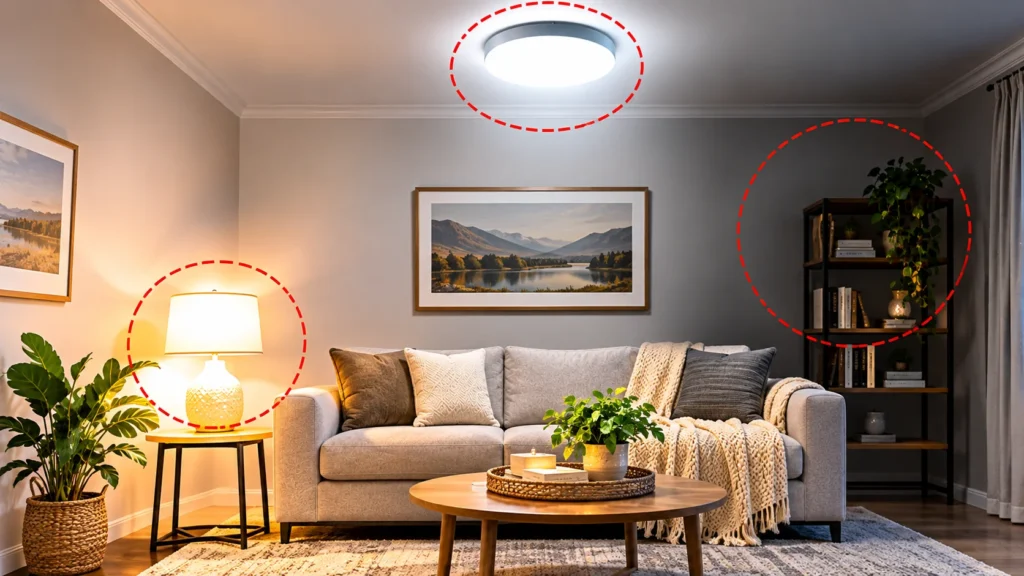
Living room lighting mistakes are choices that make a space harder to use, less comfortable, or less visually balanced. They usually involve brightness, light color, beam direction, fixture placement, or poor control.
Good lighting has three jobs, and a useful setup doesn’t ask one fixture to perform all of them.
- Ambient lighting: General light that helps people move around and enjoy the room.
- Task lighting: Focused illumination for reading, sewing, games, or other close work.
- Accent lighting: Light that draws attention to art, shelves, or architectural details.
A comfortable arrangement can use just a few fixtures. What matters is whether each source has a clear purpose.
What Are the 12 Most Common Living Room Lighting Mistakes?
Start with the problems that affect daily comfort. You may only need to correct two or three mistakes to change the whole room.
1. Relying on One Harsh Overhead Light
A single ceiling fixture often makes the middle of the room bright while leaving reading spots and corners dim. It can also cast unflattering shadows across faces.
The fix: Keep the ceiling light as one layer, then add a shaded lamp beside seating and a gentle source across the room. For more options, explore these ambient lighting ideas.
- Use overhead light for general visibility and cleaning.
- Use lower lamps for relaxing or talking.
- Choose one small accent instead of spotlighting everything.
2. Choosing the Wrong Color Temperature
Color temperature describes how warm or cool white light appears, measured in Kelvin (K). Very cool bulbs can make a cozy room feel clinical after dark.
The fix: Start with 2700K–3000K for most evening living areas, then judge the result against your wall and fabric colors. ENERGY STAR’s color-appearance guidance explains the Kelvin scale.
- 2200K–2700K: Extra-warm atmosphere for soft evening light.
- 2700K–3000K: A useful warm-white starting range for everyday living.
- 3500K–4000K: A more neutral look for some multipurpose spaces.
3. Buying Bulbs by Watts Instead of Lumens
Watts tell you how much power a bulb uses, not how much visible light it produces. Lumens are the number to compare for brightness.
The fix: Read the lumen value on the package and consider the shade or diffuser around it. The ENERGY STAR brightness guide gives familiar reference points.
- 450 lumens: Roughly equivalent to an old 40-watt incandescent bulb.
- 800 lumens: Roughly equivalent to an old 60-watt incandescent bulb.
- 1,100 lumens: Roughly equivalent to an old 75-watt incandescent bulb.
These are bulb comparisons, not fixed requirements for an entire room. Wall color, ceiling height, and beam direction change how bright a space feels.
4. Forgetting a Dedicated Reading Light
An overhead lamp may brighten the room without putting enough light on a book. That’s especially noticeable beside a deep sofa or armchair.
The fix: Place an adjustable floor or table lamp near the reader and aim its light toward the page. Our table lamp placement guide covers shade height and positioning.
- Check that the light reaches the reading surface.
- Keep the bare bulb outside your seated line of sight.
- Choose a stable table or floor base.
5. Leaving Bright Bulbs Exposed at Eye Level
Glare happens when a bright source becomes uncomfortable to look at. Clear shades, exposed filaments, and poorly aimed spotlights can cause it even when the room isn’t bright overall.
The fix: Sit in your normal seat and look toward each light. Use a suitable fabric shade, frosted globe, or redirected beam to hide the bright source.
My simplest test is to look around the room without squinting. If a bulb draws my eyes more than the furniture does, I would adjust its position or diffusion first.
6. Ignoring TV and Window Reflections
A lamp that looks attractive from the doorway may reflect directly in the TV. Windows can create the same problem during bright afternoons.
The fix: Test the screen from your actual viewing spot, then move or dim the offending source. Avoid aiming a spotlight at the display.
- Shift lamps away from the screen’s reflection path.
- Filter strong daylight with suitable blinds or curtains.
- Keep a little soft background light for moving around.
7. Using the Same Brightness for Every Activity
The brightness you need for cleaning is different from what feels pleasant during a movie. One permanently bright setting gives you very little flexibility.
The fix: Create separate settings for everyday use, reading, and relaxing. Dimmers can help, but the LED bulb and dimming control must be compatible.
- Everyday: Moderate background light plus a nearby table lamp.
- Reading: Softer room light with a focused lamp at the chair.
- Movie night: Dim, indirect background light without screen reflections.
8. Hanging Fixtures Too Low or Choosing the Wrong Scale
An oversized pendant can crowd a low ceiling, while a tiny fixture can disappear in a large seating area. Poor mounting positions can also bring bright bulbs too close to faces.
The fix: Check the fixture’s full dimensions, your ceiling height, and the location of walking routes. For small rooms, consider appropriately placed wall sconces instead of another floor-standing fixture.
A decorative size rule is only a starting point, not a safety standard. Verify clearances and mounting requirements before installing a hardwired fixture.
9. Placing Every Lamp on One Side of the Room
Lighting concentrated beside one sofa can leave the opposite side gloomy. The imbalance becomes more obvious when the main ceiling light is off.
The fix: Spread useful sources across activity zones and more than one height. This floor lamp placement guide explains how to use dark corners without creating glare.
- Position one lamp near the main seating area.
- Use a second, softer source across the room.
- Aim an uplight at a suitable pale wall or ceiling for reflected light.
10. Ignoring Color Rendering and Bulb Quality
Two bulbs with the same Kelvin value can show furniture colors differently. Color Rendering Index (CRI) describes how faithfully colors appear under a light source.
The fix: Look for at least 80 CRI as a practical baseline, with 90 or higher worth considering near colorful textiles or artwork. The U.S. Department of Energy’s LED basics guide explains this measure.
Also check for visible flicker, unwanted buzzing, and unsuitable dimming behavior. These problems can come from an incompatible bulb-control combination.
11. Ignoring Cords, Voltage, and Bulb Ratings
A beautiful lighting plan isn’t useful if cords create trips or electrical parts don’t match. Risks include overloaded fixtures, damaged cables, and incompatible plug-in dimmers.
The fix: Check the bulb base, supply voltage, fixture maximum wattage, and dimmer requirements before buying. The Electrical Safety Foundation International advises keeping extension cords temporary and away from damage.
- Never route extension cords under rugs or across busy walkways.
- Replace frayed cords and keep plugs accessible.
- Ask a qualified electrician to handle new hardwired fixtures or outlets.
12. Shopping Before Testing the Room After Dark
Daylight hides lighting gaps, so daytime shopping decisions can miss the real problem. A stylish new lamp may not solve a misplaced beam or a dark reading area.
The fix: Test the existing lights at night, move portable lamps, and note what still needs attention. Then shop for a specific purpose rather than a matching set.
- Photograph the room with your usual evening lights on.
- Mark where you read, watch TV, and walk.
- Replace the weakest bulb or lamp position first.
Which Living Room Lighting Fix Should You Try First?
Use this comparison to match the symptom to the smallest useful change. Exact bulb needs depend on the fixture and room, so treat the numbers as reference points.
| What you notice | Likely mistake | First fix | Useful reference |
|---|---|---|---|
| Room feels flat | Only overhead light | Add a shaded side lamp | Ambient + task layers |
| Light looks cold | High Kelvin bulbs | Try warm white | 2700K–3000K |
| Reading is difficult | Missing task light | Add an adjustable lamp | Try an 800-lumen bulb if suitable |
| Bulbs hurt your eyes | Direct glare | Diffuse or redirect light | Check seated eye level |
| Colors look dull | Poor color rendering | Compare CRI labels | 80+ baseline; 90+ for color detail |
| Movies show reflections | Light aimed at TV | Move or dim lamp | Test from the sofa |
How Can You Fix Living Room Lighting Step by Step?
You don’t need a renovation to solve most everyday lighting problems. I would follow this order before spending money on decorative fixtures.
- Map the room: Sketch seating, the television, windows, power outlets, and routes people walk at night.
- Test one light at a time: Switch sources on separately after sunset to find harsh beams and weak spots.
- Correct bulb choices: Compare lumens, Kelvin, CRI, fitting type, and voltage using the FTC Lighting Facts explanation.
- Add task light: Put a controllable lamp beside the seat used for reading or detailed activities.
- Balance the room: Move a shaded lamp across the space or introduce gentle indirect lighting.
- Retest from real positions: Sit on the sofa, read at the chair, and check the TV for reflections.
For example, in a 12-by-15-foot living room, I would first test a central ceiling light and two portable lamps. I’d keep only the combination that serves the seating area without dazzling anyone.
Do Small, Large, and TV-Focused Living Rooms Need Different Fixes?
Yes. The same lighting principles apply, but the placement changes with the room’s size and purpose.
Small Living Rooms and Rentals
Use compact fixtures and avoid crowding walkways with wide lamp bases. A shaded floor lamp, small table lamp, and plug-in reading light can offer flexibility without rewiring.
Large or Open-Plan Living Rooms
Light separate seating, reading, and conversation zones rather than flooding the entire space. Keep controls independent so unused areas can stay softer.
Living Rooms Built Around a TV
Prioritize reflection control over decorative brightness near the screen. Gentle lighting behind or away from the TV often works better than a bright spotlight facing it.
Which Lighting Products Can Help Correct These Mistakes?
If moving your current lamps isn’t enough, these are three specific products worth comparing. The ratings below describe my editorial fit for each use case, not verified customer-review scores.
Compatibility matters: The listed U.S. models use 120V electrical systems and E26 fittings where specified. If your home uses 220–240V or different sockets, choose a manufacturer-approved local version instead.
🏆 Best simple bulb upgrade
GE Relax HD A19 Soft White LED (60W Replacement)
★★★★★ 5/5 editorial fit
The medium-base version delivers 800 lumens at 2700K, uses 8.5W, and has a CRI of 90. I’d consider it first when an existing lamp needs a warmer, more color-faithful bulb, provided the fitting and voltage match.
💡 Best plug-in dimmer
Lutron Credenza LED+ Lamp Dimmer TTCL-100H
★★★★☆ 4/5 editorial fit
This 120V plug-in slider is designed for compatible dimmable LED lamps, without wall rewiring. I like the practical concept for an existing table lamp, but I’d check Lutron’s LED compatibility information before choosing a bulb.
🎨 Best for flexible light scenes
Philips Hue Essential A19 E26 Smart Bulb
★★★★☆ 4/5 editorial fit
This 8.8W smart bulb offers up to 800 lumens, adjustable 2200K–6500K white light, and app-controlled dimming. I’d choose it where changing the room’s mood matters more than keeping the purchase simple.
Affiliate disclosure: As an Amazon Associate, this site may earn from qualifying purchases. Check the current product listing, regional specifications, and seller details before ordering.
Frequently Asked Questions About Living Room Lighting Mistakes
What Is the Biggest Lighting Mistake in a Living Room?
For many homes, the biggest mistake is relying on one overhead light for everything. It may illuminate the room but leave reading areas dim and create glare.
A combination of background light and a well-placed task lamp usually gives you better flexibility.
Is 3000K Too Bright for a Living Room?
The 3000K rating describes the appearance of white light, not its brightness. A 3000K bulb can be dim or bright depending on its lumen output.
For cozy evenings, compare 2700K and 3000K in your actual fixtures and choose what feels comfortable.
How Many Lamps Should a Living Room Have?
There is no fixed number of lamps for every living room. A small space may work with a ceiling fixture, one table lamp, and one reading light.
Larger rooms often benefit from several separately controlled sources across different seating zones.
Should All Living Room Light Bulbs Match?
They do not need identical brightness, but keeping most visible white-light sources in a similar Kelvin range often looks more coordinated. Task lights can be brighter than accent lights.
Also compare color rendering and dimmer compatibility, since matching Kelvin values alone doesn’t guarantee identical results.
Can I Improve Living Room Lighting Without Rewiring?
Yes. Start by moving portable lamps, replacing unsuitable bulbs, adding a stable reading light, and choosing compatible plug-in controls.
Keep cords clear of walkways and avoid using extension cords as permanent wiring. Any new hardwired installation should follow local electrical requirements.
Final Takeaway: Fix the Light Before Replacing the Decor
The best solution to living room lighting mistakes is usually better placement, softer direction, and more control—not simply more brightness. Begin with one uncomfortable spot, test a small change after dark, and build a balanced scheme around how you actually use the room.
Before your next purchase, check three things: what the light needs to do, where it will shine, and whether the bulb and fixture are electrically compatible. Those decisions make every lighting upgrade more useful.