

⚡ Quick Answer
A good coffee table should feel easy to reach and easy to walk around. Start near two-thirds of your sofa’s length. Keep its top near the seat height. Leave about 14 to 18 inches from the sofa. Then choose shape, material, and storage around your daily use.
Coffee table fit checks
- Length: Start near two-thirds of your sofa’s length.
- Height: Keep the tabletop near your sofa’s seat height.
- Gap: Leave about 14 to 18 inches from the sofa.
- Shape: Match the table to your seating layout and walking paths.
Before choosing your coffee table
- ✓Measure your sofa before shopping.
- ✓Tape the planned footprint on your floor.
- ✓Check every walking path before buying.
You sit down and reach for your drink. The table feels too far away.
Or your knees hit its edge every time you stand. These small problems often come from poor scale.
James Fox keeps the first choice simple: fit matters more than trends. Measure your sofa before comparing colors, shapes, or finishes.
The right table should support daily life without crowding the room. Good dimensions make every later style choice much easier.
📌 Key Takeaways
- →Measure first. Sofa size should guide your coffee table dimensions.
- →Protect movement. Keep enough space for knees, feet, and walking paths.
- →Match your life. Material should suit spills, children, pets, and cleaning habits.
- →Keep function clear. Leave useful tabletop space instead of filling every inch.
What Size Coffee Table Should You Choose?
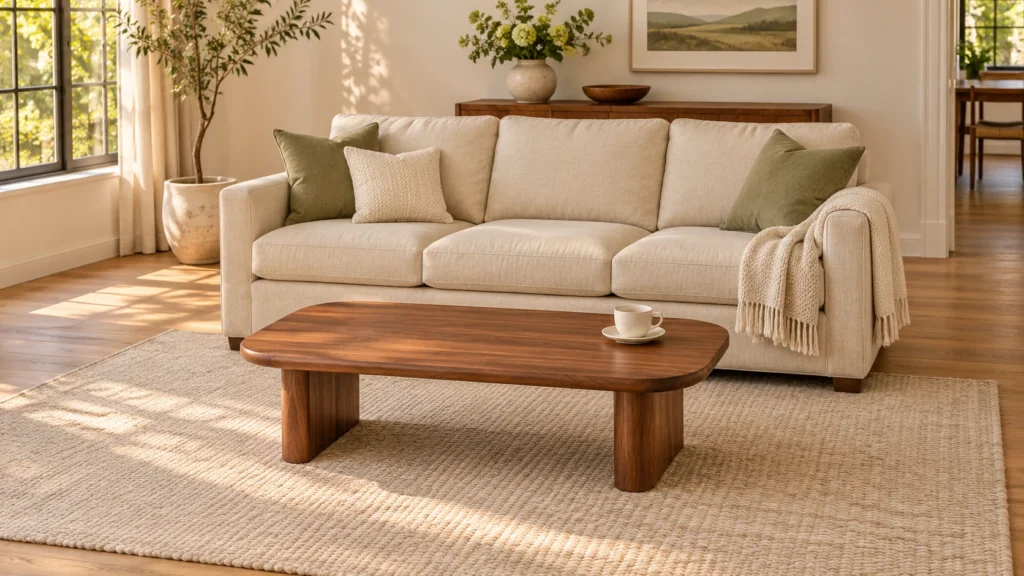
Start with your sofa length, not the empty floor space. A useful starting point is about two-thirds of the sofa’s length. Architectural Digest also cites this common proportion rule for coffee tables.
An 84-inch sofa therefore points toward a table near 56 inches. A 72-inch sofa points toward a table near 48 inches.
The ratio is a guide, not a strict building rule. Your room still needs clear paths around each side.
You may think a larger table always looks more luxurious. Oversizing often makes the seating zone feel crowded instead.
A tiny table creates the opposite problem. People at each sofa end struggle to reach it.
So if two sizes look suitable, check reach and clearance next. Those two tests usually reveal the better fit.
This matches Super Dwelling’s broader advice to measure before choosing living room pieces.
Use this table as a starting point for common sofa lengths.
Choose within the range only after checking your real floor clearance.
✅ Tip
Mark the table footprint with painter’s tape. Sit, stand, and walk around it before buying.
Length solves only one part of the fit. The next check is tabletop height.
How Tall Should a Coffee Table Be?
Your coffee table should sit close to your sofa’s seat height. This keeps drinks and remotes within a natural reach.
Crate & Barrel suggests staying within three inches below the seat. It also allows about one inch above it.
Architectural Digest notes that many coffee tables measure 16 to 18 inches high. Your sofa height should still make the final decision.
A low sofa often works better with a lower table. Tall seating can support a slightly taller one.
You may think standard height matters more than sofa height. It does not solve reach problems in your actual room.
Measure from the floor to the sofa’s compressed seat top. Compare that number with each table before ordering.
So if your sofa sits unusually low, ignore generic store averages. Match the table to the seat you use daily.
Once height feels right, distance controls whether that table remains comfortable.
How Far Should a Coffee Table Sit From the Sofa?
Leave about 14 to 18 inches between your sofa and coffee table. That space balances reach with room for legs.
Crate & Barrel recommends about 14 inches from the sofa. Super Dwelling uses a 14-to-18-inch planning range.
Move closer when easy reach matters more than pass-through space. Move farther only when people still reach comfortably.
Your main walking routes need more room than the sofa gap. Super Dwelling suggests roughly 30 to 36 inches there.
You may think every side needs identical clearance. Real rooms rarely work with perfect symmetry.
Protect the busiest path first. Then adjust the table slightly toward quieter seating areas.
So if guests keep turning sideways to pass, change the layout. Don’t blame the room’s square footage first.
With spacing fixed, table shape becomes much easier to judge.
Which Coffee Table Shape Fits Your Room?
Choose shape from the seating arrangement and walking paths. Rectangular tables suit many straight sofas and balanced layouts.
Round tables remove projecting corners and soften rooms with many straight lines. They also ease movement through tight paths.
Crate & Barrel notes that square tables fit well inside sectional corners. Its guide also favors round forms for easier circulation.
Oval tables blend qualities from round and rectangular designs. They provide length without four sharp visual corners.
You may think shape is mainly a style choice. Shape also changes reach, movement, and usable surface area.
Large sectionals can make one small rectangle look lost. A square table or paired tables can serve more seats.
So start with the seating footprint. Let the table echo that layout without copying it exactly.
💡 Choose Your Shape
Straight Sofa
You want simple reach across several seats.
→ Try rectangular or oval
Sectional
Your seating wraps around a central zone.
→ Try square or round
Tight Walkways
People often pass close to the table.
→ Try round or oval
For harder rooms, these show several seating patterns.
Shape controls movement. Material decides how the table handles daily wear.
Which Coffee Table Material Fits Your Lifestyle?
Pick material by daily use before choosing color. Wood adds warmth and works across many decorating styles.
Glass keeps more floor visible and can feel lighter. Metal offers a slim look with strong structural support.
Stone creates visual weight and a solid focal point. Upholstered ottomans provide a softer surface and extra flexibility.
Crate & Barrel lists wood, metal, marble, glass, upholstery, and stone as common options. Its guide links material choice directly with lifestyle.
Room & Board also uses wood, steel, glass, ceramic, and stone across coffee tables. Each material changes care needs and visual weight.
You may think the toughest material is always best. A difficult surface can still become annoying in daily use.
So consider spills, fingerprints, children, pets, lifting, and cleaning. Choose the finish you can maintain without stress.
This quick comparison shows where each common material works best.
Daily habits should decide the winner, not showroom appearance alone.
⚠️ Glass Table Safety
For glass tabletops, check whether the glass is tempered. CPSC says tempered glass breaks into smaller fragments when shattered.
For glass safety details, review the . The alert includes horizontal tabletops and coffee tables.
Material matters everywhere. Room size changes how visually heavy that material feels.
How Do You Choose a Coffee Table for a Small or Large Room?
Small rooms need useful surface area without blocking movement. Start with the same sofa-based measurements, then reduce visual weight.
Round and oval forms can ease tight movement paths. Glass or open-base designs keep more floor visible.
Nesting tables add flexible surface area without one large permanent footprint. Storage tables can also replace separate storage pieces.
You may think every small room needs a tiny table. A table that is too small often becomes less useful.
Instead, choose correct proportions and lighter construction. That keeps function while reducing the crowded feeling.
Large rooms have the opposite issue. One undersized table can look detached from broad seating groups.
A wide sectional can support a larger square table. Two coordinated tables can also fill a long seating zone.
So judge visual scale and walking clearance together. Neither room size nor sofa size should work alone.
Super Dwelling’s guide on also favors clear paths and lighter furniture forms.
After the table fits the room, styling decides whether it stays useful.
How Should You Style a Coffee Table Without Clutter?
Keep part of your coffee table open for daily use. Start with one anchor, such as a tray.
Add a small group of objects with different heights. Books, a low bowl, and greenery create simple variety.
Crate & Barrel suggests using trays and personal objects for larger tables. Its designers also suggest grouping pieces in threes.
You may think an empty area looks unfinished. That open surface is what makes the table useful.
A clear zone holds drinks, snacks, phones, or a laptop. It also keeps the display from feeling crowded.
A round table often works with one centered group. Long tables can support two small visual zones.
So style around how you use the table each evening. Don’t design a surface you must constantly dismantle.
- Clear the full tabletop first.
- Add one tray or book stack.
- Add one taller object for contrast.
- Leave useful space completely open.
For the wider room, these steps on help coordinate furniture and accessories.
Good styling cannot rescue the wrong table. That leads to the mistakes worth avoiding.
What Most People Get Wrong About Coffee Tables
Most coffee table mistakes start before the purchase. People often choose style before measuring the sofa or floor.
Another mistake is treating one sizing rule as absolute. The two-thirds rule only gives you a useful starting point.
Height, reach, and clearance still matter. A perfect ratio can fail when people cannot move comfortably.
People also assume matching furniture creates the best room. Your coffee table does not need identical materials or colors.
Crate & Barrel says a coffee table can match a TV stand. It also says matching isn’t required.
Another common error is covering the full tabletop with décor. A coffee table should remain useful after styling.
You may think correcting these issues requires a new table. Often, moving or simplifying the current table solves them.
- Wrong: Buy by appearance first. Better: Measure the sofa and floor first.
- Wrong: Match every finish. Better: Repeat one material or color elsewhere.
- Wrong: Fill the surface. Better: Keep a clear everyday-use zone.
Once these mistakes disappear, the final buying check becomes simple.
What Should You Do Before Buying a Coffee Table?
Measure your sofa length, seat height, and available floor space. Then tape the planned table footprint on the floor.
Walk around it and sit beside it. Choose shape and material only after that test.
Right now, measure your sofa from arm to arm. Write that number down before you shop.
Frequently Asked Questions
What Is the 2/3 Rule for Coffee Tables?
A coffee table starts near two-thirds of the sofa’s length. Use this as a proportion guide, not a strict rule.
How Tall Should a Coffee Table Be?
Keep its top near your sofa’s seat height. A slightly lower table often feels comfortable and balanced.
How Far Should a Coffee Table Be From a Sofa?
About 14 to 18 inches works as a practical starting range. Adjust it for reach and traffic.
What Coffee Table Shape Works Best in a Small Room?
Round and oval tables work well where movement is tight. Open-base or glass designs also reduce visual weight.
Should a Coffee Table Match the TV Stand?
No matching rule exists. Repeating one color, wood tone, or metal finish can create enough visual connection.
Can a Coffee Table Be Taller Than the Sofa?
A small height difference can work. Crate & Barrel suggests staying no more than one inch above.
Can an Ottoman Replace a Coffee Table?
Yes. An ottoman offers a softer surface and flexible seating value. Use a firm tray for drinks.