

Quick Answer
To clean upholstery safely, check its fabric-care code, vacuum away loose debris, test a compatible cleaner in a hidden spot, and gently blot stains without soaking the fabric. Use water-based products only where permitted, allow the furniture to dry completely, and seek professional help for delicate materials or deep contamination.
Upholstery collects dust, body oils, crumbs, and the occasional spill. The tricky part is that two chairs that look similar may need completely different cleaning methods. A water-based spray that works on one sofa could leave rings, shrinkage, or discoloration on another.
This guide covers everyday fabric upholstery on sofas, accent chairs, ottomans, and upholstered headboards. Leather, specialty finishes, and antique textiles require their own care instructions.
What Does Your Upholstery Cleaning Code Mean?
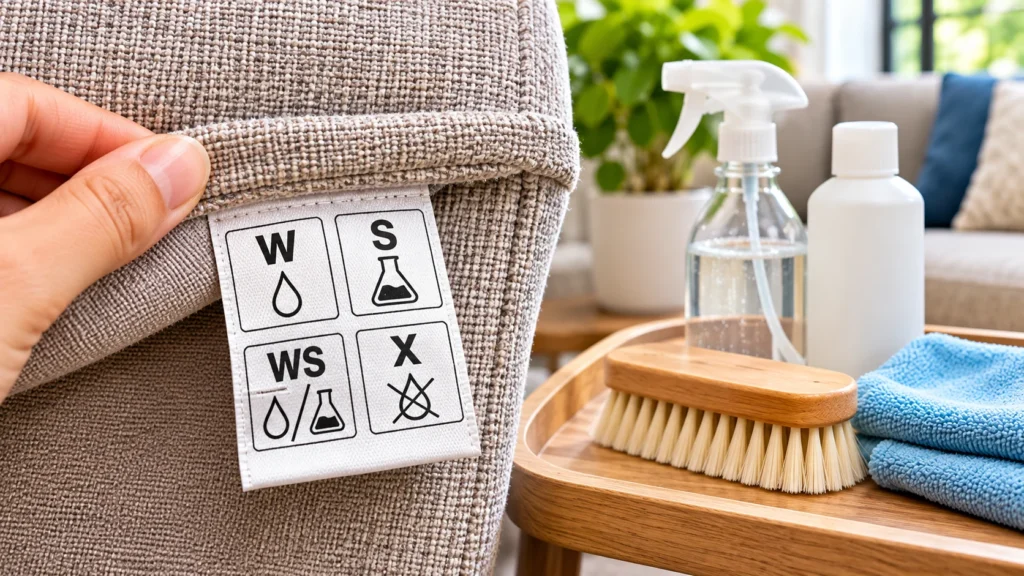
The cleaning code tells you which type of product the outer upholstery fabric can tolerate. Look for a tag beneath a cushion, on the underside of the furniture, or in the manufacturer’s care documentation. A code does not give permission to soak the cushion filling or automatically approve a steam-cleaning machine.
| Code | Allowed care | Avoid |
|---|---|---|
| W | Water-based upholstery shampoo or foam, used sparingly | Solvents and over-wetting |
| S | Manufacturer-approved water-free upholstery solvent | Water or homemade soap solutions |
| WS / SW | Either permitted water-based or solvent-based spot treatment | Saturation or assuming every cleaning machine is suitable |
| X | Vacuuming or gentle brushing only | All liquid cleaners, including water |
These definitions align with Bernhardt’s official upholstery cleaning instructions. Always follow the specific furniture label if its directions differ from a general chart.
No tag? Check the order paperwork, manufacturer website, or retailer. Until you know the correct method, limit care to gentle vacuuming and blotting fresh spills with a dry cloth. A hidden-spot test alone cannot establish whether an unknown fabric is suitable for water or solvents.
What Supplies Do You Need?
Most routine fabric cleaning needs only a few basic supplies. Do not prepare a wet solution until you have checked the code.
- Vacuum with a clean upholstery attachment and crevice tool
- Soft upholstery brush or fabric-safe lint remover
- Clean, white, absorbent cloths or towels
- A cleaner specifically labeled for the permitted fabric and cleaning code
- A small amount of clean water, only for W or WS/SW fabrics when allowed
- A fan or good room airflow for drying
White cloths make it easier to see whether fabric dye is transferring. Avoid stiff scrub brushes, colored rags that may bleed, and strong multipurpose cleaners unless the manufacturer explicitly approves them.
How to Clean Upholstery in 8 Easy Steps
Follow these steps for ordinary fabric upholstery. The stain-treatment steps apply only when the care label permits the product you are using.
1. Read the Care Label Before Applying Anything
Find the W, S, WS/SW, or X marking. Also check for instructions about removable covers, special finishes, or professional-only cleaning. If the item contains electronics, powered reclining parts, or a heated feature, keep moisture away from those components.
2. Remove Cushions and Vacuum Thoroughly
Pick up loose objects and remove cushions that the manufacturer says may be lifted. Vacuum seating surfaces, backs, arms, seams, piping, and the crevices where crumbs collect. Use gentle suction and a suitable upholstery attachment rather than a rotating beater bar that could snag fibers.
For pile or loosely woven fabrics, test the brush attachment in a hidden area first. If your furniture includes an upholstered ottoman, the same dust-removal principle applies; our ottoman guide also explains material and maintenance differences.
3. Test the Approved Cleaner in a Hidden Area
Apply a very small amount of the chosen product behind a cushion or in another discreet area, following its directions. Let the test spot dry fully. Check for dye transfer, water rings, roughened texture, fading, or changes in the fabric’s pile.
If anything changes, stop. Even an approved cleaning-code category cannot guarantee that every formula will suit every finish.
4. Blot Fresh Spills Before Treating Stains
Lift solids carefully with a spoon, then press a clean, dry white cloth over any remaining liquid. Work from the outside of the stain toward the center to avoid spreading it. Replace the cloth as it absorbs the spill.
Do not scrub. Aggressive rubbing can distort the weave and spread a mark across a larger area. For dried debris such as mud, allow it to dry where appropriate and gently remove the loose particles before attempting a code-approved treatment.
5. Apply the Correct Cleaning Method
W upholstery: Use a small amount of approved water-based upholstery shampoo or foam on the soiled surface, according to the label. Avoid wetting the padding beneath.
S upholstery: Use only a product explicitly intended for solvent-cleanable upholstery, with adequate ventilation and the manufacturer’s safety precautions. If you are not comfortable handling the product, use a qualified upholstery cleaner.
WS/SW upholstery: Choose one allowed method suited to the stain. Do not combine multiple products or assume a machine is safe merely because water-based spot cleaning is permitted.
X upholstery: Stop after vacuuming or light brushing. Do not use spot sprays, water, vinegar, or solvent.
6. Clean Gently and Evenly
Use light dabbing motions and minimal product. For some fabrics, cleaning only a tiny wet circle can leave a visible boundary when dry. Follow the manufacturer’s direction about treating the full fabric panel from seam to seam, rather than repeatedly saturating one spot.
Give a cleaner only the contact time stated on its label. More product, more force, and more time do not necessarily improve stain removal.
7. Remove Residue Without Soaking the Fabric
For water-cleanable upholstery, follow the product’s directions for removing residue; this may involve carefully blotting with a barely damp clean cloth. Do not add a water rinse to solvent-only upholstery. Continue blotting with a dry towel to pick up remaining moisture.
If the stain persists but the fabric starts to change color or texture, stop instead of repeating increasingly strong treatments.
8. Air-Dry Completely Before Using the Furniture
Ventilate the room and position a fan to move air across the furniture. Stand loose cushions upright only if their construction and care instructions allow it. Keep people and pets off the treated surface until both the outer fabric and underlying padding are dry.
Drying time varies with fabric thickness, humidity, airflow, and how much liquid was used. Avoid direct high heat unless specifically approved; a surface that feels dry can still conceal damp cushion filling.
How Should You Handle Common Upholstery Stains?
Identify the spill before choosing a treatment. These first-response steps do not override the furniture’s care code.
| Stain | First response | Next decision |
|---|---|---|
| Coffee, tea, or juice | Blot promptly with a white cloth | Use a code-approved stain treatment, sparingly |
| Greasy food | Lift solids without rubbing | Use an upholstery product labeled for oil-based spots |
| Mud | Let surface soil dry, then gently vacuum | Treat residual marks only if the code permits |
| Ink or dye | Avoid smearing or untested alcohol | Consider specialist cleaning before dyes spread |
| Pet urine | Absorb as much liquid as possible immediately | Assess whether odor has reached cushion filling |
Pet urine is a special case: the visible stain may be small even when liquid has reached the cushion interior. The IICRC’s upholstery guidance explains why severe odor contamination sometimes requires professional treatment or replacement of affected cushion components.
Which Upholstery Materials Need Extra Care?
A cleaning code remains more reliable than guessing from how a fabric looks. These material differences explain why universal DIY recipes are risky.
- Microfiber: Check the actual tag. Different microfiber finishes may permit different cleaning products, and brushing or wetting can alter appearance.
- Velvet: The pile can show pressure marks or direction changes. Use only the care method specified for that particular velvet.
- Linen, cotton, and blended weaves: Some fabrics shrink, bleed dye, or develop visible water marks, especially if over-wetted.
- Boucle and textured upholstery: Loops and raised yarns can snag under aggressive brushing or high suction.
- Leather and suede: Do not apply ordinary fabric-upholstery instructions. Identify the finish and use the manufacturer’s leather or suede care method.
If you are deciding on easier-care seating for the future, compare upholstery characteristics in the sofa buying guide and accent chair selection guide. Fabric type matters, but the actual cleaning label matters more.
What Upholstery Cleaning Mistakes Should You Avoid?
- Using water on an S or X label: It may create rings or damage the finish.
- Over-saturating a cushion: Moisture can reach padding and take much longer to dry.
- Using vinegar, bleach, or alcohol as universal fixes: Household ingredients are not automatically compatible with upholstery dyes, finishes, or cleaning codes.
- Assuming steam cleaning is always safe: Some furniture makers expressly advise against hot-water extraction or steam methods even for W or WS fabrics.
- Machine-washing zipped cushion covers: A zipper is not permission to launder the cover. Shrinkage can make it impossible to refit.
- Mixing stain removers: Use one compatible product as directed; never combine cleaning chemicals.
When to Stop DIY Cleaning
Stop if the fabric bleeds, puckers, develops a ring, or remains damp deep inside. Professional assessment is also sensible for large urine spills, mold concerns, antique upholstery, or an unknown cleaning code with significant staining.
How Often Should You Clean Upholstery?
Use a light maintenance routine instead of waiting for obvious grime. Vacuum seating surfaces about weekly in busy households, or adjust the frequency to actual use, pets, and dust levels. Blot fresh spills as soon as they happen.
Check armrests, headrests, and seat edges periodically because they accumulate contact soil. Rotate reversible cushions when the manufacturer allows it. Arrange deeper professional cleaning when the whole piece becomes soiled, not according to a universal calendar.
The La-Z-Boy fabric-care guide likewise emphasizes frequent vacuuming and recommends professional cleaning for widespread soil. Preventing buildup is usually simpler than treating several old stains at once.
Related Product
Upholstery Vacuum Attachment
A gentle upholstery attachment can help remove crumbs and surface dust without adding moisture. Check compatibility with your vacuum and the fabric’s care instructions.
As an Amazon Associate, we earn from qualifying purchases.
Frequently Asked Questions
Can you clean upholstery without a machine?
Yes. Regular vacuuming, dry blotting, and careful spot cleaning with a fabric-approved product are often enough for routine maintenance. An extraction machine is not necessary and may be unsuitable for some upholstery.
Can you use dish soap to clean fabric upholstery?
Only when the furniture maker permits a mild water-based cleaning method and the chosen solution is compatible with the fabric. Use very little product and test it first; soap residue and excess moisture can create new marks.
Will baking soda or vinegar safely remove upholstery odors?
Not on every fabric. Vinegar introduces moisture and acidity, while powders can lodge in textured fibers. Check the care code and manufacturer’s instructions instead of treating either ingredient as universally safe.
Is steam cleaning safe for upholstery?
Not automatically. Some furniture makers discourage steam or hot-water extraction even on water-cleanable fabrics. Use the method only if the specific furniture manufacturer approves it.
How long does upholstery take to dry?
There is no reliable fixed time. Drying depends on the amount of moisture, upholstery construction, temperature, humidity, and ventilation. Wait until the fabric and cushion interior are fully dry before sitting on them.
Can you machine-wash removable cushion covers?
Only if the cover’s own care instructions explicitly permit machine washing. A removable or zippered cover may still shrink, distort, or change color when laundered.
Conclusion
The safest way to clean upholstery is to start with the care label, remove dry dirt first, and use the gentlest approved method for the stain. A little compatible cleaner and patient blotting are usually preferable to vigorous scrubbing or a soaked cushion. Allow the fabric and filling to dry fully before using the furniture again. If a stain spreads, the color changes, or contamination reaches the cushion interior, stop and get professional advice rather than experimenting with stronger products.